It is by no means only academic career paths for which a master’s degree has become all but essential. But the UK’s unusual master’s loan system is making this crucial phase of study inaccessible to most graduates.
Undergraduate loans come with separate tuition and maintenance components, the latter being means-tested. In England, undergraduates will be able to borrow up to £9,790 a year for courses with a practical element in 2026-27 or up to £5,760 for classroom-based subjects – on top of £9,790 for tuition.
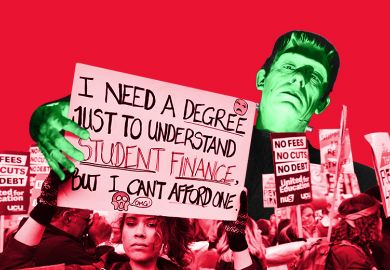
Loans for master’s degrees, on the other hand, are a single fixed sum of £12,858 at the time of writing. So for most courses, they cover only the tuition fee. This means that students need to find at least £10,000 from somewhere to cover the cost of living while they study. This is beyond the reach of many, particularly given that master’s students are already burdened by undergraduate debt and are unlikely to be able to save, with employment opportunities limited by a graduate jobs crisis.
Master’s loans were introduced in 2016 as part of efforts to diversify PhD cohorts. According to a 2020 report by the Institute for Fiscal Studies, while privately educated students were about four times more likely to complete an undergraduate degree than those from the bottom socio-economic quintile, they were over eight times more likely to complete a master’s degree and over 15 times more likely to complete a PhD. But the initial £10,000 loan limit was never enough to cover tuition fee and living costs. And despite the uprating since then, a decade of high inflation in living costs and tuition fees has made making ends meet even more difficult.
While I would like to see the UK adopt cheap or free undergraduate and postgraduate education, this seems unlikely to happen anytime soon. But even if we accept the idea that university should be accessed via loans that defer payment until after graduation, the master’s loan system still seems completely inadequate given that most of the expenses of doing a master’s still can’t be deferred, denying access to many people who would benefit from a master’s degree.
The simplest remedy would be to bring the loan entitlement in line with the undergraduate level, covering both the tuition fee and – for those who need it – maintenance. For students from the lowest-income households, this would effectively remove the financial barrier to postgraduate education, and it would dramatically decrease the additional funds that other students would need to acquire.
The changes would also alleviate the financial strain that many universities are currently facing by increasing the number of students who are able to study at a postgraduate level. Moreover, once loan-funded master’s students complete their degrees, they often become a substantial source of tax revenue for the government because they are far more likely to enter high-paying jobs.
You might argue that the value of a master’s comes from its scarcity in the job market, so expanding access to them risks flooding the market. But if we examine the government’s current industrial strategy, many key sectors for growth are areas where a master’s-level qualification might be not only desirable but also required; examples include advanced manufacturing, digital technologies (including quantum technologies as a key priority) and life sciences. It is likely that the demand for master’s graduates is only going to rise.
Moreover, recent analysis by the Financial Times has revealed that the UK is an outlier with regard to the graduate jobs crisis. In most developed countries, expanding access to university education has increased, not decreased, the graduate earnings premium. In other words, it is the UK’s stagnant economic growth, not the supply and demand of graduate jobs, that is responsible for the shrinking graduate premium here. Hence, if the government wants to stimulate economic growth through high-tech industries, improving access to master’s funding – at least in priority subjects – could actually help to stimulate a recovery in the graduate premium.
But what about the debt? Undergraduate loans are coming under heavy criticism, and there is an ongoing inquiry into the repayment terms of Plan 2 undergraduate loans. Hence, increasing students’ debt levels further might not seem the right move.
If you have such concerns, perhaps ask yourself whether you would advocate for reducing the amount of loan funding students can apply for. We could solve the crisis in graduate debt by not offering maintenance loans at all, for instance. But to the best of my knowledge, nobody has publicly advocated for this position – because it would obviously make it impossible for many students to attend university.
Concerns over ballooning student debt should not be dismissed. But they are not a strong argument against sorting out inadequate funding for postgraduates – especially when the government is so short on ideas to kick-start the economy.
Alexis Gkantiragas is a PhD student in studying bumblebee disease at Royal Holloway, University of London and a visiting PhD student at the University of Cambridge.
Register to continue
Why register?
- Registration is free and only takes a moment
- Once registered, you can read 3 articles a month
- Sign up for our newsletter
Subscribe
Or subscribe for unlimited access to:
- Unlimited access to news, views, insights & reviews
- Digital editions
- Digital access to THE’s university and college rankings analysis
Already registered or a current subscriber?