ADVERTISEMENT
India’s elections will exacerbate fraught centre-state relations over HE
Beneath the uncompromising rhetoric, however, federal higher education policies are likely to be gradually implemented, says Eldho Mathews
Source: Hindustan Times/Contributor/Getty Images
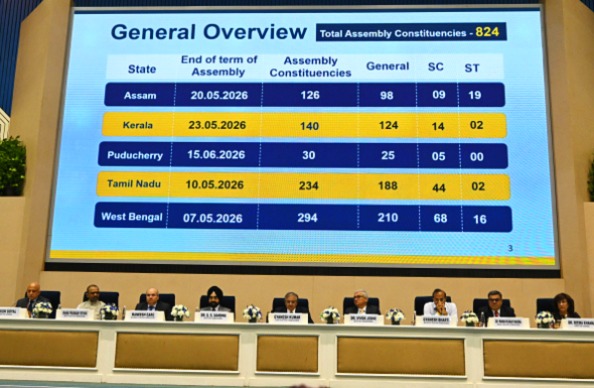
The very different recent electoral outcomes in five Indian states and union territories have highlighted the persistence of the country’s regionally differentiated political landscape.
The results of this month’s polls in Kerala, Tamil Nadu, West Bengal, Assam and Puducherry have primarily been interpreted through the lens of coalition politics, welfare governance and regional identity. For instance, Kerala had prioritised welfare-oriented public policies under the previous Left-led coalition government; Tamil Nadu, under the regional party DMK, had strongly opposed the imposition of the Hindi language by the Union government; and West Bengal also witnessed strong regional political assertiveness under the previous Mamata Banerjee government.
However, the elections’ long-term implications for India’s higher education governance may prove equally significant.
Since Narendra Modi became India’s prime minister in 2014, the higher education sector has undergone one of the most significant phases of policy restructuring since 1991’s landmark economic liberalisation. And in doing so, it has become an important theatre of dispute between the centre and the states over federalism, regulatory authority, ideological influence, public funding, language policy and constitutional power.
While higher education constitutionally remains part of the “concurrent list”, which formally grants both the union and the states legislative space, the reality of higher education governance in recent years has demonstrated the enormous structural advantages enjoyed by the union government through national institutions such as the Ministry of Education, the University Grants Commission (UGC), the national accreditation agencies, the centrally funded research councils and professional regulatory bodies.
ADVERTISEMENT
The emergence of the National Education Policy 2020 marked perhaps the most ambitious attempt by the Modi government to redefine the architecture of Indian higher education, through reforms such as four-year undergraduate programmes, academic credit transfer systems and institutional restructuring. But the implementation of these reforms has exposed deep tensions between the policy ambitions of the Modi government and regional political realities – particularly in states such as Kerala, Tamil Nadu, Karnataka and West Bengal, where higher education governance has historically been shaped by strong regional political traditions, linguistic identities and suspicion of centralisation.
While the BJP’s win over the All India Trinamool Congress in West Bengal may ease constitutional tensions there, the electoral outcomes elsewhere, including the unseating of the Left in Kerala and the DMK’s defeat in Tamil Nadu, suggest that centre-state relations in higher education in India will move towards an even more complex model of negotiated coexistence, characterised by political resistance and selective cooperation.
One of the most important areas where electoral shifts could significantly reshape higher education governance concerns the proposed Viksit Bharat Shiksha Adhishthan Bill, aimed at creating an overarching regulatory body to replace the UGC, the All India Council for Technical Education (AICTE), and the National Council for Teacher Education (NCTE). Opposition-ruled states have often viewed such reforms with caution because they fear that excessive centralisation may weaken universities under the regional governments, reduce state-level policy flexibility and increase ideological influence from the centre over curricula and institutional governance.
Public university funding is becoming one of the defining pressures in Indian higher education. Around three-quarters of the funding for public colleges and universities controlled by the state governments comes from those governments, but wrangling over institutional control has resulted in significant systemic challenges across many public higher education institutions, which includes vice-chancellor appointments.
The growing role of centrally appointed state governors in university governance represents a particular flashpoint. During the Modi era, conflicts involving governors and state governments have intensified dramatically in states such as Kerala, Tamil Nadu and West Bengal, especially regarding vice-chancellor appointments in universities administered by the state governments.
Yet it isn’t a given that stronger regional mandates in some of the states that voted earlier this month will intensify resistance to central ideological influence. Even amid all the conflicts, recent years have also seen the rise of what we might call cooperative federalism in university governance, particularly with regard to internationalisation strategies.
The Modi government has strongly projected India as an emerging global education destination through policies such as the “Study in India” initiative to attract international students and regulatory liberalisation for global academic partnerships, including the tax-free branch campus experiment in Gujarat’s GIFT City. However, implementation increasingly depends on the ambitions and capacities of individual states. The central government can promote India through national branding, facilitate visas and regulate via the UGC, but the actual establishment of a foreign branch campus, for instance, requires land acquisition, utility infrastructure and other local clearances – all of which are controlled by respective state governments. Union-state coordination will also be required to simplify regulations for foreign students and cross-border academic partnerships.
ADVERTISEMENT
So while state governments will doubtless continue criticising centralisation, ideological intervention and regulatory overreach, they may quietly implement at least some parts of the national reform agenda, many aspects of which correspond with global transformations in higher education. Any state government, irrespective of political ideology, will find it hard to reject not only internationalisation but also multidisciplinary education, digital learning ecosystems, academic credit mobility, industry partnerships, skill-based programmes, innovation clusters and global ranking ambitions.
Beneath the uncompromising rhetoric, then, pressures regarding university funding, global competition and student employability are likely to drive the gradual implementation of federal higher education policies, via a “negotiated interdependence” between the centre and the states.
Eldho Mathews is a programme officer (internationalisation) at the Kerala State Higher Education Council, Thiruvananthapuram, India. This article expresses his personal views.
Read more about

Related articles

Featured jobs
ADVERTISEMENT