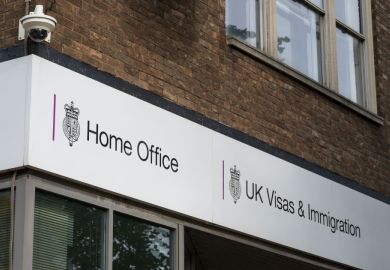
Australia’s de facto international student caps have been relegated to irrelevance by a “harsh” visa processing regime that keeps most universities well below their quotas, new figures confirm.
Public universities have admitted just two-thirds of the 161,300 overseas students they are entitled to under this year’s “national planning level” (NPL), according to the latest available data. By early November, universities had taken in about 28,000 fewer foreign students than at the same time last year, even though they had been granted permission to accept 16,000 more.
The chief constraint has been the “unprecedentedly low visa approval rates” whereby just 71 per cent of offshore applicants secured higher education visas between July and September this year, compared with 92 per cent over the same period last year, according to data analyst Steve Nerlich.
“Most universities just can’t get near their allocations because of what the Department of Home Affairs is doing with visa applications,” said Nerlich, former director of international analysis with the Department of Education.
In September, about one-eighth as many visas were issued to higher education students applying from South Asia as in September 2025, and about one-quarter as many visa applications were lodged from the region.
Despite this, non-university colleges have collectively admitted about 15,000 more overseas higher education students than they are entitled to this year – much like in 2025, when they exceeded their combined allocation by about 19,000.
Nerlich said private institutions were admitting much higher proportions of students who were already in Australia. “The system doesn’t seem able to rein this in,” he said. “So, while NPL visa prioritisation is irrelevant to most universities due to low offshore visa approval rates, even when [the system] can work – with private providers – it doesn’t.”
Under the system, visa processing is progressively slowed after institutions reach 80 per cent of their annual allocations. However, processing continues even after institutions have exhausted their quotas.
So far only five universities have reached 80 per cent of their 2026 allocations, while about 60 private colleges have significantly exceeded their quotas.
The government intends to hand over responsibility for determining the allocations to the Australian Tertiary Education Commission (Atec). During negotiations with Atec over mission-based compacts, universities stressed the difficulties created by the “current higher levels of visa rejections”, according to a new report.
Atec plans to “engage with higher education providers on their international strategies and allocations” and help the sector “navigate current challenges [and] move to sustainability”, the report says.
Nerlich said Atec would only be able to do this if it could convince Home Affairs to change its behaviour. “Where are other students going to come from? Surely universities are already approaching all the available markets.”
Monash University higher education expert Andrew Norton said Atec’s influence on international enrolments would be “near irrelevant” unless the allocations were “drastically” reduced. “Migration policy has cut demand so much that the commencing caps cannot be reached,” Norton said.
Register to continue
Why register?
- Registration is free and only takes a moment
- Once registered, you can read 3 articles a month
- Sign up for our newsletter
Subscribe
Or subscribe for unlimited access to:
- Unlimited access to news, views, insights & reviews
- Digital editions
- Digital access to THE’s university and college rankings analysis
Already registered or a current subscriber?