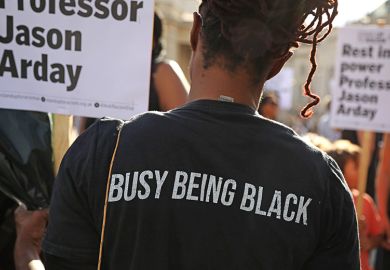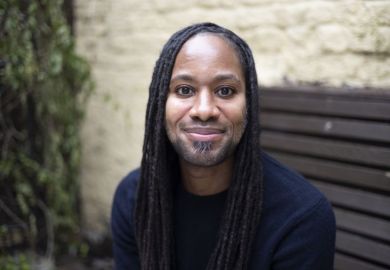
The death of Jason Arday brings one fact into painful focus: there is always a human being at the centre of every controversy. Amid the spectacle, Arday’s humanity risked being overlooked. But his case also raises a broader question: what does such intense scrutiny do to Black academics – and to the scholarship they produce?
This question is not unique to the UK. In the US, Harvard University’s first Black president, Claudine Gay, resigned in 2024 after just six months in office amid allegations of plagiarism promoted by conservative activists. Those activists celebrated her resignation as a victory nearly a year before the Trump administration’s all-out assault on diversity, equity and inclusion. In both cases, controversies involving Black professors became embroiled in larger political fights.
The research bears out the fact that Black scholars face the possibility of their work – and their characters – being intensely scrutinised. My colleagues and I asked 31 scholars of colour and 20 White scholars who study racial issues to describe their experiences conducting and sharing their research. Across more than 35 hours of interviews, a sharp racial divide emerged. Scholars of colour often described having their objectivity and scientific rigour questioned, including suggestions that their work was below standard or ideologically motivated. White scholars, who also studied racial issues, rarely described receiving such intense scrutiny and doubt.
I myself have experienced such interrogation. As a first-year professor, I found myself presenting research from my dissertation showing that White liberals sometimes present themselves as less competent when speaking to Black (versus White) audiences – a well-meaning but ultimately patronising attempt to connect across racial divides. At one conference, two people immediately challenged the work. “After all,” they said, “the science tells us that Black people are simply less intelligent than White people.” Not a single member of the audience confronted this comment. It was a painful reminder that scientific racism is alive and well – and it shapes the conditions under which Black academics work.
So how do scholars of colour navigate an academia in which they regularly expect their motives, methods and competence to be judged – and found wanting?
Our interviews revealed that they engage in what we call armouring: protective strategies designed to make it harder for them to be dismissed as biased or lacking rigour. Scholars of colour described overpreparing for presentations, ruthlessly analysing their own results before exposing them to scrutiny, softening their conclusions or avoiding research on race altogether. Some described deliberately toning down their findings and presentation style to make sure that they did not come across as threatening to their (mostly White) academic colleagues.
This level of scrutiny doesn’t just impact them; it impacts science. In an analysis of nearly 1,700 published papers about race and racism, we found that those written by scholars of colour contained more positive and less powerful language than those written by White scholars. To armour against interrogation, scholars of colour “put on a happy face”, even when describing their own research.
Our study cannot reveal the exact nuances of how these interrogations operate at places like Cambridge or Harvard. But it does reveal why scandals such as Arday’s or Gay’s can reverberate in academic environments in which Black scholars expect their competence and objectivity to be questioned. When a Black scholar is accused of misconduct, the effects extend beyond the individual and their institution. They can reinforce the suspicion that we are less qualified, less rigorous, and less deserving of our place in academia. This suspicion is all the more potent as DEI comes under intense attack on both sides of the Atlantic.
The attack on DEI in academia isn’t just material. It’s not only about grants, positions and policies. It’s also psychological. It’s about who enters the room expecting to be believed, and who enters the same room expecting to be attacked.
If young scholars of colour learn that studying racism opens them up to intense scrutiny, some will avoid the subject. If others learn that drawing strong conclusions based on the data will be seen as activism rather than an honest account of the science, they will soften their conclusions. If they believe that any mistake may be put under a microscope, they will expend precious cognitive and emotional energy trying to make themselves and their work beyond reproach. And so, Black scholars armour themselves, in ways that shape science itself.
As we process the tragic death of Jason Arday – and re-evaluate the public spectacle that preceded it – we should consider Martin Luther King’s fear, as recounted by his friend Harry Belafonte, that he “may have integrated my people into a burning house”. For many Black scholars, academia is a burning house. If we cannot extinguish that fire, Black scholars will always bear a greater risk of being burned – and therefore have to insulate themselves against the risk more than others. Both scholars and science will bear the cost.
Cydney H. Dupree is an associate professor at UCL’s School of Management.
Register to continue
Why register?
- Registration is free and only takes a moment
- Once registered, you can read 3 articles a month
- Sign up for our newsletter
Subscribe
Or subscribe for unlimited access to:
- Unlimited access to news, views, insights & reviews
- Digital editions
- Digital access to THE’s university and college rankings analysis
Already registered or a current subscriber?