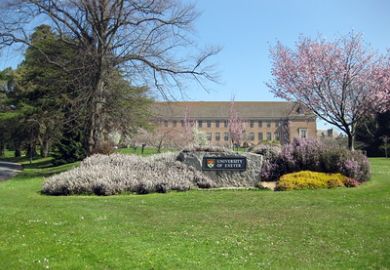
Several newly appointed British Academy fellows at the University of Exeter have been told they are at risk of redundancy, just weeks after learning they had achieved the honour.
One of Exeter’s most successful years for the fellowships, given to those who have “achieved distinction in any branch of the humanities and social sciences”, coincides with the university making deep cuts to its faculty that teaches these subjects.
Five academics received fellowships this year; historians Jane Whittle and Mark Jackson, professor of Christian history Morwenna Ludlow, human geographer Neil Adger, and professor of Arabic studies Rob Gleave. All but Adger are now at risk of losing their job.
The scholars say their achievements show the strength of their subjects at Exeter, and warn the proposed cuts put this at risk. The university has insisted it must take action to remain sustainable and has promised to retain one of the biggest humanities faculties in the country.
Speaking to Times Higher Education, Whittle, whose research explores the history of work, said that she had been “absolutely delighted” to receive the fellowship, and was considering advocating for a pay rise following the news. However, a week later, she found out that she was at risk of redundancy.
Exeter’s history department is “really at the top of its game”, she said, adding that she had never known the department to receive two fellowships in one year.
But proposed cuts of 28 per cent of staff in the department “makes me feel they have no respect for what we do, and it makes me angry because if anything’s gone wrong, it’s been their mismanagement, and yet we’re losing our jobs”.
She noted that the reforms at Exeter extend beyond job cuts and will see research leave restricted and a greater focus on teaching for those that remain. Whittle said that she will be applying for voluntary severance as she believes the changes show that the university is “not serious” in supporting research, and “I don’t want to be employed on those terms”.
“What can you say? You can achieve the peak of what can be done as an academic in this country, but it won’t necessarily buy you job security or an institution that employs you.”
Adger said he was “horrified” when he found out his colleagues could lose their jobs and raised concerns over what the proposed cuts will mean for Exeter’s reputation in the humanities and social sciences.
Exeter’s departments are world class, he said, and its success in receiving such a significant number of fellowships this year is “emblematic of the investment that Exeter has made in these departments over the years, and therefore even more astounding that actually the cuts have come at the same time”.
A spokesperson for the University of Exeter stressed that there is an “ongoing consultation” on the proposed cuts, so it would not be “appropriate to comment on individual cases”. But they added, “While we fully understand that this is a worrying time for those who are affected, it is important to reiterate that these are still proposals at this stage.”
Gleave said it was a “weird feeling” to get the fellowship amid being put at risk of redundancy. He said that his colleagues were “really pleased” for the fellowship holders, “but we can’t hold a departmental celebration at a time when you look around the room and think one in four of us is likely to lose our jobs”.
He said having colleagues to “bounce ideas off of” or fill in while someone is on sabbatical are “crucial elements” of building a successful humanities department. “Knowing it will be more difficult from now on is really disheartening and destructive, if I’m honest.”
Gleave added that he feared junior academics may reconsider their future in academia, as his situation shows “however senior I become and however recognised I am as a researcher, I’m going to continually have to demonstrate that I’m worth keeping”.
The university spokesperson added: “While Exeter remains in a strong position, rising costs, the real-terms decline in tuition fee income, underfunded research, and a sustained drop in international student demand mean we must take action now.
“These changes are intended to secure the university’s long-term sustainability, protect our teaching and research excellence, and ensure our activities remain aligned with national priorities.”
Register to continue
Why register?
- Registration is free and only takes a moment
- Once registered, you can read 3 articles a month
- Sign up for our newsletter
Subscribe
Or subscribe for unlimited access to:
- Unlimited access to news, views, insights & reviews
- Digital editions
- Digital access to THE’s university and college rankings analysis
Already registered or a current subscriber?