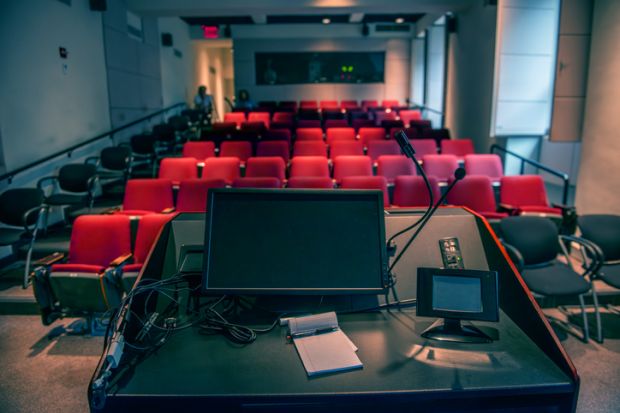
Universities are overestimating how often their teaching spaces are being used, with average occupancy levels of only 20 per cent, according to findings by a group of estates experts.
Analysis of more than 30 institutions suggests some buildings operate at only 10 per cent of their possible utilisation, the Smart Space Forum suggests – with traditional teaching methods contributing to the problem.
The findings, produced in partnership with building analytics company SmartViz, propose universities could be cutting costs at a time of serious financial strain by looking at how they operate their buildings.
“The timetable will always say that every room is fully booked and utilised and the reality is actually very different,” Trevor Payne, former director of estates at the universities of Oxford and Birmingham and chair of the Smart Space Forum, told Times Higher Education.
“As much as it’s a space problem, it’s a culture problem as well – what you’ve got are traditional practices around booking…sometimes it’s driven by historic ways of teaching, so you need an opportunity to challenge it and break out of those ways of thinking.”
Heating, lighting and cooling teaching rooms when they are not occupied means universities could be paying unnecessarily high bills, with the analysis finding many institutions face the same problem in regard to staff offices.
SmartViz cited estimates from the Association of University Directors of Estates (AUDE) revealing the sector’s collective energy bill cost £978 million in 2023-24, up from £858 million the previous year.
The issue is exacerbated by the post-pandemic norm of hybrid working. “Even at its peak, utilisation rarely exceeds 20 per cent, with a sharp drop on Mondays and Fridays,” the findings note.
“If a single-person office is only being used for six hours a week, the true cost of heating, maintaining and decarbonising that space is quite staggering,” one director of operations told the report.
One example cited by researchers is the success of Cardiff Metropolitan University, which won the Outstanding Contribution to Environmental Leadership Award at the 2025 Times Higher Education Awards as a result of efforts begun under its space-utilisation scheme.
The university avoided £5.1 million in costs after realising it wouldn’t need to construct new teaching space. Researchers also noted University of Glasgow’s move to split a single 500-seat lecture theatre into two 250-seat rooms in its own bid to reimagine its assets.
“It’s tough out there – I know from having recently worked in universities,” Payne said. “There’s a focus on absolutely every working part of the university at the moment, across the board, and the estate is a massive part of the cost of running a university – we need to use it wisely.”
Acknowledging that every university will have different buildings, campuses, and capital requirements, Payne said: “There isn’t a single off-the-shelf approach to this.”
“My key takeaway is the data,” he said. “Use the data that you’ve got and use it to start to drive actionable insights. Systems already exist that you can draw upon. It’s using the data that you’ve got and doing something with it.
“[Ask] which buildings do students prefer to be taught in, as well, so you’re playing to some of those experiential preferences.”
He suggested that laboratory space was another “area of opportunity” as a “highly serviced” part of campuses, but noted that some experiments will need to run over many years and therefore require flexibility.
But Payne called on universities to make sure they are monitoring space usage, and to do so across the year, to get a picture of how things change.
“Utilisation from October to December is very different to usage at different points in term,” he said. “You need to understand the rhythm – there may be some opportunity to switch buildings out at certain points in the year, or even to mothball some buildings.”
Register to continue
Why register?
- Registration is free and only takes a moment
- Once registered, you can read 3 articles a month
- Sign up for our newsletter
Subscribe
Or subscribe for unlimited access to:
- Unlimited access to news, views, insights & reviews
- Digital editions
- Digital access to THE’s university and college rankings analysis
Already registered or a current subscriber?