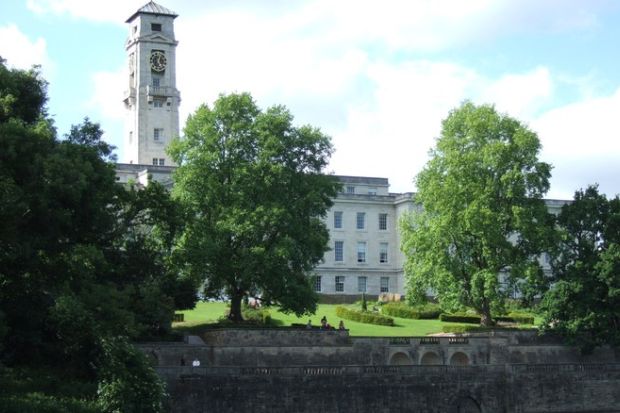
The University of Nottingham’s plans to close its languages courses would leave the East Midlands a “cold spot” for provision, politicians fear.
Earlier this year Nottingham announced plans to cut 600 academic jobs and suspend courses including languages, music and nursing.
Politicians from the All-Party Parliamentary Group on Modern Languages have told the university’s executive “in the strongest possible terms to reconsider” the plans, in a letter seen by Times Higher Education.
“The University of Nottingham must show leadership as a leading Russell Group university with a strong international remit and Global Engagement strategy to preserve its own reputation,” the politicians, MPs Darren Paffey and Tonia Antoniazzi, as well as Jean Coussins and Stephen Sherbourne from the House of Lords, write.
They add that a counterproposal put forward by the local University and College Union (UCU) branch is “credible, academically robust, and a financially sustainable model that would allow Nottingham University to retain a meaningful modern languages presence while delivering the savings required by the university”.
Nottingham is one of the largest providers of modern languages degrees in the UK, they note, with 500 students studying languages, and a further 2,000 students enrolled on language courses through its language centre.
“Cutting languages would be of national and strategic importance…If Nottingham abandons languages, it will mean there are no language degrees anywhere in the East Midlands.
“The emergence of such a large ‘cold spot’ in the heart of the country will be of immense national importance, affecting local skills, the regional teacher pipeline, and removing access to languages education to thousands of young people.”
Cold spots “disproportionately affect” students from lower socio-economic backgrounds, they note, adding that “over half of young UK students study locally”.
Allowing such cold spots to emerge is “counter” to the government’s “mission ‘to break down barriers, opportunity’ and appears incompatible with the university’s own access and participation plan”.
“The university will, we are sure, recognise that its decision is not a strictly internal matter, but will have strategic consequences affecting language provision and leadership across the UK, and risks the university’s national and regional status and obligations.”
This is the second such letter written by politicians this week, with the UCU Parliamentary Group also writing to the Office for Students on their concerns over a restructure at London South Bank University, which will result in some staff being employed via a subsidiary firm.
Nottingham UCU’s branch chair, Lopa Leach, said that the letter was an “extraordinary intervention” from parliamentarians.
"The APPG recognises what staff, students, alumni and the wider languages community have been saying for months: closing Modern Languages would damage not only the University of Nottingham but language education across the whole East Midlands and beyond.
"The university now has an opportunity to show genuine leadership by listening to its own experts, withdrawing the closure proposals and working with staff to secure a sustainable future for Modern Languages."
A University of Nottingham spokesperson said it “absolutely recognises” the importance of language studies.
“However, students are increasingly telling us that the way they want to learn languages is changing. The majority of our degree courses in Modern Languages have very low student numbers and these numbers continue to fall year on year. This year, all but four of our modern languages degree courses have fewer than 10 students on them, which is unsustainable.”
They added that studying language is “not an option for all students” because of curriculum constraints, and its aim is to “increase the number of students who can access language skills” by offering different learning opportunities.
"These courses were suspended at the beginning of the academic year. The proposals to close these courses are subject to ongoing and meaningful consultation with the unions and our university community and nothing will be finalised or implemented until a final Business Case is approved by Council in the autumn."
Register to continue
Why register?
- Registration is free and only takes a moment
- Once registered, you can read 3 articles a month
- Sign up for our newsletter
Subscribe
Or subscribe for unlimited access to:
- Unlimited access to news, views, insights & reviews
- Digital editions
- Digital access to THE’s university and college rankings analysis
Already registered or a current subscriber?