The way universities evaluate the success of their sustainability work is little understood at a “grassroots” level and needs to evolve if the United Nations’ Sustainable Development Goals (SDGs) continue beyond 2030, a forum has heard.
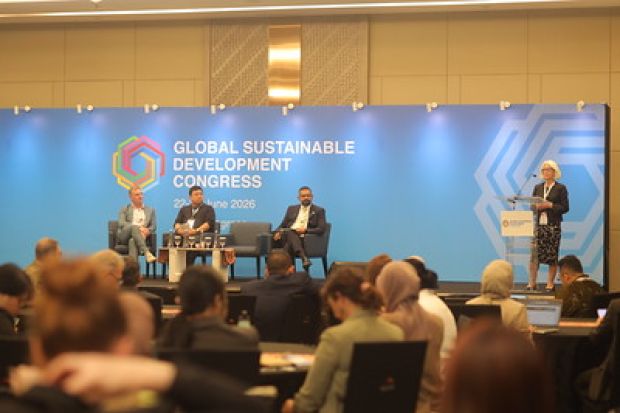
University leaders told the opening session of Times Higher Education’s Global Sustainable Development Congress in Jakarta that the SDGs have “shifted the paradigm” by entrenching the notion that economic growth and the environment cannot be considered independently from each other. But most SDG targets will not be achieved by their 2030 deadline, and the framework “needs to continue”, and it must evolve by treating citizens as “partners and not recipients”.
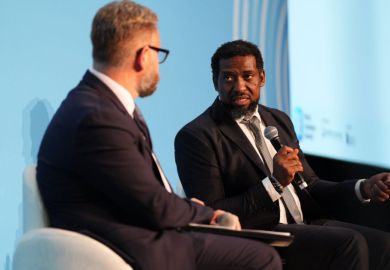
Rachel Martin, senior director of sustainability with Elsevier, said one of the reasons for the SDG framework’s “imperfect” progress was a widespread failure to understand – or embrace – the personal. “Technology alone is not going to drive progress,” Martin said.
“[For example] there’s a high expectation that vaccines are going to deliver what we want them to deliver. But these technology solutions, without a cultural understanding and contextualisation, will not work.”
Rembulan Kania Maniasa, executive director of the Green School Foundation in Bali, said the SDG framework had not had great impact at the “grassroots” level. “Oftentimes…local communities have a hard time understanding it,” she told the forum.
“It has so many different ideas of how we can make the world a better place…but what I would love is for it to give more examples for everyone to contribute to the conversations.”
Dawn Freshwater, executive director of the Worldwide Universities Network, said the “measures of success” used by research organisations to evaluate their sustainability work were “pretty much meaningless” to their communities in the regions that they serve.
Freshwater said tertiary organisations could only contribute effectively to the SDGs through work led by their communities. “Who are we kidding…that we have the power to make all of that happen on our own?” she asked.
The forum heard that more than half of published SDG-related research was now produced in lower- and middle-income countries, and the share of overall research devoted to the SDGs was higher in Africa than in any other region. Freshwater said emerging economies arguably had a “head start” because their research capacity had developed during a sustainability emergency. “But…you could also argue that [their] relationship with community is different,” she said.
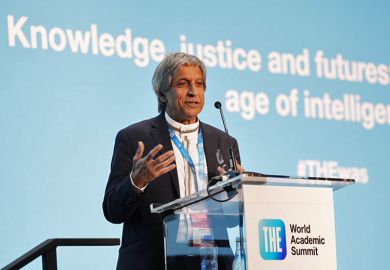
Abhi Veerakumarasivam, provost of Sunway University in Malaysia, said the “intent” of sustainability efforts was blunted by the measures that universities and other research institutions employed to convey their progress. “We all try to conform to a particular metric…and then [we] get stuck in it,” he said. “Rankings, metrics and indicators are essentially tools. As leaders, if we blindly use them and [fail to] understand the need for optimising [them] contextually, [it is] we [who] become a tool.”
Veerakumarasivam challenged the view that progress in the SDGs had been hampered by a sudden erosion of trust in science and universities. “The trust deficit is perhaps more augmented in the West rather than East,” he said.
“We often speak about SDGs as though they were written for a world where science, multilateralism and goodwill moved together, and that somehow…we have departed from that world. Perhaps the deeper truth is that the world has always been plural, unequal and contested.”
Veerakumarasivam said that while the emerging “multipolar” world would be “undeniably more complex” for advanced economies, the “unipolar” world that preceded it had not been comfortable for developing economies. He reiterated the need for “common but differentiated responsibilities”, as articulated following the Rio Earth Summit 34 years ago.
“We embrace…the language of shared responsibility because it’s morally compelling. Differentiated responsibility is a lot harder – differentiated by history, by capability, by wealth, by emissions, by access to science and technology, by who industrialised first, who benefited most, and who is still developing.
“These are uncomfortable but necessary questions. Must every country develop in the same way? Must every university pursue the same models of excellence? Must every society define sustainability through identical metrics? My instinct is no.”
Register to continue
Why register?
- Registration is free and only takes a moment
- Once registered, you can read 3 articles a month
- Sign up for our newsletter
Subscribe
Or subscribe for unlimited access to:
- Unlimited access to news, views, insights & reviews
- Digital editions
- Digital access to THE’s university and college rankings analysis
Already registered or a current subscriber?