The closure of a German university’s main building should be seen as part of a wider infrastructure crisis affecting universities across the country, experts have said, warning that ageing structures and underinvestment have left campuses with a mounting backlog of repairs that could cost billions of euros.
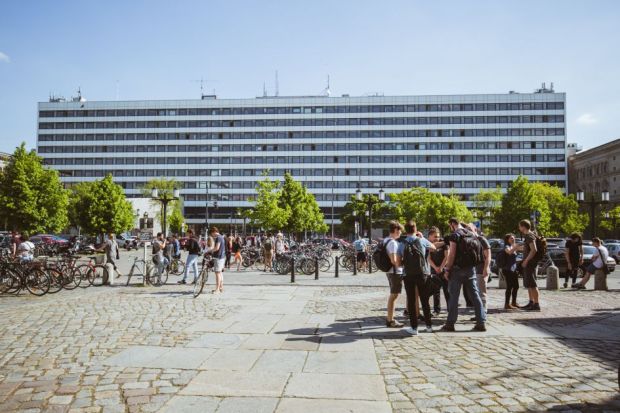
The Technical University of Berlin (TU Berlin) indefinitely closed its main building last month after an inspection found defects affecting fire safety and power supply. “The safety of all members of the university community is our top priority. This is why the measure must be implemented immediately,” the university said in a statement.
The issue has become contentious in Berlin, where universities are pressing lawmakers to amend proposed legislation that would overhaul responsibility for campus construction work.
In a recent statement, Humboldt University of Berlin said it supported efforts to tackle the capital’s more than €8 billion (£7 billion) maintenance backlog but said the draft bill does not clearly treat universities as equal partners and warned that important questions about the financing of projects and responsibility for construction projects remained unanswered.
“This is not an isolated case,” said Grit Würmseer, managing director at HIS Institute for Higher Education Development, referring to the closure of TU Berlin’s main building. “A significant number of buildings are closed temporarily or in part due to their structural condition. But the complete closure of a main building is rather unusual and has therefore attracted increased political attention.”
Many of Germany’s university buildings were constructed in the 1960s and 1970s, when the higher education sector experienced a massive boom in student numbers.
Quantity often took precedence over quality, while building techniques and materials that were considered modern at the time, including reinforced concrete and asbestos, have now resulted in major renovation challenges, Würmseer explained.
Frank Ziegele, executive director of the CHE Centre for Higher Education, said the sector was now dealing with the consequences of this post-war construction boom. “These buildings are now reaching the end of their lifespan,” he said.
Governance issues have also exacerbated the problem over the past 20 years. University infrastructure was financed jointly by federal and state governments before 2006, when a constitutional change transferred responsibility entirely to states.
“Basically it’s a good idea but the problem is that the responsibility was not accompanied by a reallocation of funds. So states now have full [responsibility] over infrastructure and buildings but they didn’t get a higher share of tax revenues,” said Ziegele.
As a result, Germany is facing a growing renovation backlog that experts have been warning about for years. Estimates of the scale of the problem vary widely, from about €74 billion to as much as €140 billion.
Ziegele also pointed to bureaucratic delays and complex approval processes. “It takes quite a long time to build a building in our country,” he said. “If we really talk about a new building, we are talking about something between 10 and 20 years of planning.”
Würmseer added that university governance structures have also contributed to the backlog.
In Germany, university buildings are generally owned by federal states, also known as the Länder, and managed through state property agencies, while universities themselves are responsible for maintenance and repairs. “The differing responsibilities for investment and repair can, under certain circumstances, lead to stalemate situations,” she said.
She added that there is often “no clear allocation of responsibilities” for the strategic development of university estates, which makes long-term planning and investment decisions more difficult.
Register to continue
Why register?
- Registration is free and only takes a moment
- Once registered, you can read 3 articles a month
- Sign up for our newsletter
Subscribe
Or subscribe for unlimited access to:
- Unlimited access to news, views, insights & reviews
- Digital editions
- Digital access to THE’s university and college rankings analysis
Already registered or a current subscriber?