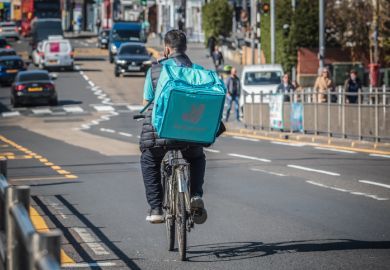
“If I missed one shift, I couldn’t pay rent that month.”
That’s how one student employee described the financial reality of working their way through college to us. For many students today, campus employment isn’t a supplement to college life – it’s what makes college possible.
Last month marked National Student Employment Week, when US colleges and universities celebrate the contributions of student workers. The recognition is well deserved, but it also underscores a growing disconnect between how institutions publicly value student employment and how those jobs function in practice.
For decades, on-campus jobs have been positioned as a win-win: institutions benefit from increased retention and engagement while students gain opportunities for professional development and résumé-building, as well as a bit of extra spending money. But national data tell us that the assumption that students’ income from campus jobs is supplemental rather than essential income is becoming increasingly misplaced.
Financial aid has not kept pace with the cost of attendance. When the Pell Grant was introduced in the 1960s, it covered the majority of the cost of attending a public four-year college. Today, it covers less than a third. The result is a growing reliance on paid work to close the gap: roughly 40 per cent of full-time college students and nearly 80 per cent of part-time students are currently employed while enrolled.
Surveys from the Hope Center for Student Basic Needs consistently find that a majority of college students experience some form of basic-needs insecurity, including food insecurity, housing instability or homelessness. These pressures are not evenly distributed. The Hope Center also finds that students from lower-income backgrounds, first-generation students and those supporting families of their own are especially likely to depend on employment income to meet basic needs.
The housing affordability crisis has also contributed to the financial strain on students, as 2024 average housing costs approached $1,000 per bed per month.
In a 2021 survey of student employees at our institution, the University of Maine, more than 80 per cent reported they could not afford college without working. A version of this survey was replicated at the University of Maine at Augusta in 2024, with a smaller sample but strikingly similar results, suggesting these patterns are not isolated to one campus or a particular moment. Many respondents used nearly all of their wages to cover essentials like rent, groceries and tuition, and significant shares reported food and housing insecurity.
Meanwhile, the students we surveyed reported that on-campus jobs paid less than comparable work in the surrounding community. Hours were often capped, and schedules could fluctuate week to week, making it difficult for students to rely on those jobs as a stable source of income. And that meant students who had the option to work off-campus often took it, even when they had to sacrifice convenience or university connections.
This reveals a contradiction at the heart of student employment policy. Universities promote campus jobs as a tool for student success, emphasising their role in fostering engagement, belonging and persistence toward graduation. But the students who are most in need of such encouragement are often the most in need of supplementary income – and, nationally, entry-level wages in retail and food service have risen in recent years, often outpacing campus jobs tied to institutional pay scales or minimum-wage thresholds.
Students in our survey frequently reported that off-campus employment offered $2 to $3 more per hour. Consequently, those who remain in campus employment are often those with the fewest alternatives: those without reliable transportation, those whose financial aid is tied to work-study, or those balancing academic schedules that make off-campus work difficult.
This has implications not only for individual students, but for the outcomes that are increasingly being used to judge institutions: equity, retention and timely graduation. Recent research finds the top reasons for students dropping out are cost (87 per cent) and scheduling conflicts with work (81 per cent). A student choosing between class and making rent cannot fully benefit from the academic experience.
Some institutions have begun to recognise this tension, raising wages or expanding access to paid positions. At the same time, institutional leaders have expressed concern about the budgetary impact of higher wages, particularly in the context of broader financial pressures facing higher education.
That tension is real. But so is the cost of maintaining the status quo.
If universities want campus employment to support student success, they need to align those jobs with students’ economic realities, ensuring that they function as genuine support systems rather than financial stopgaps. That means offering wages that are competitive with local labor markets and providing predictable hours. Even incremental changes in this direction could have tangible impacts on the students who suffer the most from financial precarity.
Universities often speak proudly about their commitment to the communities they cultivate. Student employment is one place where institutions must decide whether those commitments are reflected in practice – or remain heart-warming aspirations at best, or promotional window-dressing at worst.
Robert W. Glover is associate professor of political science and honours at the University of Maine. Ben Cotton and Tamra Benson collaborated with him on campus labour research at UMaine as undergraduate students.
Register to continue
Why register?
- Registration is free and only takes a moment
- Once registered, you can read 3 articles a month
- Sign up for our newsletter
Subscribe
Or subscribe for unlimited access to:
- Unlimited access to news, views, insights & reviews
- Digital editions
- Digital access to THE’s university and college rankings analysis
Already registered or a current subscriber?