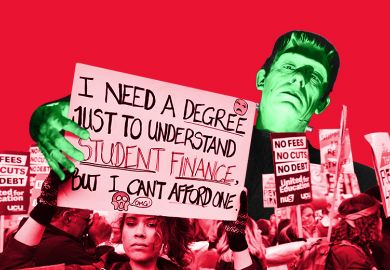
Student finance should be made more flexible, with borrowers allowed to vary loan amounts dependent on need, MPs have been told.
Other submissions to the ongoing House of Commons Treasury Select Committee inquiry into student loans and the taxation of graduates stress that new ways need to be found to force higher earners to pay more into the system.
But for some, the review, announced earlier this year amid widespread discontent with the current system, is not going far enough.
Independent Higher Education, which represents more than 90 specialist and independent institutions, writes in its submission that the question of university funding – which is not being looked at by the committee – is “inseparable” from conversations about the fairness of student loans.
Sector mission group University Alliance also said that there could be “unintended consequences” if the student loan system is reviewed “in isolation from its core purpose”, particularly as universities are struggling financially.
Independent Higher Education suggested that, if loans are to continue, students should be given more agency over the amount of money they take out, including being offered “genuine choices” to reduce their borrowing through alternatives to traditional degree programmes.
“The three year, full-time, on-campus undergraduate degree is not the right answer for many students,” the submission states. “It is expensive for the student, expensive for the state, and in many cases delivers more learning than the student needs or less practical preparation than employers want.”
The group said more flexible delivery models would address the value-for-money concern directly but that “funding and regulatory barriers” are preventing these models from scaling.
Although the Lifelong Learning Entitlement, set to launch later this year, is intended to provide more flexibility over student finance, Alex Proudfoot, chief executive of Independent Higher Education, said the initiative was the “necessary starting point for this paradigm shift” but is “not sufficient on its own”.
“It offers a foundation on which to build a more flexible system, but the government needs to demonstrate real commitment to this vision by trusting learners, empowering providers and incentivising employers to play their part,” he told Times Higher Education.
The mission group argued that students should also be able to borrow more than is currently permitted, so that those “who choose to study intensively can do so without being forced to work long hours alongside their studies simply to cover basic living costs”.
Research published by the Higher Education Policy Institute last year found that current maintenance loans typically cover half of students’ living costs – meaning many rely on part-time work to fill the gap.
Former education secretary Justice Greening has also written to the committee, saying it is time to “stop tweaking a failing system”.
The ex-Conservative politician said she had flagged concerns while in government that the student loan system was not “resilient for the long term” but that this “fell on deaf ears at the Treasury”.
She outlined a proposal that the Department for Education had worked up while she was in office, that would see all graduates make payments for the full repayment term that would be paid into a “Higher Education Fund”, in place of paying off their loans.
“The graduates that earn the most from having a degree would pay the most into the Higher Education Fund,” Greening says.
She adds that employers could also contribute to the fund and, optionally, universities could be funded for the actual costs of delivering the course, rather than receiving a flat tuition fee.
University Alliance also pointed out that the government is set to generate a surplus from loan repayments, while universities are often losing money on teaching students because direct government funding has fallen.
The Russell Group submission agreed that it is “unreasonable for the system to be designed in a way that routinely generates a net profit from graduates”.
“A fair approach should ensure that contributions reflect both the private and public benefits of higher education, rather than creating fiscal gains,” the group writes in its submission.
Register to continue
Why register?
- Registration is free and only takes a moment
- Once registered, you can read 3 articles a month
- Sign up for our newsletter
Subscribe
Or subscribe for unlimited access to:
- Unlimited access to news, views, insights & reviews
- Digital editions
- Digital access to THE’s university and college rankings analysis
Already registered or a current subscriber?