It is fair to say that no redundancy process is likely to project the managers overseeing it on to the Christmas card lists of those who lose their jobs. Yet the extent to which it has shattered confidence in them even among those who escape the axe is laid bare by responses to Times Higher Education’s UK University Redundancy Survey.
“Cutting staff is wrongheaded,” said an English literature academic, who was “the only person to leave my department of 30 (now a department of 8) to an academic job” after a recent round of redundancies. “If senior management understood the situation (beyond a sketchy grasp of the immediate finances) they would protect staff, expertise and disciplinary knowledge…for the future. [But] senior management are radically underqualified for their jobs and unable to make these important decisions: this leads to them thinking of academic staff only as ‘costs’.”
A psychologist is likewise convinced that her university’s leadership “does not care about staff and our futures, our livelihoods or our careers, and I am certain that they will throw more of us under the bus if they get half a chance”.
Meanwhile, those staff who have (so far) escaped redundancy “all suffer survivors’ guilt and are constantly looking over our shoulders as the next ‘review’ heaves into view. It’s hugely stressful,” said a marketing and recruitment professional. “Add to this increased workloads and a complete lack of support or meaningful recognition from senior management – with our v-c taking a huge pay increase while we were asked to accept a paltry ‘cost of living’ rise delayed by nearly a year – and you have a tinderbox scenario.”
Teaching in one science department is “now bare-bones, with our pro vice-chancellor using the term ‘minimum viable product’ as the goal”. A politics academic keeps “trying to be positive, but it is exhausting. I moved my whole family here for this job; the guilt is horrendous. The stress is overwhelming.”
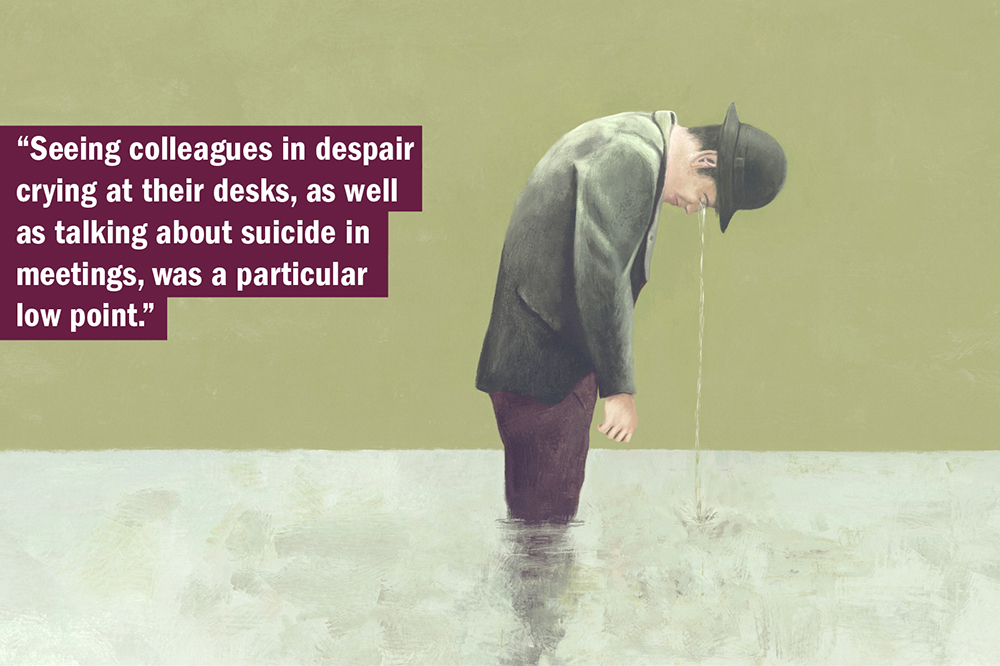
In one history department, the situation is even worse: “Seeing colleagues in despair crying at their desks, as well as talking about suicide in meetings, was a particular low point,” a respondent said.
And while these comments are some of the more colourful submitted, they are far from unrepresentative. Taken as a whole, they constitute a startling picture of a sector barely holding together amid unprecedented strain.
Of the 1,095 respondents to the survey, 198 (18 per cent) had been made redundant in the past two years. As our article last week, focused on their responses, made clear, the human impact of redundancy has been enormous. But the survey also reveals the enormous impact of their loss on those left behind.
Again, it is important to say at the outset that respondents to the survey, which ran from 13 February until 12 March this year, were self-selecting and are likely to contain an over-representation of people with strong feelings about the waves of redundancies sweeping across the UK university sector. Nor is the sample necessarily demographically representative of the sector as a whole, although respondents do span the range of job categories, ages and subject areas (see the previous feature for a detailed breakdown).
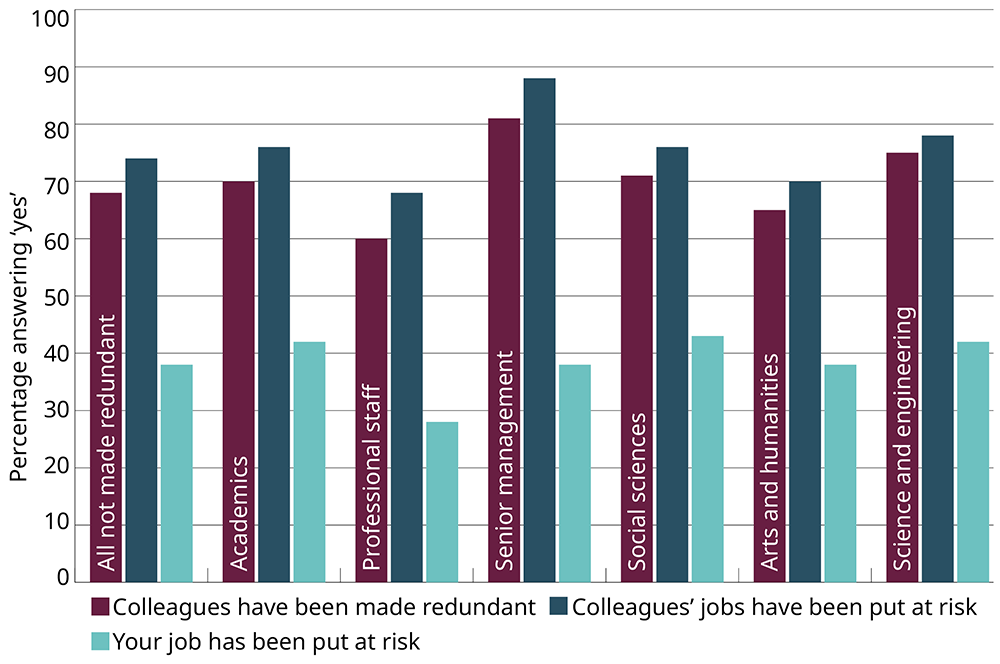
Of those who have not been made redundant themselves in the past two years, 68 per cent have nevertheless seen some of their departmental or divisional colleagues depart as part of a redundancy round. A similar breakdown, with proportions about 5 percentage points higher, was reported when respondents were asked whether colleagues’ jobs had been put at risk recently – and many respondents commented that staff had also been removed from the payroll by other means, such as not renewing fixed-term contracts and cutting the hours of casual staff.
An even higher proportion of respondents – 74 per cent overall – had seen colleagues’ jobs formally put at risk of redundancy in the past two years, rising to 88 per cent of senior managers and falling to 68 per cent of professional and support staff.
And, individually, 38 per cent of respondents who had not been made redundant themselves in the past two years had nevertheless had their jobs formally put at risk of redundancy during that period, rising to 42 per cent among academics (28 per cent for professional staff), and 43 per cent among social scientists.
In the last two years...
“HR appeared at a regular weekly group meeting and announced some of us would be being made redundant,” reported a finance professional. “They told us to go back to our desks and they would come round and let us know if we had been chosen. We had to sit there two hours waiting not knowing.”
Others had to wait a lot longer than that. An academic development professional in her 50s “managed to get a role in the new structure but the experience was traumatic and compounded by the timeline. It took them a year to share their decision about restructuring my department and they expected staff to make decisions about redundancy packages and apply for roles within a four- to five-week timeline. We were pooled against colleagues and friends and expected to competitively apply for a smaller number of new roles.”
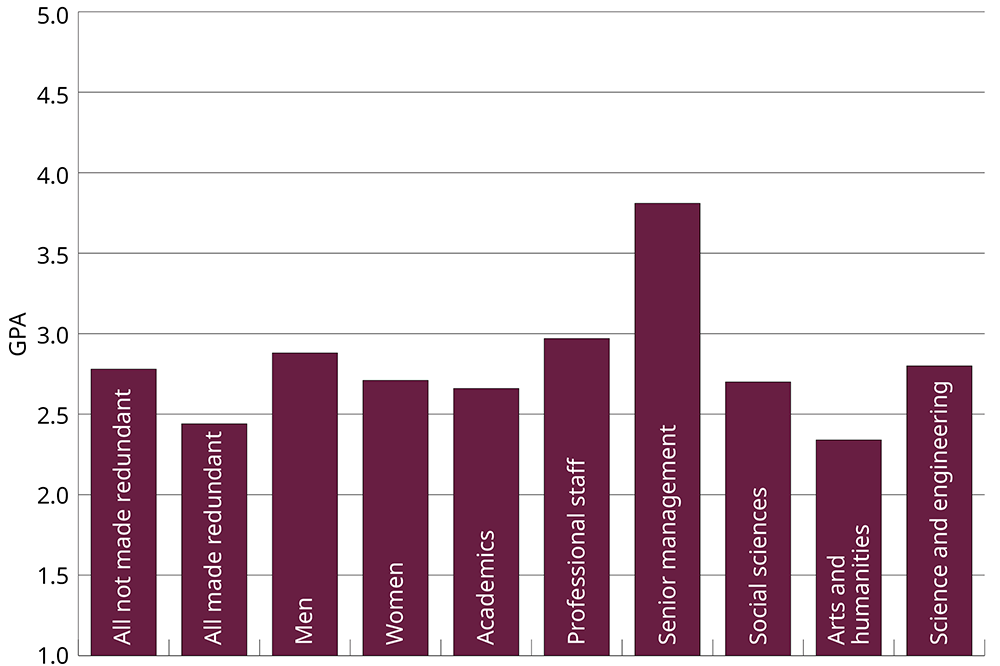
So was all this necessary? The group of respondents most likely to consider that redundancies were unavoidable at their institution, by some distance, were senior managers, 77 per cent of whom agreed that they were, 29 per cent strongly. This converts into a grade point average (GPA) of 3.81 when “strongly disagree” is assigned a score of 1 and “strongly agree” a score of 5. That compares with only 2.66 among academics, 2.34 among academics in the arts and humanities and 2.44 among those who had been laid off themselves (compared with 2.78 among those that hadn’t).
If your institution has had redundancy rounds in the past two years, to what extent do you agree that they were unavoidable?
One respondent noted that their university “has been a building site for the last 15 years: it clearly has money”. And many blame construction for the holes not just in their campuses but also in their balance sheets, with “shiny new buildings” frequently depicted as managerial vanity projects.
“We accidentally blew £85 million on a campus we didn’t need and have put up for sale,” explained one respondent, who strongly disagreed with the necessity for redundancies.
“We purchased…a lot of campuses with the view to expand without the demand being there,” said another academic. “This failed investment cost the university a lot of money.”
Another thought their university “overexpanded and overspent, and its internal governance systems are completely top-down and inadequate to react to changes in the landscape.”
Internal university markets are also viewed with deep suspicion. A cultural studies and modern languages academic resented their central administration “pulling more and more resources from our schools and departments. The salaries of the senior management team rise and rise, with more SMT roles being created, and ridiculous capital expenditure [is undertaken]. There are sector issues, but there is also a massive issue of undemocratic and unaccountable distribution of resources within universities. That is our biggest threat.”
A human geographer blames their universities’ priorities: “It chose to make people redundant rather than cutting in other places.” A microbiologist failed “to see any voluntary reduction of pay (or redundancies!) in any higher management levels, where surely a major pot of money could be saved”. And a social anthropologist suspected that redundancies and associated restructuring “may cost more money now already than allowing for natural decrease in staff numbers due to retirement and job changes. Course closures had a massive impact on declining student numbers.”

But a research support professional agreed on the need for her university to restructure “due to financial crisis” – even if she disagreed with “the level of people lost”, while a librarian noted “the coming together of many [situations] which are out of our hands: Brexit, Covid, immigration [crackdowns]. The crime of the sector is not identifying the risks we faced and winning arguments in wider society.”
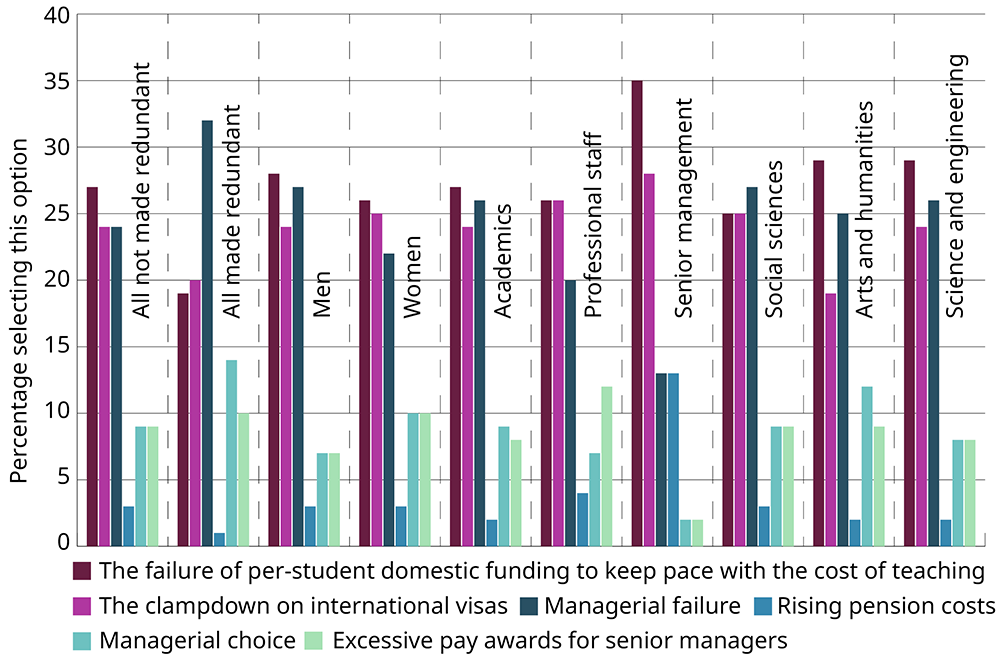
Asked what they considered the main reasons for any unavoidable redundancies at their institutions, senior managers were disproportionately likely to blame the failure of per-student domestic funding to keep pace with the cost of teaching, as well as the government’s clampdown on international visas.
They were disproportionately unlikely to blame managerial failure; only 18 per cent did so (respondents could name up to two reasons), compared with 32 per cent of respondents overall. That figure rises to 48 per cent among those who have been made redundant.
Other external pressures that were frequently cited were high inflation, research funders not paying full economic costs, the increased cost of the Teachers’ Pension Scheme, the increase in national insurance employer contributions and the impact of the improvement in universities in China on the Chinese international student market.
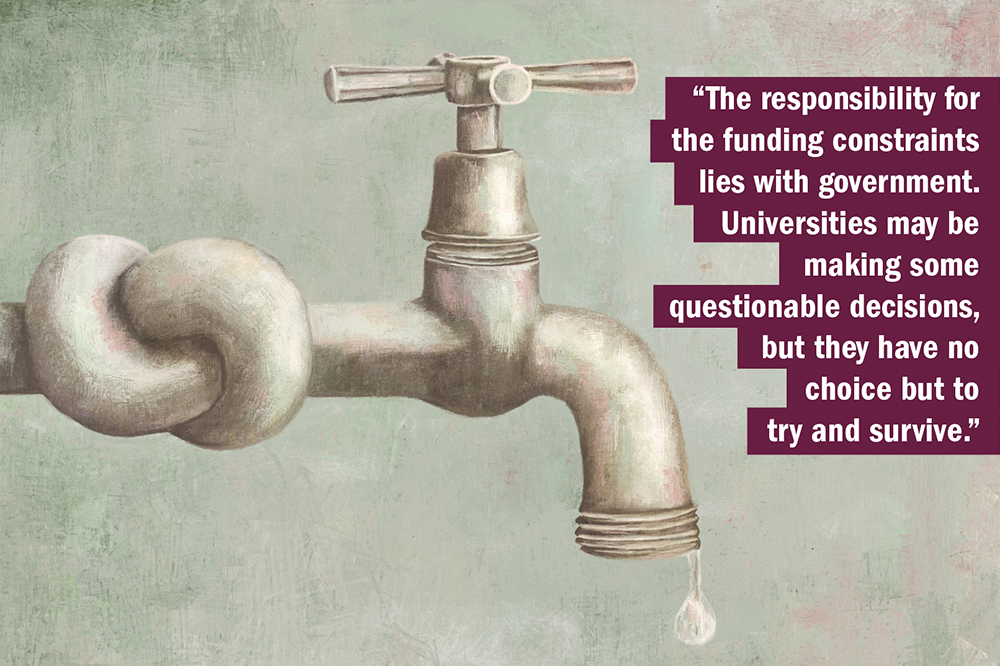
A biologist thought “the responsibility for the funding constraints lies with government. Universities may be making some questionable decisions, but they have no choice but to try and survive. My institution is largely reliant on teaching income, and every home student we take makes a loss. Added to the constraints on acceptance of international students, we are in a world of pain.”
But many respondents also complained of a lack of proactiveness among managers.
An operations and development professional recognised “a lot of inefficiency in our institution’s processes [such as not having] the right IT infrastructure. Change is incredibly slow due to culture. As an institution, I am sure we could have done more to anticipate and address inefficiencies.”
An English academic cited the need to service “loans on big investments that became a problem during Covid”, as well as a dip in student numbers. And a sociologist called for senior managers to keep abreast of population data: “If we know there are fewer 13-year-olds, for example, prepare for that as it will impact student numbers in five years’ time.” He also called on managers to charge marketing staff with being “proactive in evaluating the market and suggesting new, dynamic programmes in light of current staff expertise. Academics are researchers and teachers, not business people.”
A geographer conceded that “the international fee issue is a big part of the story”, but he also blamed mismanagement of university finances. “Only a year or so before putting people in redundancy pools, our pro vice-chancellor was making people permanent and promoting people (and therefore spending more money). They quickly came back to get rid of people when they realised the money wasn’t there. Of course they got promoted to deputy vice-chancellor.”
However, an English academic argued that “the free market model of higher education means we are unable to produce accurate forecasting. No number caps mean all is uncertain. The Russell Group were affected by the international student visa, which then meant my mid-tier institution was affected. The SLT were trying their best not to fail. They didn’t get it right, but how could they when the variables are out of their control?”
A psychologist agreed: “The governments over the past 15 years have created a broken system: notional competition with no caps per university or course but with capped fees that are falling in value year-on-year. As a result, once visas were tightened and other economic headwinds arose, the more attractive universities had to recruit more students to offset their own rising costs (instead of, for example, being able to charge more for being more desirable, which would be a normal market response). This has then taken from other institutions and there are not enough who want to go to university…The long-term harm will be significant.”
An English academic put it more pithily: “The Russell Group continues to be rapacious and to forget the purpose of education in favour of rampant financial gain and plays a zero-sum game to damage their competitors. How is this a healthy education system?”
Blame is also partly a function of the observer’s position in the university. A senior manager in civil engineering said their university “hired too many people in non-academic positions, making the overhead cost unnecessarily excessive.” But an employability professional attributed blame to “keeping ineffective people in jobs and just moving them round; keeping what we would term “workshy” managers in role; and keeping very low-subscribed courses running at the expense of gutting professional service roles.”
Respondents who considered redundancies to have been avoidable were most likely to cite “fear of the financial future” as the reason why they occurred anyway. Asked to name up to two reasons, 43 per cent selected that option, with “to pursue a new vision for the university/department/division” the next most common (cited by 21 per cent).
Interestingly, people who had been made redundant were twice as likely (14 per cent) as those who had not to attribute the redundancies to a managerial desire to “remove awkward colleagues”. And they were one-third as likely (2 per cent) to select “to remove underperforming colleagues”.
Senior managers, by contrast, were disproportionately likely to select the removal of awkward colleagues (11 per cent) and fear of the future (53 per cent) and less likely to cite a new vision (11 per cent). Arts and humanities academics were most likely (20 per cent) to blame a desire to close certain courses.
Many respondents attributed sinister motives to senior managers. An international student support professional suspected a desire to “redistribute income from lower grades to senior management”. The cultural studies academic cited “an opportunity to reduce staff costs”. A social scientist blamed “union busting”. A business and management academic suspected managers wanted to “increase control over staff, increase surplus and exploitation”, while a social scientist thought they wanted to “further commercialise the university and squeeze maximum profit from minimum workforce”. A marketing professional blamed managers’ “personal ambition. These changes will look great on a CV if they work, and upset staff are simply collateral damage.”
More abstract reasons for redundancies were also cited. Another social scientist blamed “neoliberalism and economic capture of higher education and the country”, and an international relations academic blamed “managerialism” and managers’ sense that “something must be done. Redundancies are something.”
Others doubted whether managers were really in charge of their own ships; a philosophy academic said redundancies in her department had resulted from “opaque financial calculations from a management consultancy firm”.
Among respondents who haven’t faced redundancy personally, the failure of per-student domestic funding to keep pace with the cost of teaching was the most cited driver of redundancies across the sector as a whole (as opposed to at their own institution), followed closely by the clampdown on international visas and managerial failure. However, those who had been laid off are more likely to cite managerial failure and managerial choice.
Senior managers themselves are disproportionately unlikely to cite managerial choice, managerial failure or excessive pay awards for themselves. They are much more likely to cite external factors such as the domestic funding freeze, rising pension cost, inflation and the national insurance increase.
Across the sector as a whole, which factors do you consider the main drivers of redundancies over the past two years? (choose up to 2)
Yet those outside the management cadre frequently bring up senior pay in comments. “Senior managers certainly do have excessive pay awards. We asked our v-c if he’d be OK to live on £150,000 and he said no,” said an English academic.
A student recruitment professional agreed: “When you’re doing voluntary early retirement schemes but you increase the level of staff on six figures or more while trying to reduce your staff on £20-25K, something isn’t right.”
An education academic, however, thought a bigger factor was the expansion of the demands on universities from students and regulators: “There is an expectation now that they will provide healthcare (in the form of university-employed nurses), mental health support, counselling etc. This is expensive and I think should not be within the remit of universities.”
So much for blame. What about the impact of all the redundancies on the sector?
One consequence is a huge hit to motivation. A full 93 per cent of respondents whose department or division had experienced redundancies in the past two years said it had damaged morale, 77 per cent strongly. And 88 per cent said it had damaged their own morale, 64 per cent strongly.
Senior managers felt the least strongly that morale had been hit, but 93 per cent of them still agreed that it had been. Senior managers were also the least personally demoralised by redundancies, but 72 per cent agreed that they were, 31 per cent strongly.
Redundancies have “absolutely destroyed morale in the number two-ranked school for our subject in the UK”, said a physical sciences academic. “In normal times the institution should be maximising this success to grow.”
A technical management professional said morale in his division was “already at an all-time low when our head of department was replaced with a new one with an authoritarian management style who…uses a stick rather than carrot approach...All goodwill has died now.”
A chemist has seen a “total and utter breakdown of morale. Mental health is at an extreme low. [There have been] suicides, deaths and general inability of colleagues to even focus on simple issues.”
Arts and humanities academics were the most personally demoralised, although the disciplinary differences were not huge: 92 per cent agreed that they were, 75 per cent strongly.
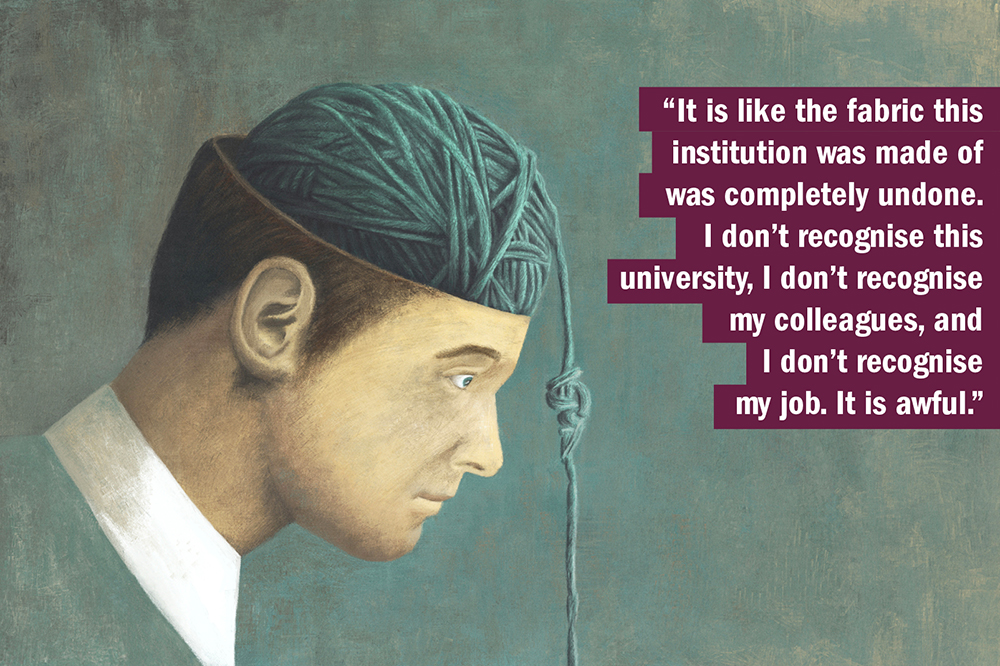
“There is no sense of community, no sense of shared purpose or any sense of collegiality,” said a film and media academic in her 50s. “It is like the fabric this institution was made of was completely undone. I don’t recognise this university, I don’t recognise my colleagues (some of whom are doing extremely well in these new structures), and I don’t recognise my job. It is awful.”
Others, too, reported a collapse in collegiality. A social scientist in her 40s described her colleagues as being in “a rat race to the bottom…For individual survival it appears best strategy to compete with each other...Tears, stress-related illnesses and breakdowns are on the rise. What’s most ironic is that it has lost more staff hours overall than it will save.”
A sport and exercise science academic in her 20s is “much less willing to help out or do things off my own back” than she was.
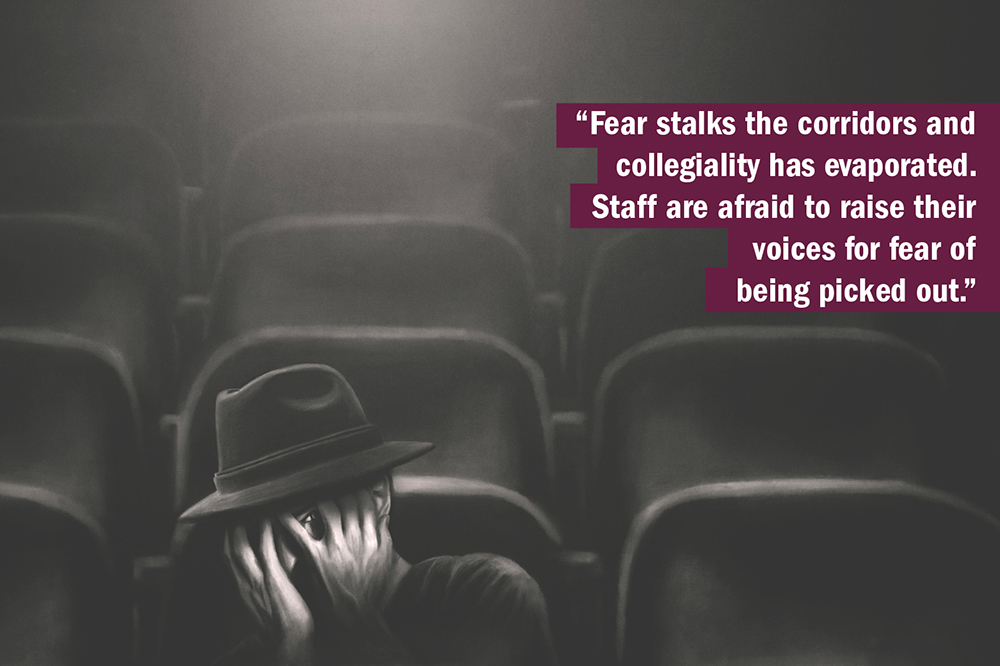
A modern linguist said: “Fear stalks the corridors and collegiality has evaporated. Staff are afraid to raise their voices for fear of being picked out.”
Managers are frequently condemned in comments for failing to deal with redundancies in a sensitive way. An English academic in her 60s said senior university management “seem oblivious to just how much permanent damage has been done. I suspect this is irredeemable under the current leadership…It is a real tragedy as the leadership team (under a previous v-c) had a wholly different approach to the Covid crisis, which is only a few years ago. At that time, staff loyalty was at its highest point, I think, because of the leadership style.”
One fine art department’s “exceeding low” morale is “more due to the amount of unneeded change as a result of poor management…In the last six years we’ve had to rewrite the BA course three times as the v-c keeps changing the overall structure of degrees. We wrote the last course with ChatGPT as we’d lost hope.”
A biologist has “been in academia for over 25 years and I have never known it this bad. In my institution, our management have insisted on pushing through multiple reforms while making people redundant, which has added to loss of morale.”
And most academics in a modern languages department “were told their job was at risk just before Christmas”.
A research professional said her division was “seeing the fallout” of low morale “with people who remained through the restructuring now choosing to leave. Cutbacks were not uniform, some being severe, leaving areas practically unviable and increasing institutional risk.”
A scientist in his 40s said: “I no longer put any effort into my work. Indeed, I am retraining whilst maintaining the pretence of working. Perhaps this is dishonest? But I am following the old Nixonian adage: ‘Do unto others before they do it unto you’.”
But other respondents were less concerned. “Redundancies inevitably lower morale in the short term, but, even in the medium term, people are glad that change has happened as it means they are safe,” said an allied health professional. And a management academic had already begun to see a rebound: “I feel that within our department we have reset and are now much more collegiate and positive as a result.”
In terms of personal morale, women’s is lightly lower than men’s, and academics’ is lower than professional staff’s.
A psychologist in her 40s has “gone from an academic with a keen ambition to pursue research to someone with zero ambition to continue in HE because I don’t see a future for me in it at all”.
A senior member of professional staff at a research centre in her 50s has “twice been through counselling and await a third round. Stress and anxiety have [led to] jaw clenching and I have suffered bouts of anxiety and insomnia.”
A social scientist in her 40s is “angry, bitter, disappointed and petrified. I knew this was coming but did not expect the scale and velocity at which it hit…as we were fakely reassured we were in good financial health until very recently. I am a foreign national with a young family and we’ve all made a difficult move from another country to be here. The pressure to look for jobs and move yet again leaves me sleepless and stressed, hampering my ability to perform my job.”
Mistrust in senior managers is also having a negative effect on morale. A marketing and recruitment professional said hers were “not alongside us in this, in the trenches, taking incoming – but were firmly insulated and taking nice, fat pay rises. Gordon Gekko is alive and well in HE, it seems.”
A management academic “escaped being scoped last time, but I know it can happen again at the drop of a hat, partly because senior management can just make up any reason they like for doing it”.
An online learning professional put it more colourfully: “The egomaniacs at the top of the university can aways find ways to justify the cuts they want to make even to profitable areas. The cuts are based on their ‘vision’ and desire to mould the university to what they think it ought to be, and they tailor the data to suit.”
Perhaps the biggest drag on morale is the increased workload that the loss of colleagues has imposed on those that remain. There is extremely strong agreement among all categories of respondents that this has occurred, with 88 per cent of those whose department has seen redundancies agreeing that it has affected their workload, 64 per cent strongly. Senior managers are the least likely group to agree but 80 per cent still do so. Those in their 30s and 40s are most likely to agree.
A research support professional said her work had “quadrupled in the last six months”. A chemistry academic is now “doing student-facing work which used to be done by three people”. A student support and welfare professional’s workload had doubled. A politics academic has seen his “teaching load increase by 33 per cent”, although “interestingly, over half my colleagues have seen no increase”.
A manager in admissions and marketing “needed to carry out additional work to manage the redundancy process, sit on panels etc”. But, once again, managers receive little sympathy from those beneath them in the hierarchy.
“Senior leaders continue to demand more for less and don’t listen,” said a psychologist in her 50s. “Imagine being chronically overworked and repeatedly told by senior leaders and HR that you have plenty of time. Two hours to prepare a transformational teaching session is not enough. Neither is 20 minutes to mark a 2,500-word essay, or 15 minutes for an exam.”
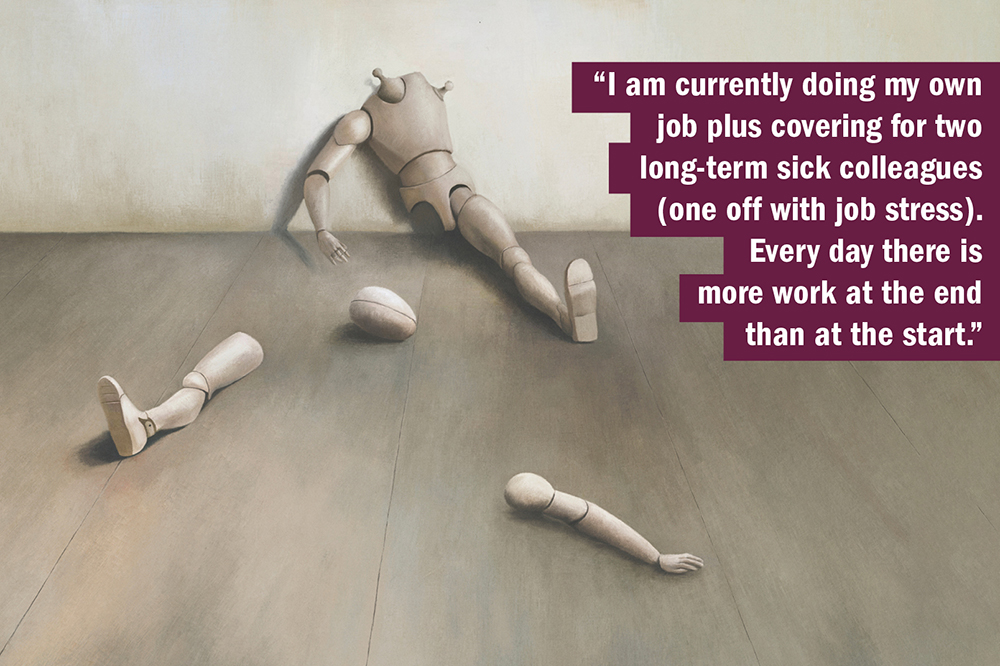
An academic skills support department now has “a very high number of staff on sick leave, which puts additional stress on remaining colleagues. Some courses are struggling to have enough staff to run them due to the redundancies.” And a management academic is “currently doing my own job plus covering for two long-term sick colleagues (one off with job stress). Every day there is more work at the end than at the start. There is no more to give. I love teaching and research, but we are all perpetually exhausted.”
A technical management professional’s workload is “quite literally off the scale…There is no light at the end of the tunnel so…Absenteeism is climbing as morale drops, which I have to pick up. The HoD is uncompromising and deals with this by setting harder deadlines to pressurise results so she doesn’t lose face with senior management. There are not enough hours in the day to complete anything to any degree of quality.”
A programme assistant said tensions between professional and academic colleagues “have worsened due to staff shortages and competing priorities, deadlines and demands”. But the overwhelming sense among academics was that the loss of professional staff had made their own jobs much harder.
“Academics are now expected to cover administrative tasks that were previously undertaken by professional services staff,” said a psychologist. One example is “employability activities – because the central careers [division] has very few staff now”. This has impacted on research time – “Yet we still have to deliver for the Research Excellence Framework on 150 research hours a year.”
An architecture academic said the need for academics to take up the slack left by redundancies among professional staff was “undermining the ability to deliver core academic responsibility: teaching, research and curriculum development”.
But a historian in his 50s has “chosen to ‘phone in’ so much of my extra work that [the redundancy round] hasn’t made much of a difference” to his workload. Another arts and humanities academic in their 50s is “senior enough to have dared refuse additional work”, while a finance professional in his 40s has the sense that “a lot of staff were not doing a [great] deal, so losing some has not made much difference to workload”.
If departmental/divisional colleagues have been made redundant over the past two years, to what extent do you agree that it has...
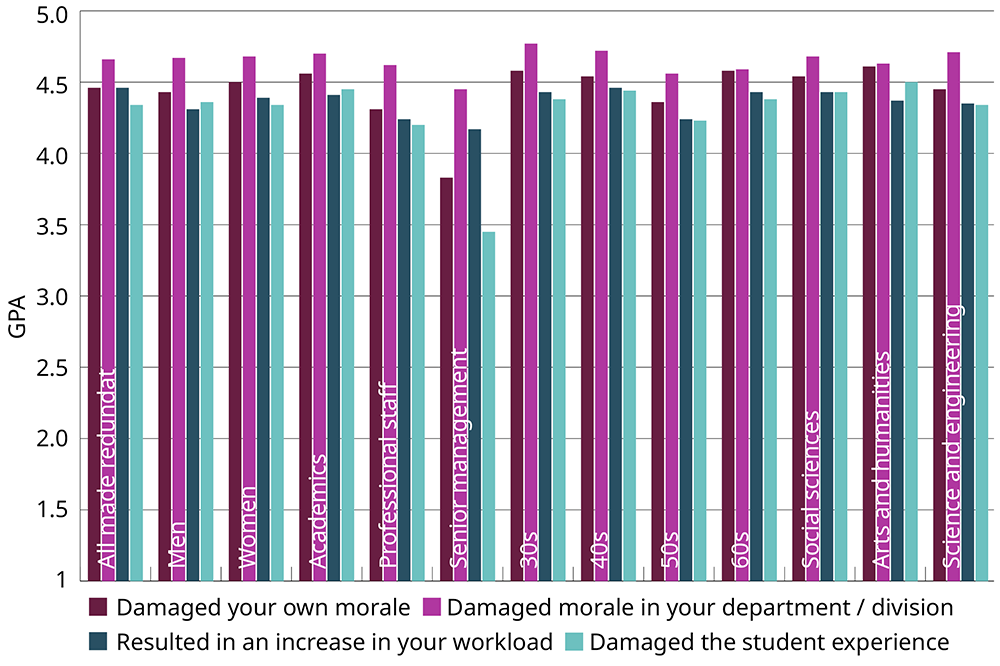
Most respondents linked redundancies and the increased workload on everyone else with a decline in the student experience. Overall, 81 per cent of respondents agreed that redundancies had damaged the student experience, 54 per cent strongly. Arts and humanities academics were the most likely to agree, but senior managers were much more likely than everyone else to disagree.
A senior manager in the social sciences believed his faculty had “maintained the student experience by being innovative in our approach to workloads and curriculum design. This has made our inflated and complex awards much more precise” – although he conceded that “we do not have the same budget for purchasing new kit, sustaining external partnerships and having the same breadth of field trips.”
An English academic, though, believed redundancies in the sector were being “managed solely in financial terms, with no understanding of the consequences for student education and experience, which means little to no support for staff left to try and manage heavier teaching loads. There is no strategy, no coherent aim, no adequate managing of the process, just an increase in workloads as we’re told to mop up. Which we do, for our students and our colleagues, all the while feeling that we’re playing into management’s hands.”
One digital journalism academic was “exhausted by Tuesday. Students cannot get the best from me.” A scientist and his colleagues “try our best to shield our students, but there are direct consequences in terms of having to pull back to offering what we can get away with rather than what we want to deliver…The ‘secret’ of our [dire] financial position is also well and truly out of the bag, causing stress and near-panic among many students.”
Respondents also cited being obliged to teach outside their expertise to cover for lost colleagues.
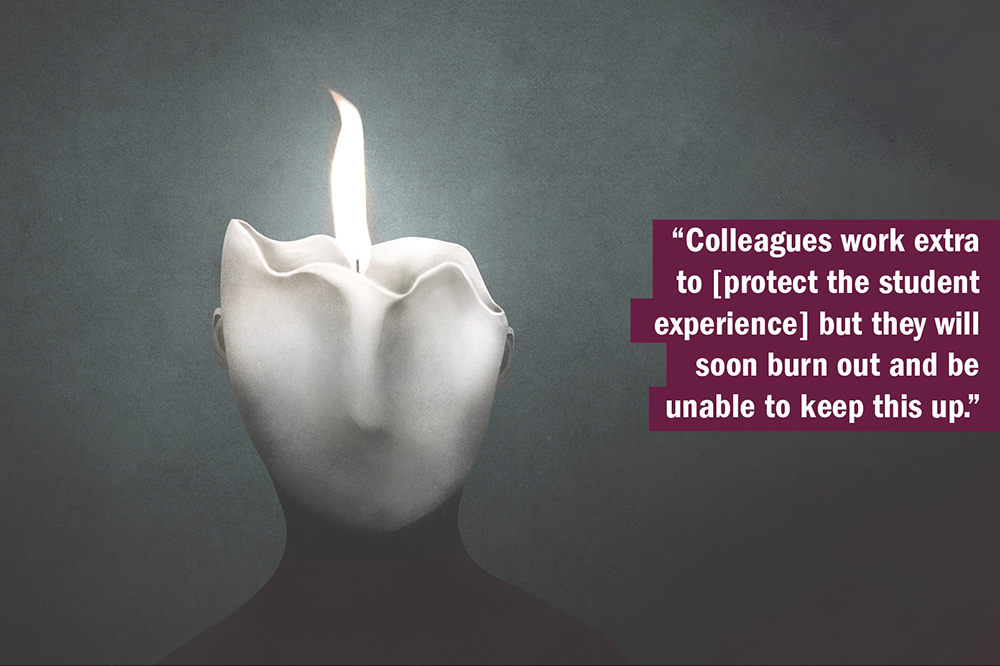
A sport and exercise scientist predicted that colleagues who were working harder to protect the student experience would “soon burn out and be unable to keep this up”. A social policy academic agreed, particularly as “students’ needs are increasing (more than ever have special circumstances and disability statements), class sizes are larger, marking time is less. They’ll have nice chairs to sit in in the new communal areas with primary colour paintwork, but no contact with academic staff.”
A sociologist had already “had to listen to several student complaints about things that are directly the result of having fewer staff, such as [fewer] module options, [lower] quality of assessment feedback and [less] quality of time with lecturers”. A film and media academic has also heard complaints about “the lack of community and cohesion”.
Current students “are receiving an impoverished version of the university their peers [experienced] only five years ago, and it is unrecognisable from what students will have experienced 10 or 15 years ago”, said a human geographer in their 40s. But the fact that students don’t know this “means that we end up with false metrics around student satisfaction (one that universities are happy to accept)”.
A careers and employability professional agreed: “Students don’t know how much more difficult it is for them to access support than a year ago. It is pitiful how long they have to wait for services and support they are paying for through their fees.”
Respondents are also very clear that any further redundancies would be very bad for students. Only 15 per cent agreed that there was capacity to make redundancies in their department or division without having a significant negative impact on the student experience; 57 per cent disagreed, 50 per cent strongly. But 45 per cent of senior managers agreed – albeit only 3 per cent strongly.
“There are some really lazy staff who hide behind non-existent research. If this was a commercial organisation, they wouldn’t be here due to lack of meeting their job criteria,” said one senior manager in the social sciences. But another was unconvinced: “We are already cutting beyond the fat and going straight into bone. More redundancies across professional, academic and technical teams will mean it will not be viable to run courses.”
Women and those in their 30s are least optimistic about the impact on students of more redundancies. An English academic predicted that her department would have to “offer fewer options and probably cut teaching hours somehow. Staff will have to spend less time on marking and feedback.” And a research support professional in her 60s said: “We are at skeleton staffing, minus one or two key bones.”
But some of the rank and file do see scope for painless cuts – “if approached in a targeted way (which might be illegal)”, as a modern linguist put it.
“The [redundancy] schemes do not target the underperforming colleagues,” said a physicist. “Instead, they support high-performing colleagues to move away.”
And in one biology department there are “a number of staff phasing into retirement who have remained on one day a week contracts for several years and do not contribute to the student experience, as well as some staff who focus primarily on research but have not brought in grants for several years but have not shifted to contributing to the student experience. If they were to take voluntary redundancy or fully retire, this would not have a negative impact on the student experience but may free up workload resource for new staff or promotions of existing staff to recognise their continued significant effort.”
Another aspect of the hit to morale is the sense that even if you have survived so far, there is no guarantee that you will survive future redundancy rounds, particularly given that there is no obvious solution to the financial pressures that the sector is facing.
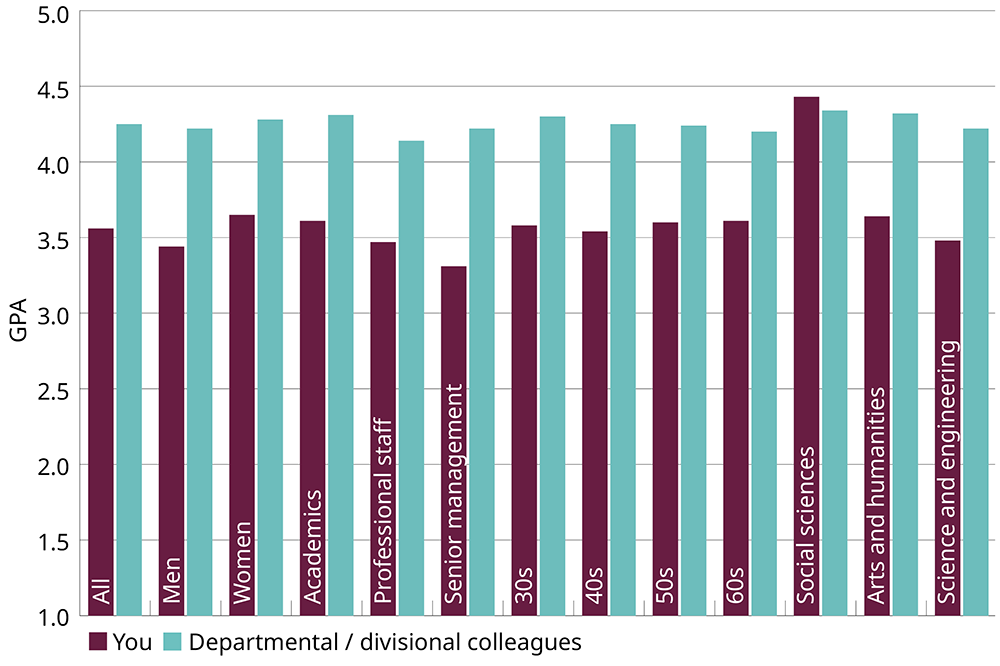
Asked whether they fear losing their job in the next 12 months, 59 per cent agreed, 26 per cent strongly. Senior managers felt the most secure, while professional staff were marginally less fearful than academics. But the biggest variations in response were between subject areas, with social sciences much more fearful than arts and humanities academics – an odd finding given that more cuts have been imposed on the latter.
Perhaps relatedly, women were more fearful of losing their jobs than men were, with a GPA of 3.65, compared with 3.44. That may reflect their concentration in social sciences; 43 per cent of female respondents were in social sciences, compared with only 22 per cent in arts and humanities and 28 per cent in science and engineering.
A psychologist in her 40s “absolutely fear[s] losing my job and I am making plans to start my own business and leave HE as soon as possible to avoid this”.
A human geographer in her 40s was a little more confident: “It will be difficult to remove me first (very strong EDI case and reasonable performance). But there is a serious risk that my research area will be defunded or forcibly redirected, to streamline grant capture in light of government’s changing priorities, making it untenable for me to stay long term anyway.”
A politics academic in her 50s said that “after 18 months of slash and burn across the board, we are in a limbo year before a more targeted cull starts. Our student recruitment has grown every year for a decade and 2026 looks good, but that didn’t keep us safe last time. I’m a strong performer and will probably be OK, but I expect another at-risk email.”

The head of a social science department was fearful another restructure would eliminate his role “because of another merger being created for more super-sized departments based on declining student numbers, staff FTE and research portfolio”.
A social policy academic in her 40s found it hard to know how secure she is because “zero information has been shared over the last 20 months about which subject areas, research ideas, disciplines, courses etc are a priority to keep and which are to be dropped… So it could easily be me and my school, but at the same time we might not get any cuts at all. Who knows? A shambles.”
Beyond social science, an English academic in her 50s believed “no one is safe. I might be a world-leading researcher with a long track record of grant capture and international connections who will teach anything asked of them, but…I’m confident I’m on a list for voluntary severance now that I’m a professor.”
A peace studies academic in her 40s is “waiting for the email to say we are bankrupt”.
Unsurprisingly, scientists felt the most secure among academics, but 55 per cent still feared for their jobs, 26 per cent strongly. A computer scientist in his 40s was “in a pool where 40 per cent of people will be made redundant”. Another scientist his 50s said that despite being assured that his department would be safe from further cuts if saved £35 million – which it did “through extensive cost-saving measures, including job losses” – “six weeks later, we were told we had to save another £30 million this year. Even if we manage that (and there’s no fat left to trim) no one believes our leadership any more.”
A chemistry academic in his 50s is “most worried I will finally upset a manager so much they get rid of me. But the multimillion research grant I established and the fact I can and do teach across four STEM subjects means I’m relatively safe.”
Everyone at one marketing professional’s university has “been told we won’t be made redundant this year (only because of unions holding them accountable) but next year, who knows? We may also be moved into other roles that we would never have applied for, or to locations that are functionally hard to reach. There are ways of making people leave without making them formally redundant.”
Lots of respondents are jumping before they are pushed. “I know I will [be made redundant], said a Germanist in her 50s. “I have therefore applied for voluntary redundancy and been accepted.” And a film academic has already started a new job after her previous course was “put under a very likely trajectory for closure. I feel relatively secure so far.”
A fine arts academic in his 50s, meanwhile, is currently at risk. However, “Fear is the wrong word. The new contracts are so bad I don’t know that I want one.”
A former careers and enterprise professional in his 50s has left the university sector entirely after 10 years since he “cannot tolerate the impact [of redundancies] across the board: operational breakdown, poor student experience, low morale and clueless leadership out of their depth in a crisis”.
Even if respondents don’t personally fear for their jobs, they are aware that many of their colleagues do. Even 88 per cent of senior managers agreed that this was the case. Professional staff report the lowest levels of fear, while social scientists again reported the most, but less dramatically so than when asked about their own fears.
Do you or your colleagues fear losing your job in next 12 months?
A human geographer said that her teaching-only colleagues were particularly fearful. And an English language support professional said the “majority of my colleagues are likely to lose their job” in the next three months, while “80 per cent or more” of a chemist’s colleagues are “actively looking for new jobs”.
Fear of redundancy is “one of the most frequent topics of conversations, when we have time to chat”, a historian reported, while a social scientist said their managers were “picking off groups one-by-one and we don’t know who will be next (or why they have been targeted)”.
A Hispanic studies academic in his 50s pointed out that “fear is not always rational”. But neither is equanimity. “Most people” in one politics department “seem to be very naive that no jobs will be lost”.
But those happy few were very much in the minority. Asked whether redundancies in their department or division are less likely in the next 12 months than they were in the previous 12, only 22 per cent overall agreed, against 56 per cent who disagreed – a GPA of 2.36. Staff may be somewhat reassured that senior managers are the most likely to say that the worst is indeed over (2.78). But trust in managers’ assurances is strikingly low.
“We’ve been told we’re the last wave of redundancies as then everyone in the university will have been fired and rehired into the subsidiary,” said one fine art academic. “But we don’t believe the management. The university is on its last legs – there’s no money for anything at all. We’re making art out of photocopy paper because it’s the only thing we have. There’s no money for trips despite them being advertised. There’s no money to keep workshops running. There’s no way they aren’t making more redundancies.”
Academics in the arts and humanities (2.18) and social sciences (2.20) were the least optimistic. But scientists (2.43) were also generally pessimistic and sceptical. “Trust in what leadership tell us about our collective financial position is at rock bottom,” said one scientist. “We have no idea what the future holds…We’re now basically working on the assumption we won’t get any international students any more so it sort of can’t get any worse, but on the other hand again we’re still sinking.”
And anyone over 55 in one medical sciences division is considered a “fool” if they are not thinking about taking voluntary redundancy: “There are now only a handful of senior scientists left as a result and those remaining feel pressurised,” says one of those scientists, in her 60s. “And even if this is not directly articulated, it is clear that more junior staff feel that those who can afford to retire should do so to take the pressure off the budget and allow more junior people to ride this out [because] they have mortgages and children and really need the job.”
The Hispanic studies academic said that “due to the number of academic staff who have left, retired, or moved sideways, the financial pressure on the staff budget has decreased significantly”. But a psychologist puts it more pointedly: “So many people have left and not been replaced, because of management bullying and overwork, there is little chance of redundancies. We are understaffed and overwhelmed.”
Senior managers, unsurprisingly, were also by far the most likely group to believe that their “university’s leaders will do everything they possibly can to avoid (further) redundancy rounds in the next 12 months” – although only 37 per cent of them agreed, 28 per cent strongly. Academics were less likely than professional staff to agree and younger staff less likely than older staff. Social scientists were particularly unlikely to agree.
The phrase “they don’t care” cropped up frequently in the comments. “The university SLT has made it very clear that they view staff as a financial burden and will be getting rid of people to suit their bottom line,” said a biologist in her 30s.
The consultation over job cuts held by one university’s leadership was “a fake one. We proposed several ways out and they were all rejected,” said the computer science academic.
Even people who agreed that their university leaders would do all they can to avoid more job cuts were often cynical about their motives.
“They will do all they can to avoid negative publicity about redundancies,” said a historian in his 40s. “They care far more about reputational damage than the well-being of current staff and students.”
“Lip service only is paid,” said a chemist. However, “Unrealistic targets have been set that will ensure future losses, but in such a way that management can shrug and say ‘we tried’ while taking away bumper remuneration.”
“It feels like they’re enjoying this,” said a public health academic.
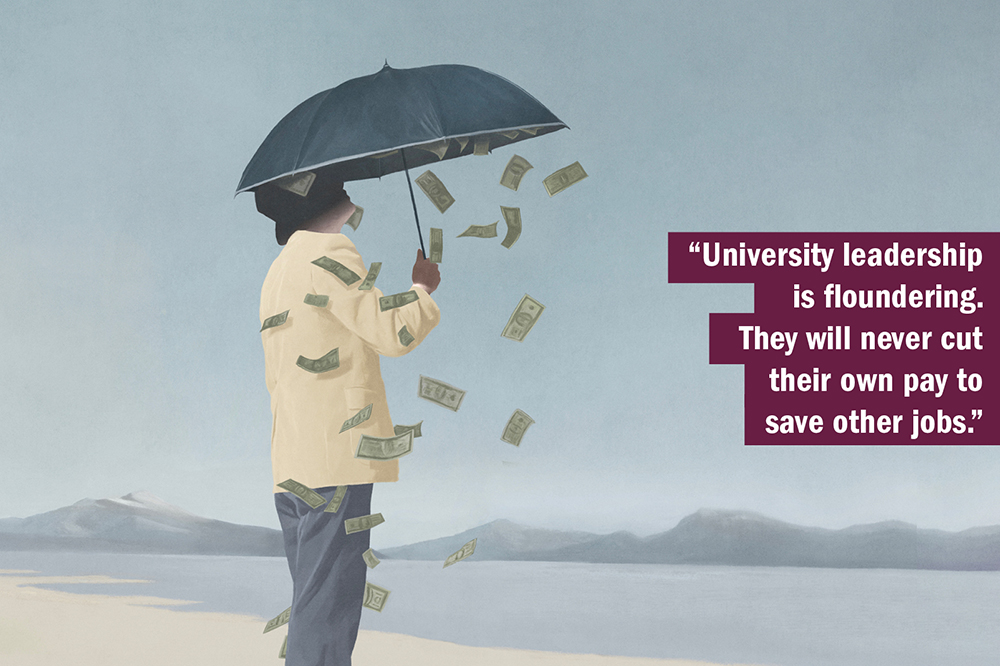
Others suggested that senior managers were not even honest with themselves about whether they are really doing all they could to avoid redundancies: “They believe this, but nobody else does,” said a social scientist. “University leadership is floundering. They will never cut their own pay to save other jobs.”
An education academic went so far as to suggest that “we should just get rid of all senior managers and adopt a democratic and collegial approach to university governance. It has worked well elsewhere, but the UK often lacks the intellectual humility to look beyond the Channel.”
A health and social care academic said his institutional leadership “do seem to be doing what they can to avoid compulsory redundancies and keep things voluntary (they have just opened a third voluntary round). That said, they are dismissing ideas from staff and unions to make the same savings without redundancies.”
But a healthcare professional education academic in his 30s has every faith in his institution’s leadership’s good faith: “There is plenty of chat about option A – everyone keeps their job and no pay rise – [as against] option B – pay rise, but people will have to lose their job.”
Respondents were considerably less cynical about the motives of their line managers. Overall, 49 per cent agreed that their immediate managers would do their best to avoid redundancies, against 29 per cent who disagreed, 13 per cent strongly. Interestingly, people in the arts and humanities were particularly likely to be positive about their immediate managers.
How confident are you that managers will do everything they possibly can to avoid (further) redundancy rounds in the next 12 months?
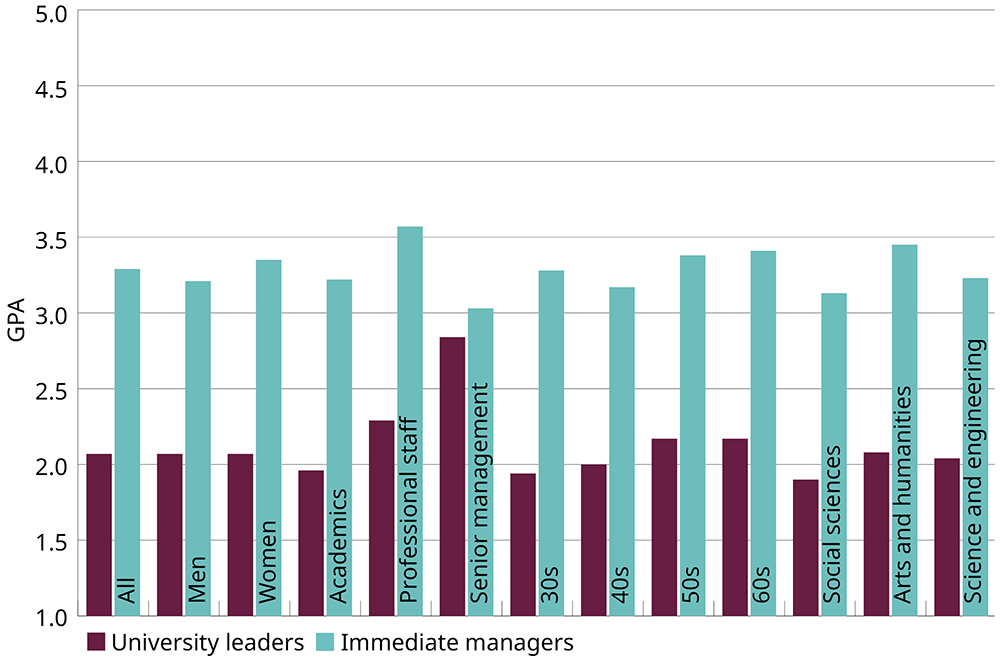
“Our department’s senior leader is very clear she will not be accepting any more requests to cut costs,” said a careers and employability professional, while an English academic believed that “No one running a department wants to lose colleagues: it is churn, teaching suffers, and they value colleagues as individuals.”
One research support professional’s manager “fought tooth and nail to formulate an alternative structure for our department, reducing headcount but covering all roles, albeit thinly”.
And the head of a science department was “absolutely inspirational in their tireless attempts to defend us from poor and unnecessary decisions falling on us from above”. But they were “worrying themself into an early grave for their efforts” and those efforts were ultimately futile since “all power has been concentrated into the hands of a few at the very top, so HoDs are basically powerless”.
That view is expressed extremely commonly by managers and the managed alike. A medical sciences academic who line managed around 15 senior academic staff was reduced to railing against the plight their colleagues found themselves in: “None of them enjoy their jobs or feel valued…It is outrageous that the responsibility for fixing the university finances is put on academic staff. We can never plug the gap with external grants. The mantra is now that ‘research costs us money’ even though we are a Russell Group.”
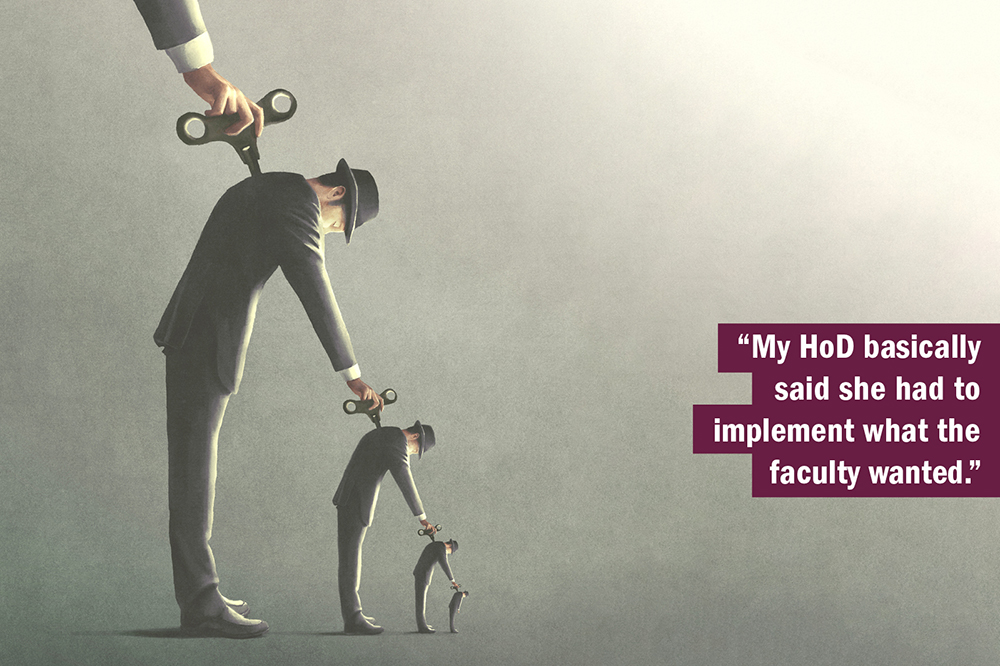
This lack of power was often phrased pejoratively, in terms of middle managers “just doing as they are told” by senior managers.
“My HoD basically said she had to implement what the faculty wanted,” said one scientist. “There was no duty of care during the process, which was made as unpleasant as possible by HR and the senior management team. Procedures weren’t followed correctly and business cases when we finally got to see them were inaccurate.”
Some respondents even thought their line managers are exploiting what limited power they have to minimise their own chances of being made redundant.
“My immediate manager has been placed at risk and can also apply for our jobs in the redundancy pool, so he’s being an arse and competing with us all and trying to get rid of anyone he can,” said the fine art academic. “I’ve presented ideas to increase recruitment and protect jobs, but I went above him as he’s too wrapped up in saving himself. The managers at the top of school are good and so is the dean.”
One postgraduate admissions professional believed his immediate managers would “throw everyone they can grab under the bus of the oncoming redundancies to protect themselves”, while a medical academic thought her HoD has exploited the reduced “accountability for their actions in a workplace where is there is low staff morale and high compliance from fear” to “use university resources/funding to further their [own] careers…There is no remorse.”
A geographer thought her managers had “tried their best but disappeared during the redundancy process, leaving us without leadership during the hardest time”.
If managers are not doing enough to protect jobs now, will they at least make sure that any headcount lost now will be replaced “if and when the financial climate improves”? Only 7 per cent agreed that they will, and only 1 per cent strongly, against 79 per cent who disagreed, 40 per cent strongly. Even senior managers were not confident that headcount would ultimately bounce back: only 16 per cent agreed, none of them strongly. Professional staff and those in their 30s were also a little less pessimistic, while those in the arts and humanities were the most pessimistic, with only 5 per cent agreeing.
Some respondents suggested that better conditions would never transpire anyway. For instance, a postgraduate admissions professional in her 60s said: “It is impossible that the financial climate will ever return to the heydays of universities” – not least because “AI is changing the education sector. There will be no going back” – although, interestingly, only 10 per cent of respondents expected to lose their job to AI within the next three years.
Other respondents were cynical that managers would feel the need to increase staffing costs again. A finance professional foresaw the replacement only of roles “deemed business critical, strategically important or linked with future income/surplus growth”, while an English academic expected her managers to “tell us that we’ve managed with staffing levels so we can keep managing”.
Yet an operations and development professional observed that research “shows that those institutions that make large cuts end up over-recruiting in later years”. And some were already seeing that dynamic in action: one IT department “cut 25 per cent of jobs, but nine months later, we are back to the original, with increased salaries for some”.
But others suggested that any headcount replacement is likely to be at more junior levels and on considerably worse terms and conditions. And, as an international student support professional observed: “Headcount can be replaced, but institutional knowledge and experience cannot.”
Yet for all the pain, grief and cynicism, respondents were still generally glad to work in the higher education sector. Overall, 40 per cent agreed that they were, 15 per cent strongly. Professional staff and, especially, senior managers were the happiest, with social scientists the least happy, although the variation within disciplines is relatively small.
Even those who proclaimed themselves happy, however, tended to add a caveat about the sector’s current direction of travel.
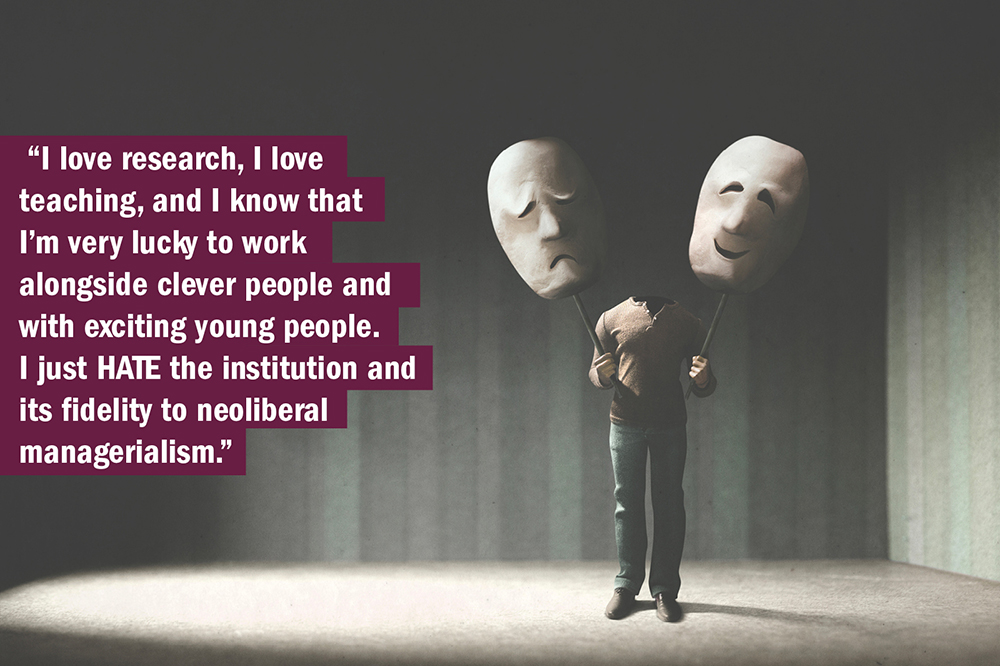
“I adore my job,” said a historian in his 50s. “I love research, I love teaching, and I know that I’m very lucky to work alongside clever people and with exciting young people. I just HATE the institution and its fidelity to neoliberal managerialism.”
An English academic loves “the freedom to research and the opportunity to write. I love engaging students and the public in my research, which I genuinely believe has value. I love teaching and I love my students: I believe absolutely in the capacity of education and critical thinking to transform lives and in the moral necessity to share knowledge across all communities regardless of entitlement and economic background. This is what a university should do. And it is important to acknowledge that I am paid much more than I would be if I worked in a low-paid or zero-hours job. How long that can sustain me in the face of such persistent hostility from senior management and the heart-breaking lack of understanding of what a university should be, I don’t know.”
A careers and employability professional in her 30s also remained “proud to say I work in HE because I think at a local level staff are doing their best to provide a good experience for students. I still think my work is meaningful and has an impact, but I am tired of the constant uncertainty and lack of transparency from executive level.”
But many respondents used variations of the phrase “I used to be”, with older respondents typically saying that they were much happier 20-30 years ago.
A geographer in his 60s “used to love my work, but now it’s overly bureaucratic, under-resourced and you are under constant pressure to deliver across multiple and shifting targets”.
An academic department manager in her 50s also “used to love this sector and used to encourage people who were interested in an admin career to consider HE [because there are] lots of interesting jobs, career opportunities and relatively good work/life balance. However, the pay has dropped massively in real terms, the morale is much lower and jobs are much more precarious. I would not recommend it now, even though academic colleagues are great to work with.”
And while a social scientist in her 40s “can still think of worse jobs, including high-skilled ones, with less autonomy, lower income and higher pressure”, being an academic is “not the job I thought it would be when I…did a doctorate”.
Others with more personal exposure to other sectors felt the benefits of academia more strongly. “My partner is a teacher in a special needs school, which always grounds me,” says a librarian in his 50s. “Some of the day-to-day moans in HE are small beer in comparison to teachers buying snacks for their class out their own pocket.”
An academic skills support professional in her 30s agreed that HE is “a massive improvement on working in schools”. And in the experience of a research support professional in her 50s, working in industry is “dog eat dog. It’s less so in the university environment.”
But an occupational therapy academic said she “left the NHS and I regret it”. And a health sciences academic who had made the same switch was also unsure of her wisdom: “I made financial sacrifices to move from a secure NHS role to teach. I worry about being able to sustain quality for students in the current climate.”
How happy are you?
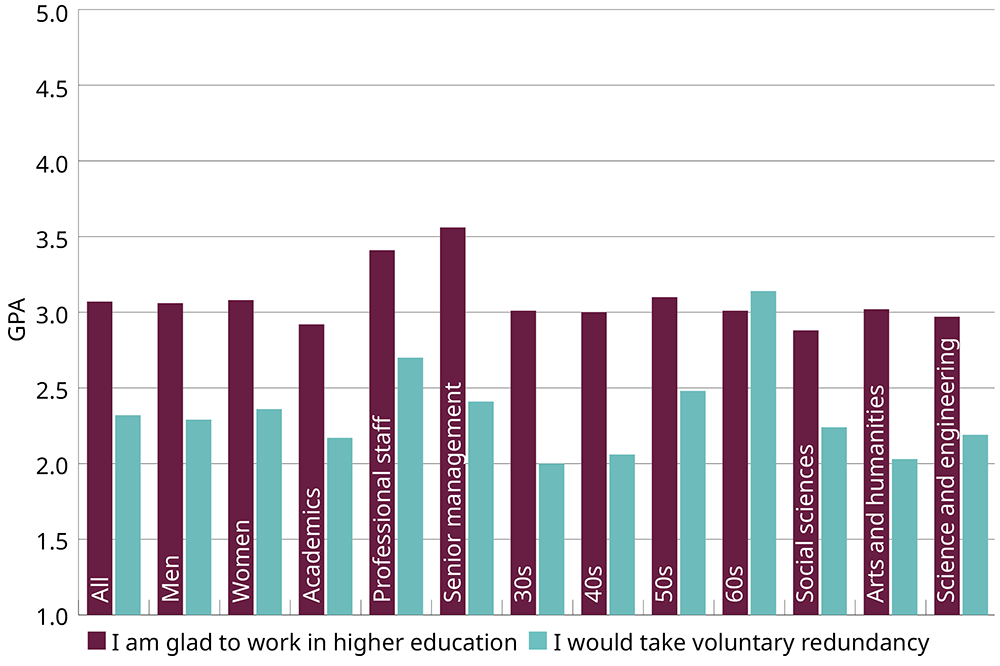
Given the generally high levels of happiness with life in academia despite everything, it is unsurprising that relatively few respondents would take voluntary redundancy if it was offered to them. Only 19 per cent agreed that they would, 9 per cent strongly.
One of those, a human geographer in their 40s, is “looking to move out of the HE sector. It breaks my heart as I have loved this job, but managerialism and mismanagement of finances have ripped the guts out of universities. Standards are constantly being eroded as deadlines are made tighter, pressures to make students ‘happy’ are pressed on academic staff and a ‘doing more with less’ mantra has become the norm.”
Another academic in their 40s said they “want out now: it’s time to sacrifice my science and research for stability and peace of mind.”
Willingness to take voluntary redundancy rose sharply with age profile. Interestingly, though, while academics were the least happy group to work in HE, they were also the least inclined to take voluntary redundancy, with arts and humanities the least of all.
A sociologist in her 50s would “hate to leave in this way. It would feel like not just the end of a personal career trajectory (I doubt I would find work in another university in my discipline) but also the generational defeat of a vision of HE that had inherently democratising and life-enhancing qualities.”
Moreover, many of those who would take voluntary redundancy noted that they would only do so because the alternative would be likely to be worse.
“If [redundancy] were truly voluntary my answer would be ‘strongly disagree’,” said one scientist. “However, in some circumstances, it is being made very clear that if you don’t take voluntary redundancy it will be compulsory: ‘Take the payout to avoid the university having to admit it is making people redundant.’”
Many respondents said their answer would depend on the details of the package on offer. “On recent terrible terms, no!” said an English academic in her 60s. “After 30 years’ service I would have got 3.5 months’ salary: the bare minimum.”
A civil engineer in his 60s had his sights set much higher than that, despite the “unbearable workloads” he faced: “So long as the payout covers two years’ take-home salary, I will go.”
A research manager in the arts and humanities in her 40s would “jump” at voluntary redundancy if the package was “enough to retrain”.
But some of those intent on staying in the sector were wary of accepting even a relatively generous package given the likely difficulty of finding another job: “It would only be a reasonable payoff if I could find a similar job quite quickly, which would be unlikely in the East of England, where I live,” said a health and social care academic with a young child.
“I want out but don’t have a clear alternative,” said a sociologist in his 30s. “I am worried about the impact of chronic stress on my long-term health, but I also have a mortgage and dependants.”

Many of those who had taken the plunge did not expect to miss such conditions. “I love my work, but right now I’m relieved because it feels like escaping a ship just before it sinks,” said a Classics academic in her 40s who is currently working out her notice period. “I don’t want to be the last one on board.”
A senior manager in social science was “tired of working 80 hrs a week 51 weeks a year, whilst being insulted by the shaming of ideological attacks [on the sector]”.
And a virologist in his 60s was “so pleased I’m not starting out now. As a senior leader, I feel disappointment that I will leave the sector before long (voluntarily or otherwise) that has given me a good career. But, my word, it is in a terrible situation now. It’s very depressing and occupies a huge amount of my headspace.”
It is very evident from the overwhelming response to our survey that he is far from the only one in such a miserable condition.
Register to continue
Why register?
- Registration is free and only takes a moment
- Once registered, you can read 3 articles a month
- Sign up for our newsletter
Subscribe
Or subscribe for unlimited access to:
- Unlimited access to news, views, insights & reviews
- Digital editions
- Digital access to THE’s university and college rankings analysis
Already registered or a current subscriber?