The head of UK Research and Innovation (UKRI) has blamed “information leaks” after conceding changes to science spending have not been communicated in the right way, leading to “upset and uncertainty” among researchers.
Addressing concerns over the news that the Science and Technology Facilities Council (STFC) is seeking to find £162 million in savings by 2029-30 and other research councils had suspended responsive-mode funding, UKRI head Ian Chapman told MPs on 3 February that his agency had “not done a good job” in communicating recent developments related to how funding allocations to different research councils would change.
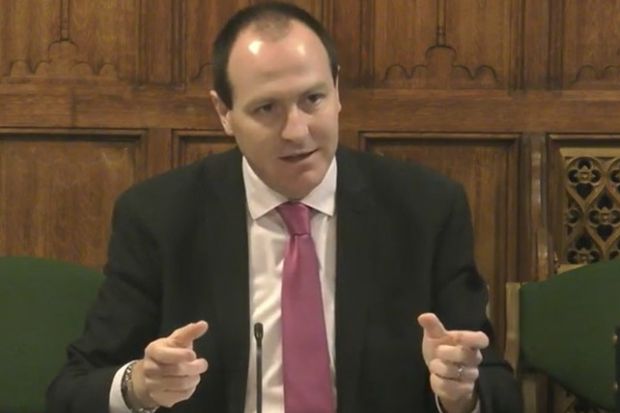
“We have not done communications in the right way over the last month,” explained Chapman as he appeared before the House of Commons’ Science, Innovation and Technology Committee.
“Information security has not been good enough in my organisation,” he continued on the “information leaks outside the organisation” which, Chapman said, had forced UKRI to “rush communications out when we had not done…engagement” with researchers.
“This causes upset and uncertainty, and causes [researchers] to worry about their jobs,” Chapman added.
His statement follows news that project leaders at STFC had been asked to model cuts of up to 60 per cent on existing schemes as the council seeks to make significant savings by the end of the decade.
That follows a shake-up of how UKRI allocates budgets to research councils, announced in December, with more money set to be directed into cross-council projects based on priority economic areas identified in the Labour government’s industrial strategy rather than handed directly to councils.
In addition, the Medical Research Council (MRC), the Biotechnology and Biological Sciences Research Council (BBSRC) and the Engineering and Physical Sciences Research Council (EPSRC) have confirmed several of their main funding routes have been suspended in recent months.
Speaking to MPs, Chapman said the MRC’s funding freeze would end in “early summer” while the BBSRC’s pause would finish in a “matter of weeks” while schemes are realigned to UKRI norms that see the end of application deadlines, with bids submitted on a rolling basis.
On the STFC’s budget situation, Chapman denied the council’s budget had been cut but explained an unforeseen increase in electricity prices and a rise in the cost of international subscriptions, caused by currency rate fluctuations, had led to a shortfall.
In addition, the council had “started more projects than we could offer” and it “did not have the operational cost expenditure to cover all these projects”, Chapman explained.
“Hard choices have to be made – there is no way around that,” he said, adding that some £100 million of the £162 million shortfall would “fall on us” [UKRI] rather than the STFC.
The agency would need to “find a way to be more efficient, run facilities more efficiently and run facilities with fewer people”, he said.
On speculation that the budget shortfalls could result in the UK leaving some high-profile international science collaborations, such as the Large Hadron Collider (LHC) project at CERN in Switzerland, Chapman insisted this was not the case.
“We fully expect to be a partner in that [the LHC] and in CERN we are the second biggest contributor,” he said.
“But we cannot just layer up cost pressure on cost pressure,” said Chapman on the decision to scale back STFC projects.
Register to continue
Why register?
- Registration is free and only takes a moment
- Once registered, you can read 3 articles a month
- Sign up for our newsletter
Subscribe
Or subscribe for unlimited access to:
- Unlimited access to news, views, insights & reviews
- Digital editions
- Digital access to THE’s university and college rankings analysis
Already registered or a current subscriber?