‘We can either save jobs or award pay rises – but not both’

New Ucea chair warns ‘much is at stake’ if unions and employers don’t collaborate to tackle ‘negative’ sector image, as he promises action on the ‘employee experience’

Published on
January 16, 2026
Last updated
January 16, 2026
Source: University of Leicester

Universities are having to make “a trade-off” between awarding pay rises and protecting jobs, according to the new chair of the Universities and Colleges Employers Association (Ucea).

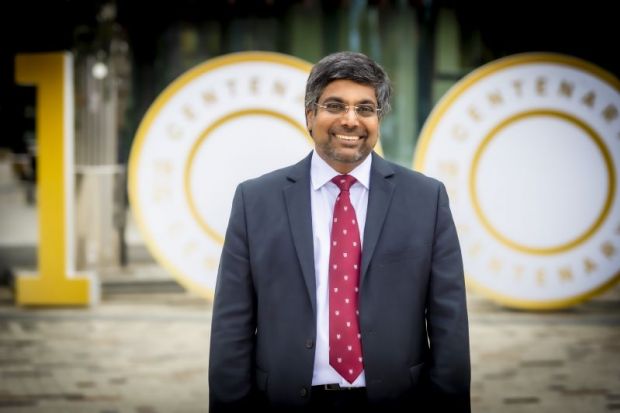
Nishan Canagarajah, vice-chancellor at the University of Leicester, told Times Higher Education that the staff may have to cope with lower wage increases in order to ensure colleagues can remain on the payroll.

The recently knighted engineer has taken over from the University of Aberdeen’s former principal George Boyne in overseeing the employer body.

He joins as the organisation prepares to begin annual pay talks in March at a time when institutions continue to shed thousands of jobs to reduce staff costs.

ADVERTISEMENT

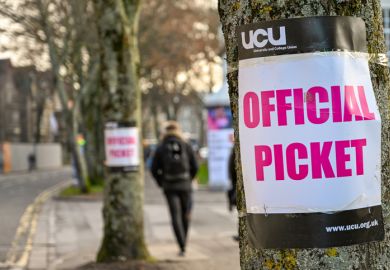
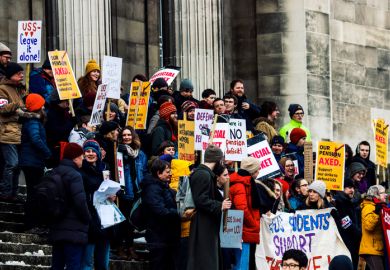
Trade unions rejected last year’s employer offer of a 1.4 per cent rise for most staff but the largest of those involved, the University and College Union (UCU), was prevented from taking industrial action after its ballot received only a 39 per cent turnout. 

Referencing this ballot, Canagarajah said: “On the one hand they were saying, ‘We want the pay to increase,’ on the other, ‘We want all the universities to agree there will be no job losses.’ You can’t have both, given the financial position.

ADVERTISEMENT

“If we increase the pay uplift, then clearly, there will be job losses to meet that pay rise. If you want to keep more jobs and staff on the payroll, that will mean less uplift. That’s the trade-off that we have to manage, unfortunately.”

UCU has now failed to reach minimum turnout requirements for a national ballot on industrial action twice since 2023, and Canagarajah questioned “whether it was wise” to pursue national action amid widespread local disputes. 

He said: “You need to ask the question by balloting, are they likely to come up with a different outcome? I don’t think so in the current financial climate. So I think there’s more damage to the sector overall by taking another ballot when we know the financial position is getting worse, not better.”

The sector’s unions have rejected every Ucea pay uplift since 2017-18, but Canagarajah said that the delays in implementing the 1.4 per cent rise at several universities showed the extent of some institutions’ troubles.

Instead, he believes universities and the unions need to work “collaboratively” to tackle political and cultural attacks facing universities.

ADVERTISEMENT

He said there is currently a “negative portrayal” of the sector “that is not helpful for the trade unions or the employers”, and added: “While no, we will not agree on everything with unions, I think trade unions should work collectively with the employers to get the message that the system needs more support.”

“I don’t want to use the word existential threat”, continued Canagarajah. “But I think it is important that the unions understand that there’s lots at stake for both of us if we don’t work together and address the fundamental issues that are affecting the sector and will affect the long-term prospects in the sector if we don’t get it right.”

Elsewhere, he said his priorities as Ucea chair also include improving the employee experience, saying that the sector needed to be “attractive” to staff. Specifically, he wanted to look at the gender pay gap, precarious contracts, workloads and pay spines.

ADVERTISEMENT

While the unions’ decision to hold a strike ballot meant that negotiations between the unions and Ucea on these non-pay items were suspended, he added that he “absolutely” hopes these conversations can resume.

Canagarajah’s knighthood was controversial in some quarters, given his institution has recently put more than 160 jobs at risk, with areas such as modern languages and film studies set to close. The vast majority (96.2 per cent) of the 1,022 staff members and students who participated in a recent vote said they had no confidence in the vice-chancellor. 

But despite the pressures, Canagarajah remained firm. “The reason for the dispute is the unions want us to rule out compulsory redundancies,” he said, “and I cannot rule that out.”

Ultimately, “there’s no way around” that universities need to be looking at efficiency and productivity.

ADVERTISEMENT

“Every other sector is looking at the same things and universities are not immune from that. These are difficult conversations, but it’ll be best done collectively with the trade unions…If we don’t, we will be in this position year-on-year where the pay award will not meet the expectations of the unions,” he said.

juliette.rowsell@timeshighereducation.com

Register to continue

Why register?

  • Registration is free and only takes a moment
  • Once registered, you can read 3 articles a month
  • Sign up for our newsletter
Please
or
to read this article.

Related articles

Reader's comments (13)

new
Easy for Sir Nish to say with his total remuneration of approximately £341,000 in 2024–25, with a base salary of £336,000!
new
When exactly over the last decade or so have staff had a proper pay rise? Pretty much all imposed pay uplifts have been real-terms pay cuts. UCEA expect trade unions to 'work collectively' through the JNCHES process - yet UCEA attack staff pay every year in that process and impose below inflation pay awards. There is seemingly no desire to even acknowledge pay erosion has occurred, let alone address the question over the medium to long term. I'm not quite sure how Sir Nish, with his 'inesteemable contribution' to higher education, expects to make the sector more attractive to work in without addressing this fundamental question, given wider wage increases in the economy.
new
The median base salary for vice-chancellors at the RG universities increased by 5%, rising from £334,500 in 2023–24 to £350,500 in 2024–25. The median total pay package for Russell Group VCs is £397,000. Analysis of 115 universities suggested that total remuneration packages for VCs typically increased by 5% last year. In addition some VCs were awarded non-monetary rewards, such as knighthoods, dame hoods, OBES, CBEs etc. Does Sir Nish see that some might think there is an element of hypocrisy here? Why don't VCs just say that they will take the same pay rise as all academic staff? After all 1.5% (if that is what it turns out to be) of £350k is £5250 pa which is around fives times in hard cash terms what the average academic would be getting at that rate??
new
What would an extra £5k pa mean to the average academic I wonder?
new
Note that this is from the Employers' Association, not an association of finance officers. Can THE put two simple questions to Sir Nishan please? 1. Does the need for pay restraint apply to VCs and senior management, and if not why not? 2. If the answer to (1) refers to market rates of pay, are academic salaries also part of the market?
new
Yes this is the most obvious and urgent question in most fair minded perople's minds I would submit. Why was it not asked where? It is the role of the journalist to ask difficult questions to those in power, in my view.
new
And it seems we are spending £570 million (rising to £840 million) on Erasmus Plus, an eye-watering sum that will mainly benefit the children of the European bourgeoisie. So tgere is certainly plenty of money to spend. Is it from all that "headroom" we were told about. Why can't this money be used to give colleafues a decent pay rise, £840 million pa goes a long way!!
new
There is plenty of money to retain academic staff and restore their pay to 2010 levels if universities aggressively cut the bloated middle management, administrative and wellbeing functions that have ballooned in recent years. Return to focus on core activities - rigorous teaching and academic research - which have been peripheralised in recent years in favour of student “experience”, impact, DEI, etc..
new
University leaders are completely detached from the problems universities face. The UK's universities are not attractive places to work or study. There is little academic community left in them. They don't value excellence in research properly and provide a miserable, corporate style experience for staff and students. Pay is poor, except for a few (often in business schools). There is very little research funding. How can they possibly attract the world's best minds? When are the Deans and VCs plus their coterie of support staff going to step out of their bubble and deal with this properly?
new
"Canagarajah’s knighthood was controversial in some quarters, given his institution has recently put more than 160 jobs at risk, with areas such as modern languages and film studies set to close." Well this is quite bold for THE, so well done. Of course one might guess the phrase "in some quarters" as "the entire UK higher eucation coimmunity and all fair minded people in the wider world".
new
Slash the bureaucracy bye bye EDI, bye bye Athena Swan bye bye Associate Deans, Bye Bye Deputy VCs, Bye Bye Pro VCs, Bye Bye work from home, Bye Bye consultants, Bye Bye OfS and Hello to decent pay rises for a change.
new
Well said!!!
new
Maybe Canagarajah might be better soliciting givernemnt to reform UK HE funding. In 2024-25, the total interest added to England’s student loans was £15bn, compared to just £5bn in repayments. It will ultimately fall on the taxpayer to make up for graduate debt that will never be repaid, placing a greater burden on those in work. Student loans are also failing at their basic purpose: funding education. Figures from the Organisation for Economic Co-operation and Development (OECD) show that the UK charges the highest tuition fees for national students at public institutions of any rich nation (so much for the claim that student fees are not sufficient). The problem for Universities, students, and the tax payer is that some very bad decisions were made in implementing what at the time seemd to be a "cunning plan" but which was not thought through and was inherently irrational. Many pointed tis out at the time. But as we have let this system embed itself and metastasize it's actually very difficult (and massibvely expensive) to get out of it.

Sponsored

Featured jobs

See all jobs
ADVERTISEMENT