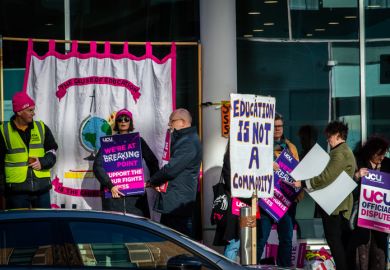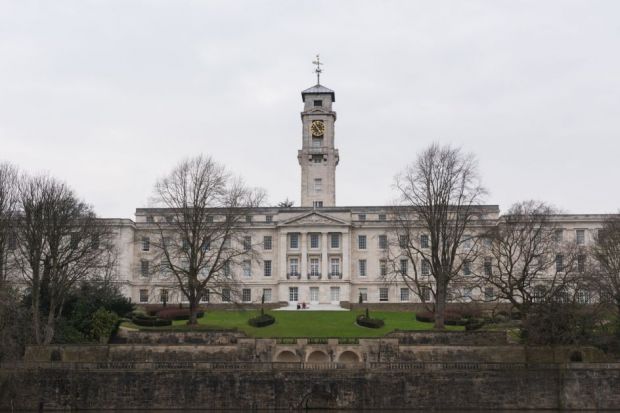
Staff at the University of Nottingham fear that planned course closures and changes to staff-student ratios could damage the university’s international standing and create “impossible” workloads.
The institution currently has between 15 and 16 students for every staff member but wants to increase this to between 18 and 22 students, according to a “case for change” document recently shared with employees.
This also outlines plans to “consolidate” the university from five faculties to three colleges by 2029.
It comes after Nottingham announced in November plans to suspend recruitment on to 42 courses which would see its music and languages departments shut down, as well as programmes in nursing, education, microbiology and agriculture affected.
The university’s vice-chancellor Jane Norman told Times Higher Education that she recognised it was a “difficult time for our university community” and “we are listening to concerns and questions raised by staff, students and trade unions”.
“However, the government has been very clear that it expects universities to manage their own finances and focus on areas of strength, and we need to take action now to ensure the University of Nottingham remains a world-leading institution long into the future,” said Norman.
The institution’s University and College Union (UCU) branch believes the plans could eventually result in up to 600 job loses – on top of 300 staff members who have already left Nottingham in recent years – and said the results would be “catastrophic”.
The university’s transformation programme does not outline any staff cuts but does say it will address the “financial sustainability” of “academic staff allocation” through the staff-student ratio changes. In November it committed to making no compulsory redundancies before 31 October 2026.
Nick Clare, secretary of the UCU branch, said “morale has never been lower” in his 10 years at the university.
“Things were difficult through Covid but there was a sense of pulling together through it. This is very different. People are looking for work elsewhere. It’s not a happy place at the moment.”
Clare said he feared the changes could create a “death spiral” of higher workloads, falling student satisfaction, fewer student applications and weakened league table results.
Union members have so far taken 25 days of strike action this academic year alone, and a new trade dispute it announced last week could pave the way for further strike action in the new year.
Philip Moriarty, professor of physics at Nottingham, said changes to staff-student ratios “make no sense at all”, and noted physics currently has a ratio of around 11:1. If this increased to 18 students per staff member, he said as many as 20 academics could be cut from the department of 55, if the plans were to go ahead.
“I don’t think I’m being dramatic when I say this could mean the end of the university,” he said, adding the remaining workloads would be “impossible to manage”.
“How does driving our staff-student ratio in entirely the wrong direction help students? It doesn’t, and it’s purely about cost cutting, and it’s purely about numbers on a spreadsheet,” he said.
The transformation plan also includes targets to achieve a surplus of between 3.7 and 9 per cent, with the latter figure considered high by sector financial experts. Moriarty said the target had “blindsided” staff, and said it is “out of line with every other university in the UK”.
Lopa Leach, the branch president, said staff have been left devastated ahead of the Christmas period, with staff also recently finding out that promotions have been paused.
She added that the proposals are “fiscally driven” and said heightened workloads put academics’ research capacities at risk.
Norman said the university was “in a period of engagement with our whole community which will assess the impacts of current proposals and provide the space to explore other options”.
“We continue to have regular dialogue with our trade union colleagues as part of our joint recognition agreement and would encourage them to submit their formal counterproposals as part of our engagement process. We are providing support for staff, students and stakeholders on the development of viable counterproposals, which will inform our final business case.”
Register to continue
Why register?
- Registration is free and only takes a moment
- Once registered, you can read 3 articles a month
- Sign up for our newsletter
Subscribe
Or subscribe for unlimited access to:
- Unlimited access to news, views, insights & reviews
- Digital editions
- Digital access to THE’s university and college rankings analysis
Already registered or a current subscriber?