“Some history professors try to stop their students using artificial intelligence for their projects – I require my students to use two or three different AI models, and show how they’ve used AI every step of the way.”
For Walter Isaacson, one of America’s most celebrated historians and biographers known for his acclaimed profiles of Apple co-founder Steve Jobs and Tesla tycoon Elon Musk, attempting to block the use of the now-ubiquitous technology is not just futile but a wasted opportunity to educate students.
“All technology tools are a wonderful arrow in the quiver of the historian – and the professor teaching history,” explained Isaacson, who has moved effortlessly from a stellar journalistic career (editor of Time magazine, chairman and CEO of CNN) into writing award-winning biographies and history books, and is now professor of history at Tulane University in his home town of New Orleans.
Many historians and educators would disagree, despairing at the bland and formulaic chatbot-written or influenced prose that is frequently submitted by students. For many sceptical of AI’s merits, digging into archives, teasing out pivotal details from hours of interviews or exploring inconsistencies in records should be the key skills taught to would-be historians.
Having spent two years with both Jobs and Musk for his books, Isaacson is feted for both his unrivalled access to subjects and the thoroughness of his research. Yet he believes students can benefit from the possibilities presented by generative AI.
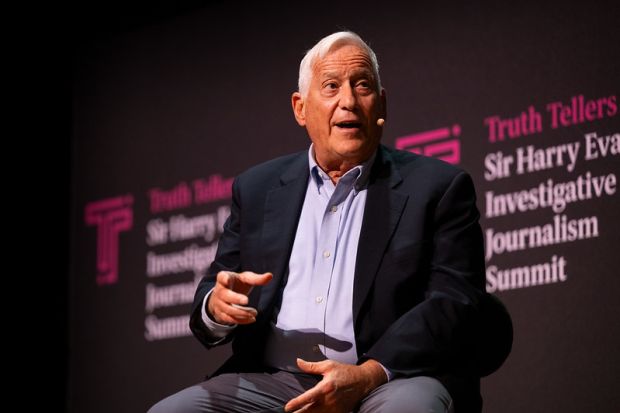
“It’s all about using AI honestly, to help you think creatively,” he said, speaking to Times Higher Education at the recent Truth Tellers: Sir Harry Evans Investigative Journalism Summit, organised in partnership with Durham University, the alma mater of the former Sunday Times editor who gave Isaacson his first reporting job in the late 1960s.
To that effect, Isaacson is adamant the writing process cannot be outsourced, even if AI can provide useful research or analytical tools, or creative starting points. “I make sure they [students] start with a blank screen but it’s fine if they use all sorts of tools to gather information. The final product must be entirely written by them,” he said.
For Isaacson, who joined the Sunday Times after attending Harvard University and Pembroke College Oxford as a Rhodes scholar, the reluctance to embrace AI is reminiscent of the “Luddite” attitudes among some colleagues he witnessed first hand as a junior reporter in London.
“When I worked for Harry Evans on Gray’s Inn Road, there wasn’t much technology but we gradually began to use computers. If you were a Luddite you didn’t get very far, but those who embraced those changes advanced.”
After several years chasing stories across the UK, Isaacson moved back to New Orleans and later joined Time magazine as its political editor, eventually becoming editor in 1996. As a sideline he began writing historical biographies, with titles on Benjamin Franklin, Albert Einstein and Leonardo Da Vinci. That has led contemporary figures to offer incredible access for Isaacson’s profiles.
Four days after Steve Jobs was told he had pancreatic cancer, he called up Isaacson’s office, having read his Franklin biography. “Now do me,” was the straightforward request from Jobs, recounted Isaacson.
That led to two years of interviews with the Apple co-founder before his death in 2013, with the award-winning book adapted by Aaron Sorkin for a 2015 film starring Michael Fassbender.
Isaacson explained he was keen to profile Jobs because, like most of his subjects, he was a pioneering figure operating “at the intersection of technology and the humanities”.
However, the pendulum may have swung too far in the direction of technology, admitted Isaacson, with technology companies currently failing to adequately compensate creative industries or the media that often serve as the inputs for large language models.
“The business model for journalism is messed up at the moment – it is too algorithmically driven and that doesn’t lead to great journalism,” he said.
“I’ve warned several times that AI systems can’t just steal great reporting done by journalists so that people can read it via AI,” Isaacson added on the imminent threat to his former trade, urging tech companies such as OpenAI and Anthropic to strike fair deals with news outlets whose outputs they use.
The tendency of social media, driven by AI, to polarise communities and political groups should also be scrutinised, continued Isaacson, who had hoped the forthcoming celebrations for the 250th anniversary of the Declaration of Independence, signed on 4 July 1776, would help America reflect more on what unites its diverse population.
“We have drifted away from the basic principles [that united America],” he said. “It used to be that 80 per cent of Americans could agree on certain things but social media has increasingly divided us. It is sad to see as I wanted this anniversary to remind us all about what unites us,” he said.
Register to continue
Why register?
- Registration is free and only takes a moment
- Once registered, you can read 3 articles a month
- Sign up for our newsletter
Subscribe
Or subscribe for unlimited access to:
- Unlimited access to news, views, insights & reviews
- Digital editions
- Digital access to THE’s university and college rankings analysis
Already registered or a current subscriber?