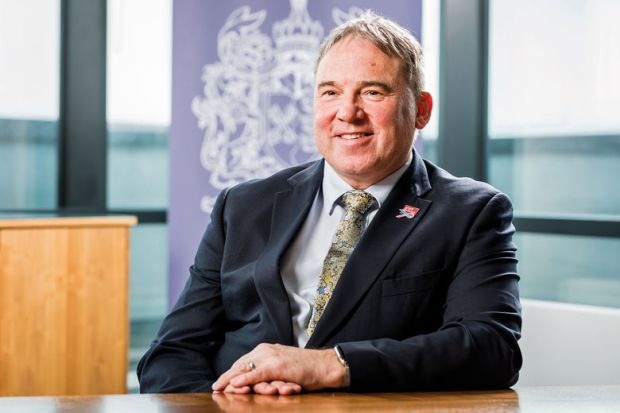
A vice-chancellor has insisted he would rather “face court” than fail to help a student amid concerns that data protection rules are stymying universities’ ability to intervene in crisis situations.
Describing his university’s approach to suicide prevention, Steve West, vice-chancellor of University of the West of England, said it asks students to provide “trusted contacts” who staff will get in contact with should they have concerns about a person’s well-being.
Speaking at Times Higher Education’s Student Success UK&IE event at the University of Bath, West said the university has begun triggering this option far earlier than it would have done previously amid widespread concerns about the rise in student suicides in recent years.
According to the Office for National Statistics, 1,108 students took their own lives between the academic years ending 2017 and 2023, equivalent to a rate of 6.9 deaths per 100,000 students.
“Often that’s the key to unlocking and helping an individual,” West said of the intervention, adding that taking this step still had to be “proportional”. Since the start of the academic year, West said the institution had already reached out to 50 to 60 trusted contacts.
“If you’d asked me that question ten years ago, it would have been a very low number,” he said. “Prevention is better than waiting for something to deteriorate to the point where you’re making a different phone call.”
Addressing concerns that such an approach may break data protection or privacy laws – especially if the student in question is unaware their contact has been called – West said he was clear “we will act if we believe there is a risk to that individual’s life or another life”.
The v-c, who chairs a government-backed taskforce focused on student mental health, added: “And if we’re not getting consent from that student, I don’t care. I want to be in court for the fact that somebody might have thought I’ve broken GDPR rather than I didn’t act… This is about doing the right thing at the right time for the right reasons for the right people.”
West said calling someone to say their loved one had died by suicide was one of the “hardest things I’ve has to do” as a vice-chancellor.
But he was clear that he did not think that universities should face a statutory duty of care requirement when it comes to protecting students.
Parents of students who died by suicide have campaigned for this to be enshrined in law, complaining current rules are inadequate at protecting students.
West, a former NHS podiatrist, said it was important to recognise higher education providers “are not” and “should not be deliverers of clinical services”.
“That’s the job of the NHS,” he said, though West added that universities must accept “substantial” but “bounded” responsibility for student well-being.
Despite West saying he doesn’t personally believe a statutory duty of care is the way forward, the taskforce chair said his panel was constructing guideline standards related to student well-being.
Before the end of this academic year, West promised, the taskforce will produce “minimum expectations” for what universities and colleges ought to do to look after their students, working with the Office for Students (OfS).
Appearing alongside West, Izzy Watkins, programme manager at Student Minds, said her charity’s position was that: “Universities cannot and should not be expected to meet every student’s needs themselves, but there is a responsibility to create environments that support well-being.”
Register to continue
Why register?
- Registration is free and only takes a moment
- Once registered, you can read 3 articles a month
- Sign up for our newsletter
Subscribe
Or subscribe for unlimited access to:
- Unlimited access to news, views, insights & reviews
- Digital editions
- Digital access to THE’s university and college rankings analysis
Already registered or a current subscriber?