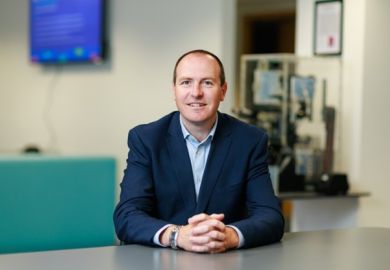
Swifter approval of grant applications will be vital for ensuring European research projects in cutting-edge technologies can keep pace with American and Chinese rivals, a director of Germany’s innovation agency has argued ahead of its largest-ever funding round.
Established in 2019 to back “high-risk, high-reward” research projects and based on America’s famed Advanced Research Projects Agency (Arpa), the Federal Agency for Disruptive Innovation (Sprind) has sought to operate differently to traditional research funding agencies in Europe, including speeding up its peer review, its head of challenges, Jano Costard, told Times Higher Education.
While the typical timeline from grant application to receiving money in Germany is six months, the agency aims to review bids within 14 days, explained Costard.
“As technological progress accelerates, funding timeframes also need to be shorter,” he said. “If our teams are really slow in giving out funding, researchers are going to look elsewhere, such as US venture capital funds who don’t wait months to award money,” said Costard on what he called the “funding bottleneck” that has hampered the approval of potentially transformative projects in fast-moving research fields.
Commenting onon whether other funders could learn from Sprind’s example, Costard said: “Our timelines are much shorter than anything seen in Germany or Europe. We’ve shown the slower pace is not the only option.”
That rapid approval of funding does not guarantee that grantees will be given carte blanche if key success markers are not met, said Costard, adding that Sprind might manage a portfolio of research projects in a given area and select only the best for longer-term funding.
“If you want to create a breakthrough technology, you can’t be the fourth best in your field so we will assess what the other three are perhaps doing better and continue those projects,” he said, recalling how a promising project to improve the interception of drones last year was cut short, with stronger initiatives taken forward.
“The team felt they could demonstrate the technology [but] It wasn’t working so we stopped the funding and moved to consider different goals – this all took about three months, from starting the project to ending it,” said Costard.
Sprind’s ability to reassess the strengths of research projects as they progress is a good example of how its dynamic funding structure is better suited to supporting innovation excellence than traditional funders, said Costard, an economist who was previously a government adviser on innovation before joining Sprind in 2021.
“We have to accept the uncertainty that you have at the early stage but it’s also important to change things as other factors can change fast. That approach is maybe more suited to the product innovation cycle rather than having a three-year timeline for a research project and sticking to that [whatever happens],” he explained.
“Research is a much more iterative process these days, where you have to change course more than you once did,” said Costard, who oversees research projects worth about €250 million (£216 million). Sprind’s overall core annual budget is about €300 million.
Sprind has just launched its largest-ever challenge, with €125 million set aside to identify the next big AI technology, with grant selection due to take place at the end of June. It is also working on establishing jointly funded Anglo-French projects and advising the Netherlands on its plans to create a Dutch Arpa. The Sprind model has recently been praised in the Draghi Report on stimulating more disruptive innovation in Europe, with the European Commission mulling how a cross-continent Arpa might work.
Created four years before the UK’s own innovation agency, the Advanced Research and Invention Agency, was launched in 2023, Sprind was designed to fill a gap in Germany’s otherwise “incredibly rich research ecosystem,” explained Costard.
“We have a strong industrial base with large companies and our mittelstand [small and medium sized enterprises], some world-class research institutes and excellent universities but the innovation had usually been incremental. Success has been about improving existing technologies – like the combustion engine – rather than taking crazy new technology and building new industries,” said Costard.
With Sprind’s new approach to funding risky research both in universities but also in start-ups and larger companies, the agency has been praised for bringing a new mindset to German innovation research, although there is now pressure to deliver tangible benefits for taxpayers in light of the considerable investment, said Costard.
“That pressure has been there from the start but it’s even more obvious, even though the kind of innovation we’re after – the next internet is always cited – usually takes years,” he said.
That said, there will soon be some very visible products of Sprind’s research – Europe’s largest wind turbines at 300m high, some 50m higher than the largest current windmills.
At that height the windmills’ structure must be redesigned so that they more closely resemble electricity pylons and, taller than the world’s highest cranes, present considerable construction problems, said Costard.
However, the out-of-the-box approach to improving wind energy shows how Sprind can take different approaches, said Costard. “At that height, the wind is more stable and electricity production more stable. Most importantly, they act as a ‘second tier’ of production in existing turbine fields where they already have the permits,” he explained.
“It’s a good example of a breakthrough technology. But I like to think our breakthroughs are also how we do research and public administration in a different way,” said Costard.
Register to continue
Why register?
- Registration is free and only takes a moment
- Once registered, you can read 3 articles a month
- Sign up for our newsletter
Subscribe
Or subscribe for unlimited access to:
- Unlimited access to news, views, insights & reviews
- Digital editions
- Digital access to THE’s university and college rankings analysis
Already registered or a current subscriber?