Terminology relating to equality, diversity and inclusion (EDI) is twice as prevalent in research projects approved by UK Research and Innovation (UKRI) than it was four years ago, says a new study that argues the “explicit EDI focus” of the next Research Excellence Framework (REF) has driven a “politicisation of academic research”.
Analysing the abstracts of around 150,000 grants approved by UKRI since the early 2000s, the study by Eric Kaufmann, from the University of Buckingham’s Centre for Heterodox Social Science, found the terms “equity”, “diversity” and “inclusion” rose four-fold in frequency from the mid-2000s to 2020 before doubling again in the four years up to 2024.
A more dramatic uptick in what Kaufmann labels “progressive discourse” terms such as “racism”, “xenophobia”, “misogyny”, “transphobia” and “bigotry” is also noticeable, the study contends. “Social justice and anti-prejudice terminology” was seven times more prevalent by 2020 than in the mid-2010s and as much as 35 times more prevalent than in the early 2000s, it says.
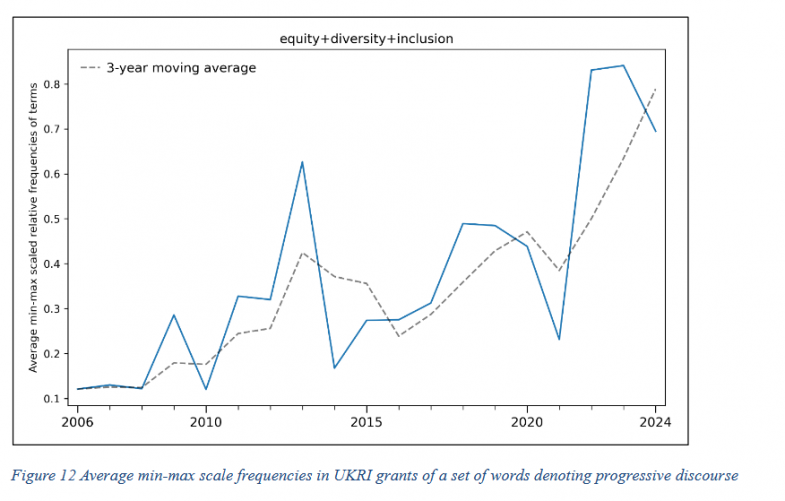
According to the study, the rise is likely to have been partly drive by the “explicit EDI focus” of the REF, whose 2029 exercise was expected to increase the weighting of its people, culture and environment (PCE) section to 25 per cent, up from 15 per cent, which would have given it the same score as impact. However, science minister Patrick Vallance announced a three-month pause for the REF in September amid speculation the PCE section could be downgraded in importance or scrapped altogether.
While some of the shift towards EDI-influenced research may be explained by the “increasingly politicised research agendas of academics”, the rise of “scholar activism” may have been encouraged by UKRI thanks to REF policies that had seen universities “compelled to submit to a growing EDI compliance culture”, explains the study.
“It’s about people who review papers and grant applications but also those who establish funding programmes with increasingly political remits, and EDI criteria embedded in grant applications,” said Kaufmann.
His study comes after frequent criticisms that projects funded by UKRI are too focused on diversity issues, such as a recent analysis in The Times that drew attention to funded PhDs on lesbians living on canal boats and decolonising Nottingham Castle – projects denounced as “absurd” by shadow education secretary Laura Trott.
“We hear stories about individual research projects but this study gives you a macro-trend on what is happening to UK research funding,” Kaufmann said. “While I accept ‘excellence’ is, to some extent, in the eye of the beholder, it’s important to argue that studies conducted using classic research methods are likely to be more robust and provide greater impact than those explicitly grounded in social justice paradigms.”
Continuing to support “explicitly activist” research or studies had huge political risks for UKRI given most of the public does not often share such political priorities, warned Kaufmann.
“UKRI are providing a lot of ammunition for those who argue, as Reform does, that the cultural left is shaping what research councils do,” said Kaufmann, who urged the government to “take a hard look at how precious funds are being spent”.
“UKRI has just been awarded a £39 billion budget over four years – it would be wrong to interpret this settlement as ‘everything is fine’,” he continued, noting concerns over “woke research” led Donald Trump to begin a sweeping purge of equity-related studies shortly after starting his second term of office.
“Reform is very aware of these concerns, as are other parties, and it is not inconceivable that Nigel Farage could get into power,” he said on the risks of a similar move happening in the UK.
A UKRI spokesperson said the organisation was “committed to promoting fairness and inclusivity as an employer and through our investments, and to meeting our statutory responsibilities as a public body”.
“Research is a collective endeavour which benefits from a diverse range of skills, experience and perspectives,” they continued, adding: “All UKRI investments are focused on advancing knowledge, improving lives and driving growth by supporting excellence in research and innovation.”
Register to continue
Why register?
- Registration is free and only takes a moment
- Once registered, you can read 3 articles a month
- Sign up for our newsletter
Subscribe
Or subscribe for unlimited access to:
- Unlimited access to news, views, insights & reviews
- Digital editions
- Digital access to THE’s university and college rankings analysis
Already registered or a current subscriber?