When Australia gains direct access to the world’s biggest research funding scheme next year, the country's academics are hoping that their collaborative horizons will be significantly widened. But arrangements set in train a quarter of a century ago have already put Monash University ahead of the game.
The Melbourne-based institution says it has already amassed around A$4 million (£2.1 million) in Horizon Europe grants this year, thanks to a small outpost established early this millennium in a remodelled family palace near Florence.
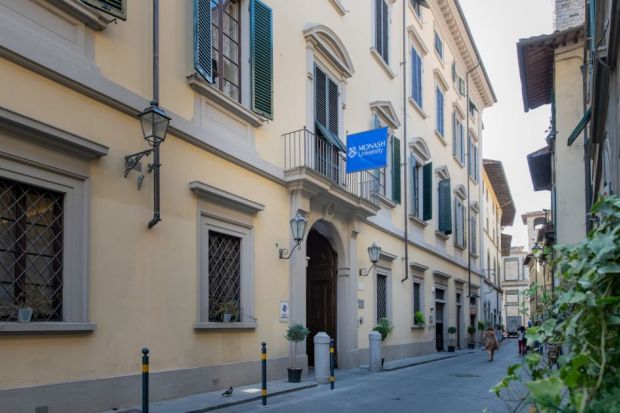
Monash University’s Prato campus was formally launched exactly 25 years ago, on 17 September, 2001, in Palazzo Vaj, a striking yellow building in the compact Tuscan city’s historic centre. Part of Prato’s 12th-century city wall is embedded in the building’s interior, and mosaic replicas of the villa’s 15th-century frescoes adorn the restored Renaissance garden.
The terrace offers views of several mediaeval towers, giving students a taste of the history that’s “dripping from the buildings”, according to Cecilia Hewlett, Monash’s pro vice-chancellor for Europe.
A historian herself, Hewlett is as beguiled by Prato’s heritage as the wide-eyed undergraduates who come to “dip their toes in the water” of overseas study.
But Hewlett is even more energised by the prospects for 21st-century research, as Australia’s formal ascension to Horizon Europe in 2027 gives its academics direct access to Pillar II, which addresses societal challenges related to climate, energy, health, food, space and the digital world.
Monash already has that luxury, thanks to the Monash University European Research Foundation established at the Prato campus in 2022. As a not-for-profit body recognised under Italian law, it also entitles Monash to direct funding under Pillar I of Horizon Europe, which supports fundamental research.
The foundation was part of an international consortium of 11 institutions and agencies that secured €5 million (£4.3 million) of Pillar II funding in July, for “CultureAI” – an exploration of how artificial intelligence is reshaping creative life. The foundation is also on the verge of obtaining Pillar I funding through the Marie Skłodowska-Curie Actions fellowship programme.
Monash’s Horizon Europe activities have taken two or three years “to really ramp up”, Hewlett said. “This is the first year that it’s really starting to pay off.”
The university’s efforts to embed itself in European research ecosystems stretch back further. The Prato campus has helped foster collaborations at the institutional level – through networks such as Eutopia, an alliance of 10 European universities and six on other continents – and the individual level, through regular disciplinary conferences at Prato.
“It’s sort of a convening space,” Hewlett said. “Organising symposiums is a big ask for researchers and a big drain on their time. We’ve got staff to help them. It’s a well-oiled machine…and an example of how different parts of the university have used Prato over the years.”
Some current use cases were probably not envisaged when a group of design, fine arts, language and law academics pushed for Monash to have a “foothold” in Europe, after earlier efforts involving multiple universities had fallen flat.
Monash’s Malaysia campus had opened a couple of years earlier, and advocates were keen to expand the scope for students to have international experiences – a practice now entrenched through the institution’s Global Immersion Guarantee programme.
Philanthropic assistance from Rino Grollo, the construction mogul son of an immigrant from Treviso, and Rino’s wife Diana helped get the concept over the line. Other notable Australians of Italian descent who were heavily involved in the campus include the late fashion designer Carla Zampatti and Victorian governor James Gobbo.
Monash’s presence also had support from the regional government of Tuscany and the municipal government of Prato, which wanted to distinguish itself from its famous neighbour. Just 20 minutes apart by train, Florence and Prato are different worlds: the former a tourist mecca; the latter a fiercely working-class and multicultural hub of Italy’s textile trade. Its population of 200,000 or so includes one of Europe’s largest Chinese communities – mostly the children and grandchildren of immigrants from Zhejiang, lured there to work in textile manufacturing.
Although Prato boasts a history as rich as any Italian city – it dates from the pre-Roman Etruscans, and Donatello and Filippo Lippi are among the Renaissance artists who left their mark – it is distinctly mercantile in character. Its famous sons include Francesco Datini, a 14th-century banker who pioneered the use of bills of exchange, the forerunner to the cheque.
Monash requires visiting Australian students to stay in Prato rather than commute from Florence, partly for safety reasons and partly to encourage local engagement. Students initially resent the constraint but soon appreciate being “out of the madness” of the tourist magnet. They enjoy having “the same people serving them every day” in cafés, Hewlett said. “They get spoken back to in Italian rather than English. They’ve made the city their own.”
The campus can accommodate about 300 staff and students, she said. Some 700 students visit each year, for between three weeks and a semester. Each receives a travel grant from Monash, and additional loans and scholarships are available. The university offers voluntary Italian conversation classes before departure, along with a co-curricular programme on “cultural norms” such as Italians’ distaste for cappuccinos after 11am.
Subjects taught at the centre range from architecture, art and design to international law, Italian language and pharmacy. Workplace experience opportunities include heritage sites, a magazine, an international law firm, local schools and a children’s summer camp. Research is conducted in fields including history, migration studies, transport and sustainable energy use. There is an artist in residence and opportunities for musical and theatrical exchange.
The hosts benefit, too, Hewlett insists, with Monash visitors injecting an estimated €4 million into the local economy each year. The campus has helped Prato diversify from textile manufacturing as it “leans into” a university city identity – a “work in progress”, Hewlett said. The universities of Florence and New Haven also have campuses there.
Monash’s presence has also helped foster outward mobility in Italy, she said. The University of Padua, one of Monash’s key partners, obtained Erasmus Plus funding to send staff and students to Australia. Students from Padua, Florence and Rome sample Australian-style education by attending classes at the Prato campus, which also helps ensure that the Australian students are not learning “in a bubble”.
Monash’s hosts also looked to their Australian tenants for sociological lessons, such as how to manage migration and social inclusion. At the time of the centre’s establishment, Australia commanded an “almost utopian perception” as a “functioning multicultural society”, Hewlett said – a perception that may have eroded in the years since.
Australia also enjoyed a perception as a bridge to Asia. “We want more contact with Australia and, through Australia, with South-east Asia,” local councillor Adrea Lulli told The Age newspaper in 2000. “[That] is one reason we’ve encouraged Monash to come here.”
The bridge functioned in a way the outpost’s architects could never have imagined, after the campus started organising local practicums for trainee teachers from Australia – including international students and Australians of Chinese heritage. Prato schoolteachers, who had long struggled to interact with pupils from the city’s Chinatown, suddenly benefited from a source of Mandarin-speaking cultural mediators.
“Italian teachers in Prato were finding themselves in front of classrooms that were predominantly not native Italian speakers,” Hewlett explained. “Schoolteachers in Italy are subject matter experts. They don’t necessarily have the sort of pedagogical training that our teachers receive.”
Global initiatives should be “weighted to the benefit of both parties”, she said. “Just as we’re benefiting from being there, we need to make sure that we are contributing positively to the community.”
Register to continue
Why register?
- Registration is free and only takes a moment
- Once registered, you can read 3 articles a month
- Sign up for our newsletter
Subscribe
Or subscribe for unlimited access to:
- Unlimited access to news, views, insights & reviews
- Digital editions
- Digital access to THE’s university and college rankings analysis
Already registered or a current subscriber?