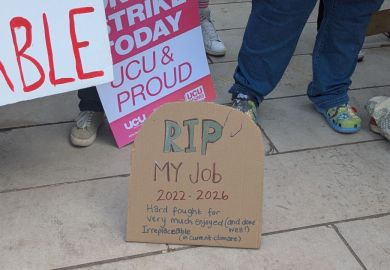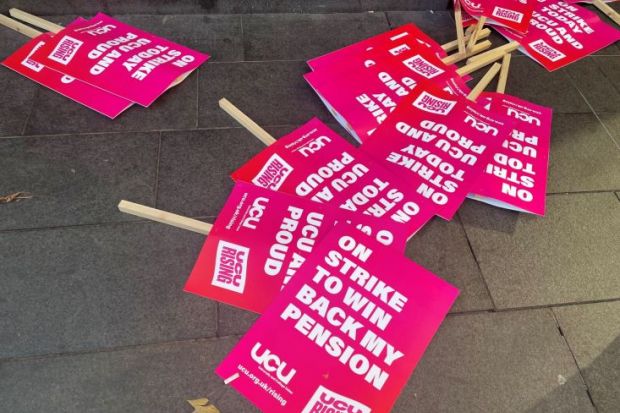
Union members at the University of Lincoln have declared “no confidence” in their senior leadership team while further strikes have been threatened at Northumbria University as concerns mount over job cuts in the English sector.
Northumbria has become embroiled in a fresh dispute after facing a fierce battle with staff over its plans to encourage them to switch pensions from the more expensive Teachers’ Pension Scheme to the Universities Superannuation Scheme. Around half of eligible employees agreed to the move before a deadline set by the university last month.
The University and College Union (UCU), which went on strike for 20 days over the pensions changes and is considering another ballot over this issue, has threatened to strike against plans to save £5 million that the union said would result in the loss of about one in 10 jobs across the affected areas “before Christmas”.
“Staff at Northumbria University have already been subjected to attacks on their pensions and working conditions,” said Jo Grady, the union’s general secretary.
“The current plans to save money by sacking staff will be devastating for students’ learning, with fewer staff, doing more work, for less pay.”
Departments where job losses will be concentrated were geography and natural sciences; engineering, physics and maths; humanities; and theatre and performance, UCU said, adding that the university management had “refused to rule out compulsory redundancies”.
The union said that jobs would also go in the School of Design, Arts and Creative Industries including at the university’s Newcastle Campus and its London-based “Interaction Research Studio”. The university said that this school was not affected by the latest plans and a consultation on the future of the studio was a separate programme of work which began earlier this year.
A Northumbria spokesperson said, as part of “regular planning”, it was reviewing “how we organise ourselves most effectively to ensure that we are structured in a way that reflects student demand and sector benchmarks”.
Preliminary discussions had been held in the affected schools, they added, but “no-one in these schools is currently at risk of compulsory redundancy”.
“Historically, the university has successfully achieved staff reductions by addressing issues early, voluntary approaches and managing vacancies tightly. We welcome feedback from colleagues, will explore alternatives and continue to discuss voluntary solutions,” the spokesperson said.
”Our priority remains delivering excellent education and research while ensuring the university’s long-term sustainability.”
The union said its members had passed a vote of no confidence in both the senior executives and the board of governors at Northumbria.
A similar vote has been passed at Lincoln, where staff are also objecting to job losses.
The university has announced two redundancy schemes in recent years, with 303 employees leaving in 2025 and 240 in 2024, according to its latest accounts.
It is understood the university’s headcount at the beginning of April was 12 per cent lower than the equivalent point last year.
UCU said 97 per cent of its members that voted said they had lost confidence in the university’s management, “driven by poor leadership, insufficient transparency in decision‑making, and policies that have adversely impacted staff wellbeing, job security, and the quality of teaching and research”.
It said it “hopes the result will be a wakeup call for the employer”.
A university spokesperson said that its focus “remains on ensuring the university is sustainable, agile and well placed for the years ahead, continuing to deliver high-quality teaching, strong student outcomes, and playing a vital role in supporting the economy and communities of Lincolnshire and beyond”.
“That work is already taking practical shape through new and expanded provision in areas of clear regional and national need, including recent government-backed investment to grow engineering, defence and advanced manufacturing skills, and the development of the Lincolnshire Institute of Dental and Oral Health as part of our wider Strong Roots ambition to help address dental workforce shortages and rural health inequalities.”
Register to continue
Why register?
- Registration is free and only takes a moment
- Once registered, you can read 3 articles a month
- Sign up for our newsletter
Subscribe
Or subscribe for unlimited access to:
- Unlimited access to news, views, insights & reviews
- Digital editions
- Digital access to THE’s university and college rankings analysis
Already registered or a current subscriber?