Belgium’s French-speaking universities have criticised a controversial tuition fee increase approved by parliament, warning that students are being asked to pay more for a chronically underfunded system.
The rise that will take fees over €1,000 annually will “in no way benefit universities”, according to Anne-Sophie Nyssen, chair of the Rectors’ Council of the French-speaking universities of Belgium (CRef).
“Its sole purpose is to help reduce the deficit in the accounts of the Wallonia-Brussels Federation by shifting a greater share of the cost of studies on to students and their families,” she said, referring to Belgium’s French Community government.
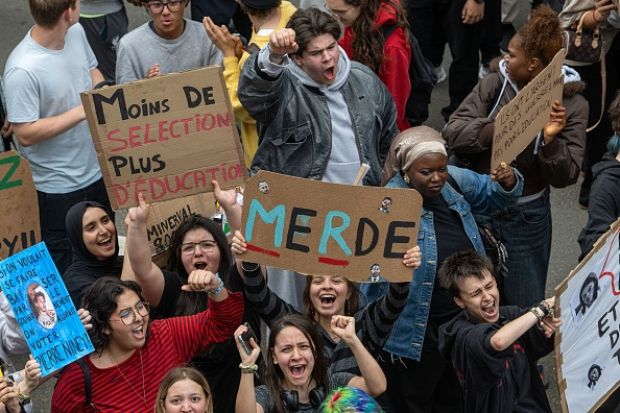
Her comments came after parliament approved a controversial education package on 5 June, following protests in Brussels that resulted in violent clashes between police and demonstrators.
As well as increasing tuition fees from €835 (£720) to €1,194 at the six French-speaking universities, the package also includes wider changes affecting secondary and primary education. While the demonstrations mostly focused on the latter, students’ unions also mobilised against the tuition fee hike.
The reform is backed by the governing coalition of the liberal MR and centrist Les Engagés. It is part of a broader austerity drive aimed at reducing the French Community’s chronic budget deficit. The government has said the tuition increase was designed to bring fees in line with Dutch-speaking, Flemish institutions.
While CRef was formally consulted on the reforms, it said many of its suggestions were not added into the final text.
Nyssen said the council had been warning about underfunding since 2006, a situation she said had led to a “deterioration in student supervision conditions”.
“The continued decline in funding per student is therefore also affecting success rates, particularly among students at the beginning of their academic pathway and among more disadvantaged students,” she said.
Academics say while the tuition hike has attracted significant attention, it obscures a more serious challenge facing the sector – declining public investment in higher education.
“The rise in tuition fees in francophone higher education is still relatively modest,” said Dirk Jacobs, a sociology professor at the Université Libre de Bruxelles.
Jacobs said about 42 per cent of students would either pay no fees or reduced rates under the tiered system that included scholarships and low-income provisions.
“The state still covers the bulk of tuition costs and there is a correction for the socio-economically disfavoured groups. This is not a radical change of policy,” he said.
But he added that university budgets had not kept pace with rising student numbers, which had increased by 40 per cent over the past two decades. “This has led to a diminishing of spending by the state of 15 per cent per student over the last 20 years,” he said.
Vincent Vandenberghe, an economics professor at Université Catholique de Louvain, said funding levels were higher in Flanders, with greater spending per student and on research.
“Structurally the systems are alike, but financially there are differences,” he said. “Flanders decided to raise tuition fees four years ago. On the French-speaking side it was impossible to do that because there was a centre-left government, and now there’s a centre-right government and also a budget crisis.”
He said the increase would restore the real value of fees that had been frozen for more than a decade.
“Since 2011, the government in the French-speaking region has stopped indexing tuition fees to the cost of living. So in real terms, tuition fees have gone down and now the government has put them back to the 2011 level,” he said. “For an economist, it’s not a big deal. But symbolically and politically, it is.”
Vandenberghe said the fee increase had drawn disproportionate attention, arguing that “the main reason why students should be upset is because of the continuous decrease of the average sum of public money that is spent on their education”.
“The real problem is the systematic defunding of the institutions they attend,” he said, adding that the measure coincides with reductions in public subsidies for universities.
“Today the government is raising the fees by a bit, but over the past 40 years it has reduced the public subsidies per student at universities,” he said.
Register to continue
Why register?
- Registration is free and only takes a moment
- Once registered, you can read 3 articles a month
- Sign up for our newsletter
Subscribe
Or subscribe for unlimited access to:
- Unlimited access to news, views, insights & reviews
- Digital editions
- Digital access to THE’s university and college rankings analysis
Already registered or a current subscriber?