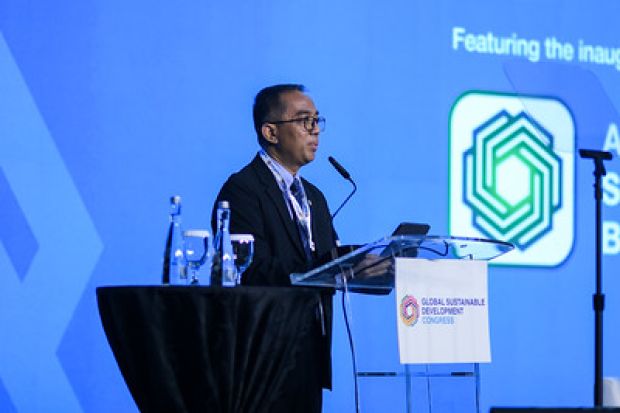
Indonesia’s higher education minister has chastised the country’s senior academics for allowing complacency to stifle the scientific culture needed to drive the archipelago’s “social and economic transformation”.
Brian Yuliarto, a former nanotechnology professor who became minister for higher education, science and technology in early 2025, criticised his erstwhile colleagues for losing interest in research once they had secured tenure.
“After getting the professor’s positions, they…forget to do research because they already have a position,” Yuliarto told Times Higher Education’s Global Sustainable Development Congress in Jakarta. “They are in the comfort zone [where] they do not research any more.
“Here in Indonesia…[when people have] the position of professor, we cannot take down the position.”
He also criticised universities for attempting to game the rankings. “Several campuses…have [a] strategy to influence other people to cite their papers [so that] they can improve the numbers of citations. This is not the way we can improve our quality. The quality, I believe, has to be improved by improving the scientific culture.”
Yuliarto served as vice-rector for research and innovation at Institut Teknologi Bandung before joining the ministry. He said that whenever global rankings were published, professors criticised the “policymakers in the universities” for poor showings. “Maybe one [or] two weeks after that, everybody forgets again and they do business as usual.”
He said that with over 4,500 institutions, 10 million students and 300,000 academic staff, Indonesia had one of the biggest higher education sectors in the world. Some universities were “already very advanced” with strong collaborations and publications in big-name journals.
But the “very weak conditions” of many others highlighted the need to improve their productivity and quality. “That’s our homework – how to make [a] good ecosystem,” Yuliarto told the conference. He said the solution lay partly in an institutional “mentorship” system where top universities coached their lower-ranked counterparts. But the problem was best addressed by rekindling a “love” for research.
“Professors who still visit the laboratory routinely. They do research with…heart, with patience. They [interact] with students, with other universities, with other professors. [They are] the best professors because their mind’s always about the laboratory. [For a] high-reputation university, the laboratory is the key.”
Co-operation is also key, he said. While Indonesia’s publication metrics showed “significant progress”, international collaboration stood at only 24 per cent. “This highlights both the challenge and the opportunity before us to strengthen the global impact, feasibility and interconnection of Indonesian research,” Yuliarto told the congress.
“The challenges we face today, from food security and public health to energy transition and digital transformation, are shared challenges that require shared solutions. We want to learn from all of you.”
Register to continue
Why register?
- Registration is free and only takes a moment
- Once registered, you can read 3 articles a month
- Sign up for our newsletter
Subscribe
Or subscribe for unlimited access to:
- Unlimited access to news, views, insights & reviews
- Digital editions
- Digital access to THE’s university and college rankings analysis
Already registered or a current subscriber?