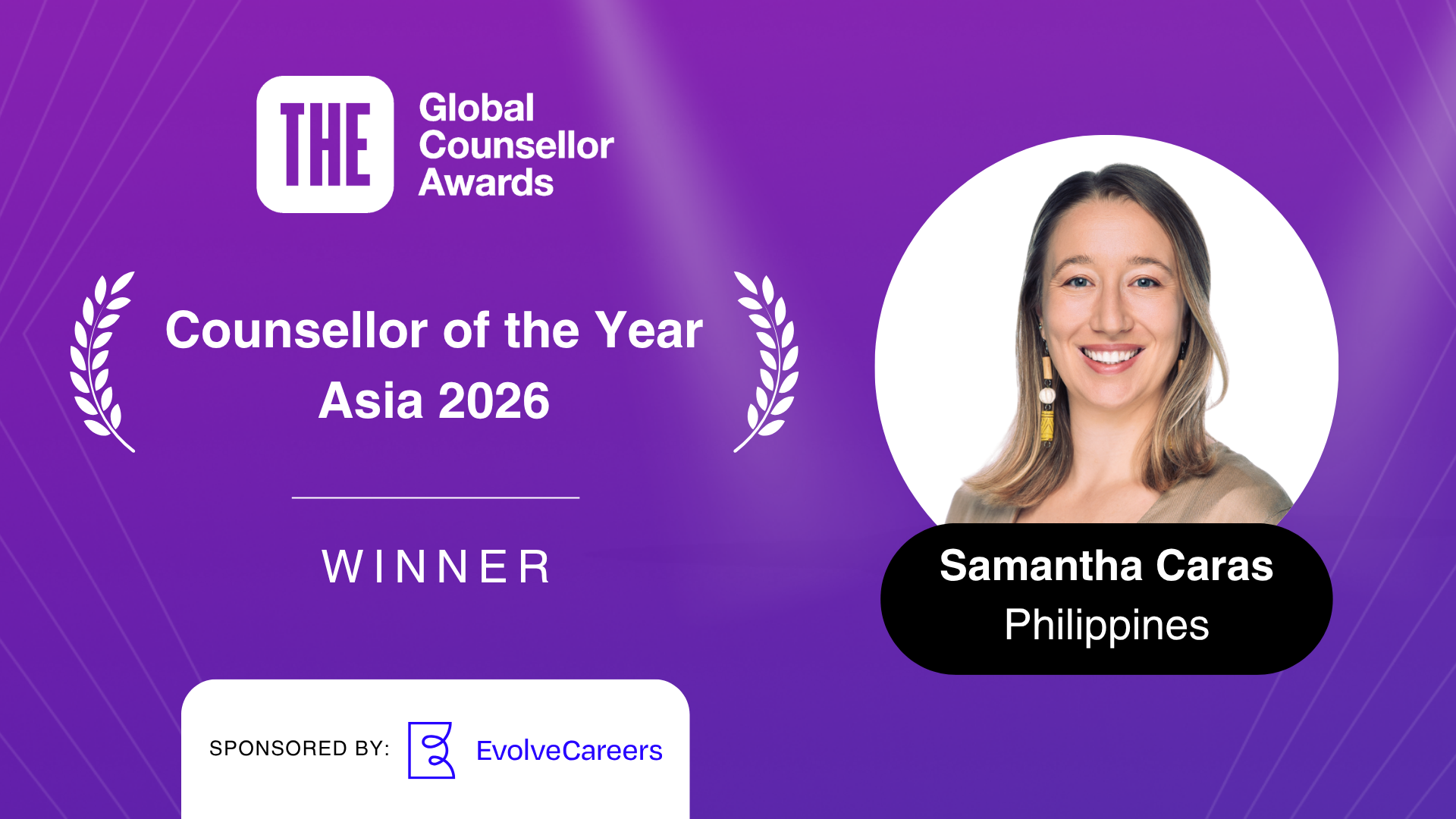
Global Counsellor Award winner 2026 – Samantha Caras
Samantha Caras has been named this year’s Counsellor of the Year – Asia. She shares why counsellors should reflect on the values of their students and families to ensure they are providing them with the right guidance

You may also like






Can you describe your feelings as you collected your award and explain what this accolade means to you?
Winning the award felt surreal. I was incredibly grateful and humbled to be recognised in a room full of people who truly understand the layered, varied and often misunderstood work of university counselling.
What made it especially meaningful was that this was a peer-nominated and peer-voted award. University counselling is a unique profession; in many ways, we often have more in common with counsellors at other schools than with colleagues in our own buildings, simply because the rhythm and demands of the role are so specific. To be seen by people I respect, and by people who understand the role from the inside, meant a great deal.
I also felt an enormous amount of warmth from colleagues in the room. It reminded me how fortunate I am to be part of a profession that is so generous and supportive. I’m truly grateful to my peers for this recognition, and to BMI/Times Higher Education for creating a space for counsellors to connect with one another in this way.
If you could give one piece of advice to new or aspiring university counsellors who want to make a lasting difference in students’ lives, what would it be and why?
Understand yourself first.
That sounds simple but I think it is one of the hardest and most important parts of the job. University counselling is not one skill. It is research, systems, deadlines, writing support, emotional support, family negotiation, cheerleading, translation between cultures and generations, and sometimes helping people name what they actually value. Those are not all the same things, and they are not all the same skill sets. They might not all be your strengths, and that is OK.
Before we can do any of that for students, we need to be honest about what we bring into the room: our assumptions, our education, our cultural background, our ideas about success, and even our blind spots around money, prestige, family, independence and risk.
You can be an excellent counsellor in one school or country and be received very differently in another if you have not done that reflective work. Students and families do not need us to impose our values on them. We will not always fully understand theirs, but we should always be trying to.
So my one piece of advice is to know yourself, and to keep returning to that reflection throughout your career. It is so much harder than it sounds, and so much more important than people realise.
Looking back on your counselling journey, what has been one of your most meaningful student success stories, and what did it teach you about the impact of effective university guidance?
One student I think about often is a high-achieving, low-income (HALI) student I worked with early in my career. She was applying for full scholarships abroad and was invited to NYU Abu Dhabi’s Candidate Weekend. It was going to be her first time on a plane.
Their background changed the nature of our counselling conversations and, ultimately, the focus of much of our time together. We were not just talking about where she wanted to go, or the idea of “fit”; we were also talking about real constraints, flexibility and remaining open to opportunities that could make university possible. When it came to the NYUAD weekend, we were not only preparing for interviews, essays, and what to pack for an admissions event. We were also talking about how to navigate an airport, what it might feel like to arrive in a new country, and how to manage an experience that was exciting but completely unfamiliar.
That student taught me that effective university guidance is not simply about knowing a lot about university systems and helping a student move through the college or career process (from values to applications to decisions). It is definitely not only about where a student goes. Sometimes, it is about whether university feels possible at all, and what needs to happen practically, emotionally and financially for that possibility to become real.
I really believe that good counselling has to begin with genuinely trying to connect with and understand the student in front of you, not with a generic idea of opportunity, procedures and prestige. I remember this student so clearly because she was one of my first HALI students, in only my second year of counselling, and I feel deeply fortunate to have learned from her so early in my career. What she taught me has shaped the way I have supported students ever since.
Many counsellors play an important role beyond their own schools. How do you give back to the wider counselling community in your region, and why is this important to you?
One way I give back is through Second Chance, which supports HALI students who are looking for another opportunity to access university abroad. That work matters to me because I have spent much of my career in international schools, and I think anyone working in this space has to be honest about access.
International education has deep inequities, and sometimes we benefit from systems that we also need to question. College counselling knowledge and networks should not only circulate within well-resourced schools. This is also why I have really valued the CAP mentorship sessions and the chance to connect with counsellors at schools very different from my own.
I am also involved with Women in International School Empowerment (WISE), as co-leader of the WISE Book Club alongside two other educators in the region. Through this virtual book club, we create space for conversations about women and girls in international education, as well as the experiences of women working in international schools.
This work keeps me learning and connected, which are both essential to life as a counsellor.
The BMI Global Forum 2026 was all about human connections in counselling – what was your key takeaway from this event?
My biggest takeaway was that there are so many ways to do this work well. Because our schools are so different, it is easy to feel like every system, programme, or resource has to be built from scratch, or that everything has to be perfectly bespoke to our community. But sitting with other counsellors is a good reminder that we do not always need to reinvent the wheel.
A lot of the best learning happens in the informal conversations: hearing how another school structures a parent programme, how someone explains a difficult admissions trend or how a counsellor has handled something you are just beginning to think through yourself. That kind of professional generosity is one of the best things about this community, and especially the CAP group of counsellors that THE has helped build.
For me, the forum was a reminder that human connection does not always need to be grand or formal. Sometimes it is just sitting next to another counsellor and realising they have already tried the thing you are about to build or have language for something you have been struggling to explain.
Are there any current trends from your region that you can share that might be of interest to other counsellors?
I am seeing more students and families think seriously about options closer to home, including Asia and Australia. There is still strong interest in the traditional destinations, but families are weighing uncertainty, distance from home, cost, safety, post-study opportunities and employability much more deliberately. Families are also thinking more practically about the future of work, especially with conversations about AI and changing job markets. They want to know where students might be able to gain experience, build networks and perhaps stay after graduation. This is something Gerald Magno, head of education at the British Council Philippines, also noted recently when he wrote about Filipino students making more deliberate and practical choices about international education.
I am also hearing more conversations about safety and belonging. Families are not only asking, “is this a good university?” but also, “will my child feel safe there? Will they feel welcome?” I think those are healthy questions, and I’m glad they are becoming a bigger part of the conversation.