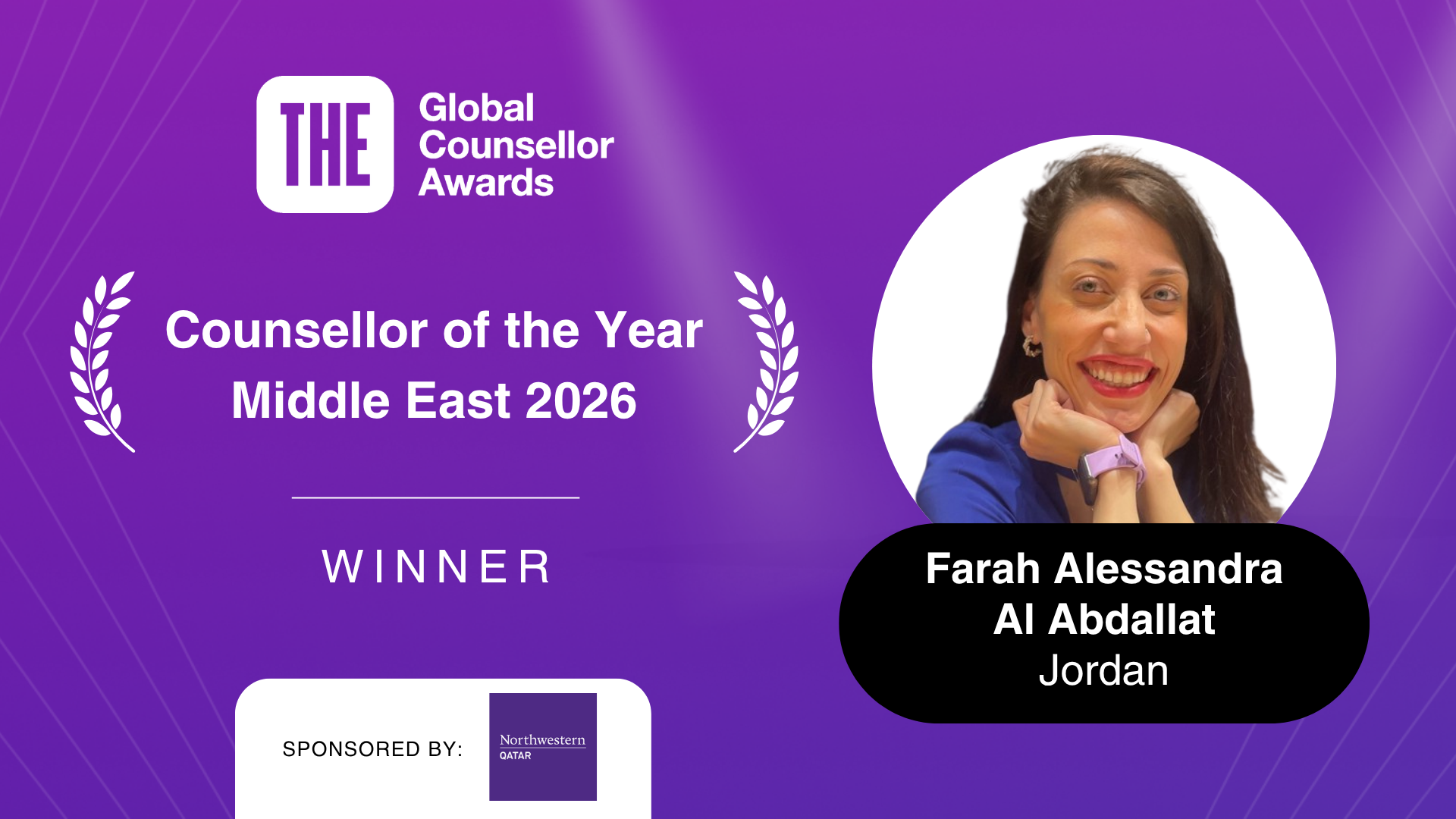
Global Counsellor Award winner 2026 – Farah Al-Abdallat
Farah Al-Abdallat has been named Counsellor of the Year – Middle East. Here she shares how she felt when she heard she had won and her reflections on how far the profession has come since she started in the role




Can you describe your feelings as you received your award and explain what this accolade means to you?
I wasn't there to collect the award myself. A dear friend and colleague, Vivian Tawadros, accepted it on my behalf. I remember waking up to her WhatsApp message and seeing that I had won. The emotions were overwhelming: surprise, excitement, gratitude and a deep sense of appreciation all at once.
What made this recognition so meaningful was not just the award itself but what it represented. I have dedicated my career to supporting students through one of the most important journeys of their lives: discovering their potential and finding their path to higher education. I have guided students through applications, essays, interviews, scholarships and all the highs and lows of the university admissions process.
When I started, university counselling was not well understood. The focus was often solely on academic results, with little recognition of the broader role counselling plays in shaping students’ futures. This award feels like recognition not only of my work but of the importance of university counselling itself and the impact it can have on young people’s lives.
Looking back on your counselling journey, what is one of your most meaningful student success stories, and what did it teach you about the impact of effective university guidance?
My counselling journey began 11 years ago at a non-profit school in Amman, Jordan. To be honest, it was not easy. I was responsible for supporting 120 highly ambitious students from different educational systems. Every day brought new challenges and opportunities to learn.
What I have come to realise is that every student I have met has taught me something valuable. Their stories have shaped me just as much as I have helped shape theirs.
One story that stays with me is that of a Palestinian student from Gaza who faced extraordinary challenges yet remained determined to pursue his education. Today, he is continuing his studies in the United States. Another source of pride has been seeing so many young women pursue higher education abroad. When I first started, it was far less common for girls in our region to study overseas independently. Watching them grow into confident global citizens has been incredibly rewarding.
These experiences taught me that effective university guidance is not simply about admissions. It is about helping students believe in possibilities they might never have imagined for themselves. Sometimes all it takes is one person who believes in them and helps them see their own potential.
If you could give one piece of advice to new or aspiring university counsellors who want to make a lasting difference in students’ lives, what would it be and why?
Ask questions and listen carefully. Every student has something special about them, even if they have not discovered it yet. Our role as counsellors is often to help uncover that unique story and build on it. The strongest applications are not necessarily those with the highest grades; they are the ones that authentically reflect who a student is.
Be patient, be creative and never give up on a student. Keep asking questions, keep exploring possibilities and keep encouraging them to dream bigger. Every student has their own story to tell, and when you help them recognise their strengths, you can truly change the direction of their lives.
Many counsellors play an important role beyond their own schools. How do you give back to the wider counselling community in your region and why is this important?
Counselling is a profession built on collaboration and I strongly believe that we grow when we support one another.
I give back by connecting with fellow counsellors, sharing resources and experiences, and helping those who are new to the profession find their own path within the field. I remember how challenging it was when I first started, often navigating unfamiliar territory with limited guidance. Because of that, I am passionate about supporting others and contributing to a stronger counselling community across the region.
I am proud of every university counsellor around the world because I know first-hand that it is not an easy job. From supporting students and demanding parents to balancing the expectations of school management, the work is challenging, emotional, and demanding every single day.
Behind every application, every acceptance letter, and every student success story, there is a counsellor giving their time, energy, patience and heart to help shape someone’s future. So, when counsellors support one another, students ultimately benefit, and that is what matters most.
Can you share any trends from your region that might be of interest to other counsellors?
One of the most significant trends I have observed is the growing awareness among parents and students about the importance of career guidance at an earlier age.
When I began my career, many students and their families viewed success through a very narrow lens. The expectation was often that students would become doctors or engineers. Today, that mindset is changing. Parents are increasingly open to exploring a wider range of career pathways and are seeking guidance much earlier in their children's educational journeys.
Students are showing interest in emerging fields such as artificial intelligence, cybersecurity, digital media, entrepreneurship, sustainability and many other careers that were rarely discussed a decade ago.
For counsellors, this means exciting opportunities ahead. Career exploration is starting earlier, conversations are becoming more diverse and families are increasingly willing to consider pathways beyond traditional professions. My advice would be: get ready. The future of counselling is becoming more dynamic, more personalised and more impactful than ever before.