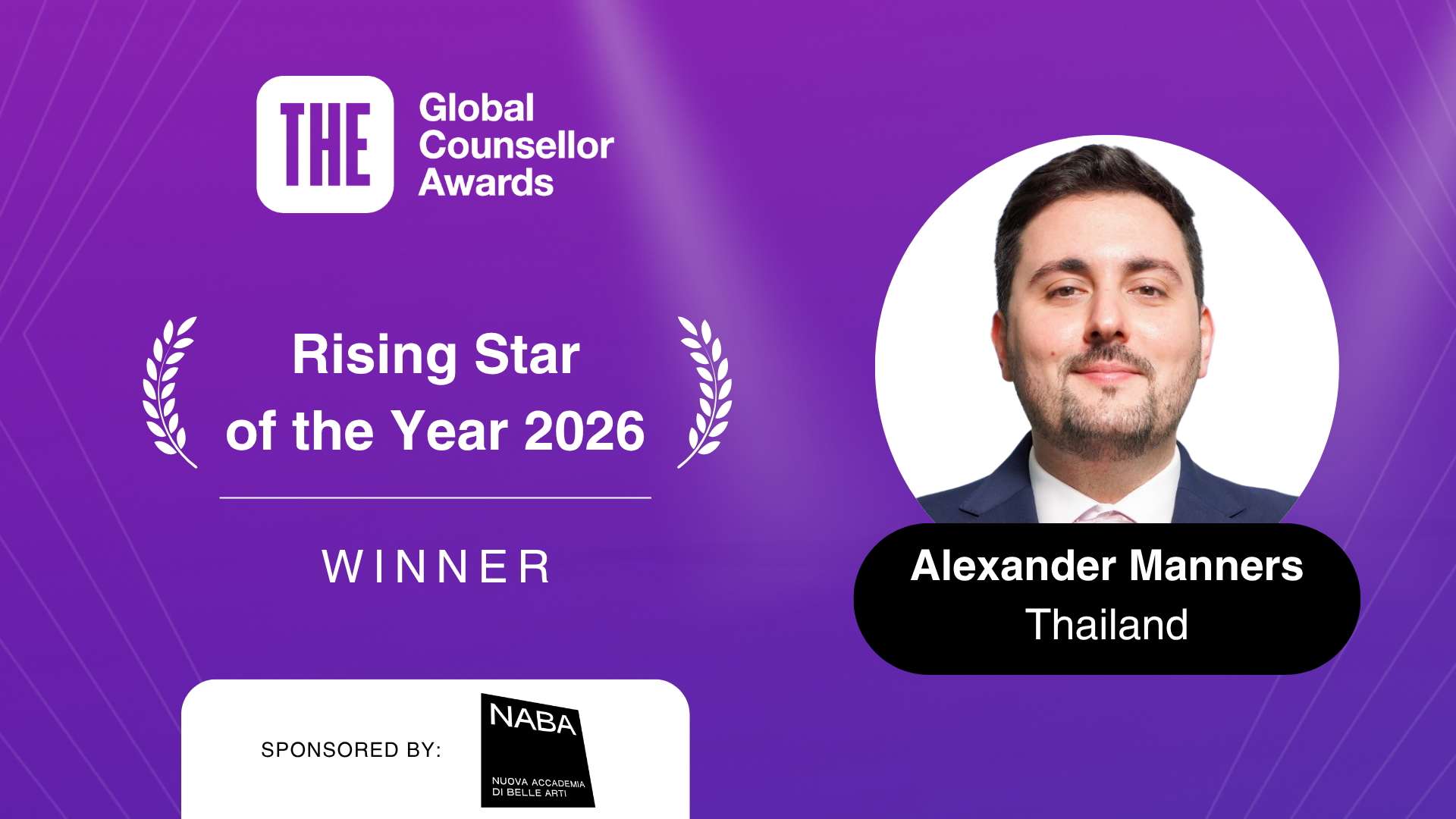
Global Counsellor Award winner 2026 – Alexander Manners
After a decade of working in fashion and advertising, Alexander Manners pivoted to college counselling. The winner of the Rising Star of the Year Award shares how the two industries are more closely linked than we might think

Alexander Manners

You may also like





Can you describe your feelings as you collected your award and explain what this accolade means to you?
As I was going up on stage to receive the Rising Star of the Year Award, I felt shocked, surprised and immensely grateful. What made the moment so special was knowing that there were people in the room whom I admire and have inspired me throughout my counselling journey. To have them celebrating that achievement with me was something I will never forget.
The award means a great deal because it is nominated and voted for by counsellors. To know that colleagues from around the world saw something in my work and chose to recognise it is difficult to put into words. Three years ago, while I was studying to become a counsellor after a career change, I remember seeing the Counsellor Awards and thinking how surreal it would be if something like that ever happened to me. A few years later, my name was called for Rising Star of the Year 2026.
It was also a full-circle moment. Before counselling, I worked in fashion and advertising, so having NABA present my award felt like a piece of my own history was there with me.
Most of all, the award fills me with gratitude. My students give this work purpose and fulfilment, and Bangkok Prep has been my first counselling home. I am also deeply grateful to Oakham School and St Benedict’s Voluntary Academy for giving me the opportunity to train in the UK, and to Buket Ayaz, who believed in me from the moment we met. This award has given me renewed energy, but also a sense of responsibility to use my voice thoughtfully and meaningfully in the profession.
Can you tell us about your journey into counselling and how long you have been working as a counsellor?
I began working as a qualified counsellor in 2024 at Bangkok Prep International School. Before that, I trained in the UK for a year while working towards my MA and the Career Development Institute’s Qualification in Career Development.
My route into counselling was not a straight line. I spent about a decade working in fashion and advertising, alongside some teaching experience. I knew I wanted a new professional chapter, and from my experiences in education I realised that I wanted to stay in an educational environment, but not necessarily as a classroom teacher. I shadowed careers counsellors in international schools, took an introduction to counselling course, and then decided to pursue a master’s degree and move into this field properly.
It felt like a very natural step. I have lived abroad for most of my life, attended international schools myself, and have a varied educational and professional background. Because of that, I have always enjoyed speaking to people from different contexts and understanding the stories behind their decisions.
At Oakham School, I had the opportunity to work with cross-cultural students and discuss universities all around the world. I instantly felt I was in the right place. During my MA, I kept connecting my assignments to international school contexts and cross-cultural students because I knew that was the sector I wanted to work in.
My previous career has shaped me more than people might expect. The creative industries teach you to be resourceful, resilient and adaptable. More importantly, fashion and advertising taught me how to identify and tell stories. I think counselling is also about stories: hearing them, understanding them and helping students retell them with confidence.
If you could give one piece of advice to new or aspiring university counsellors who want to make a lasting difference in students’ lives, what would it be and why?
My advice would be: stay student-led, and do not mistake care for ownership.
When you are new to counselling, it can be tempting to feel that you need to have all the answers or that you need to guide a student towards what you believe is the obvious choice. One of the biggest lessons I have had to learn is that this work is not about me or what I think is best. It is about creating the space for students to reflect, ask questions, explore possibilities and make decisions that feel right for them.
University guidance counselling is multilayered and contextual. A student’s choices can be shaped by family, culture, heritage, history, financial considerations, social expectations and personal aspirations. Our role is not to dismiss those contexts or impose our own beliefs on to a student or family. It is to help students make sense of the different forces around them while ensuring their best interests remain at the centre of the process.
I believe strongly in a student-led, student-focused and student-centred approach. Student-led means giving young people agency. Student-focused means understanding their individual needs, ambitions and circumstances. Student-centred means remembering that university counselling is not only about applications and outcomes; it is about the whole person sitting in front of you.
A lasting difference is made when students leave the process with greater self-understanding, confidence and ownership of their choices.
Many counsellors play an important role beyond their own schools. How do you give back to the wider counselling community in your region, and why is this important to you?
I try to give back by being present, approachable and generous with what I have learned. I do not necessarily see mentorship as something that happens only through a formal title. Sometimes it is answering a message, sharing a resource, introducing people to one another, talking through a difficult situation, or simply being honest about what has and has not worked.
I am involved in local, regional and global counselling conversations, and I value the networks that allow counsellors to support one another across schools and countries. In international education, no counsellor can know everything. Policies change, universities change, scholarships change, visa rules change, geopolitical situations change, and students’ needs continue to evolve. The only way we can serve students well is by learning from each other.
I also care deeply about writing and sharing ideas with the profession. This award has made me think more seriously about how I use that voice, and about engaging with topics that carry real weight for students, families and counsellors.
Giving back matters to me because I have benefited from people who believed in me early, shared their knowledge and opened doors. If someone was willing to do that for me, then I feel a responsibility to do the same for others. A stronger counselling community ultimately means stronger support for students.
The BMI Global Forum 2026 was all about human connections in counselling – what was your key takeaway from this event?
My key takeaway was that human connection is not an additional part of counselling; it is at the centre of the work.
In university guidance, it can be easy to focus on outcomes, systems, deadlines and destinations. Those things matter, of course. But the most meaningful work often happens through relationships: the trust between a student and a counsellor, the conversations with families, the collaboration between schools and universities, and the support counsellors offer one another.
The Global Forum was a reminder that the best counselling does not happen in isolation. It happens when people are willing to listen, share, ask better questions and understand each other’s contexts. A single conversation with a colleague or university representative can shift the way we support a student. A connection made at an event can later become an opportunity, a resource or a source of guidance for someone else.
For me, the event reinforced the importance of staying curious and open. Every student and family is different, and every counsellor brings a different perspective. Human connection allows us to keep learning, keep adapting and keep the student experience at the heart of what we do.