Robot babies and homes for horses: studying at Universidad Europea
Students at Universidad Europea, in Spain, engage in real-world challenges from their first year of study, with the aim of easing their transition into the world of work

Universidad Europea




This is a sponsored article created by Universidad Europea
Can you assist with a robot birth? How do you create a comfortable habitat for a horse? How should an operation on a cow progress?
These are among the practical questions considered by students at Universidad Europea, a Spanish private university with campuses in Madrid, Andalucía, Valencia and the Canary Islands.
Universidad Europea prides itself on its academic experiential model – an educational approach that combines theoretical and technical learning with a hands-on approach.
“Educational research has long shown that students learn best by doing,” says Karen Erazo Herrada, who works in international business development at Universidad Europea. “We want them to actively engage with real-world challenges while developing academic and professional competencies. This helps them internalise knowledge and better prepares them for a smooth transition to working life.”
Learning by doing
From their first year onwards, students at Universidad Europea are given practical projects, intended to put their newly acquired theoretical knowledge into practice. For instance, architecture students are tasked with designing habitats for zoo animals, taking into account animal welfare, sustainability and the needs of the local community. What makes this project particularly engaging is its interdisciplinary nature: architecture students collaborate with veterinary students, combining technical expertise with creative thinking to produce innovative and often surprising solutions.
Other students work in simulated environments. Medical students practise surgery with robotic patients in a simulated hospital – they will, for example, deliver a robot baby in a fully mocked-up birthing suite. Occasionally, actors will burst into the scene, simulating an emergency, to which students must respond appropriately.
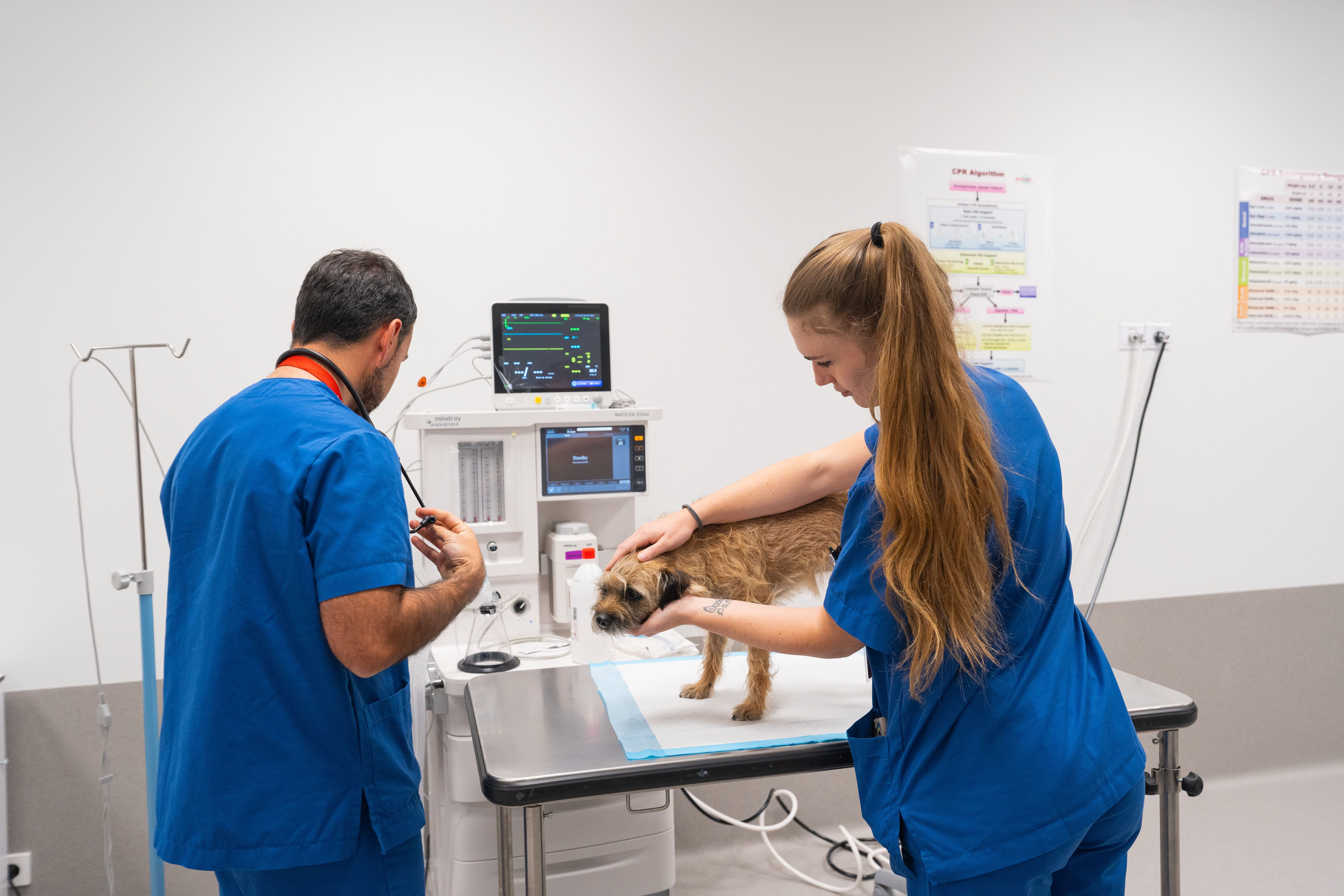
The campus also has a functioning onsite veterinary hospital, where operations are carried out on horses and cows, as well as small pets. These operations are projected on to big screens outside the operating theatre, so that veterinary students can watch them progress.
Law students participate in mock trials in an on-campus court. This enables them to make mistakes safely, in a low-stakes environment, before graduating into real legal trials.
Media and communications students record and produce their own radio programme in the campus radio studio. And a simulated TV studio allows students to manage and produce a TV programme, working cameras and sound equipment. “They can use all the tools,” says Ms Erazo Herrada. “Then, when they find a job in a real radio or TV studio, they will know what to do.”
And engineering and business students are given problems to solve using real company data, drawn from some of the university’s 6,000 business partnerships. They also have access to an Industry 4.0 laboratory, where robots and automated systems mirror the technologies that students will encounter in real industrial environments.
‘The absolute opposite of theoretical’
Mathilde Panier is in her fourth year studying biomedical engineering at Universidad Europea. She had initially enrolled in a Swiss university, but struggled with the format of the degree. “All the classes were theoretical,” she says. “It was all textbook and no group work. It just wasn’t the right fit for me.”
Universidad Europea, however, offers a very different experience. “It’s the absolute opposite of theoretical,” she says. “From the first semester of the first year, we could apply our new knowledge.”
Ms Panier and her coursemates invented an app to allow Formula 1 drivers to track their stats and oxygen levels. She has also been called on to design a stretcher to enable horses to have MRI scans. “It was really challenging,” she says. “But we had the tools to help us to do it.
“Project-based learning really made me bloom. It really allowed me to become the best version of myself – and hopefully the best biomedical engineer I can be.”
Not just a number
Universidad Europea’s model emphasises investigation, critical thinking and analysis of complex information. Classes are small, to allow for individual focus and attention.
Mathilde Panier was studying alongside 24 other students in her first year; by her fourth year, there were only 11 in her class. And she has been surprised by how happy university staff have been to make time for students outside formal class hours.
“Teachers are always available for us,” she says. “They’re always saying, ‘Please contact us if you need help with a project. We can just grab a coffee, sit down for an hour and I can explain it to you.’
“It really makes me feel listened to and valued – I’m not just a number in a class.”
Classes are complemented by one-off masterclasses delivered by professionals in specific fields, such as doctors, dentists or business people. Each curriculum is integrated and transdisciplinary – so a pharmacy student, for example, would be given opportunities to work with doctors and dentists.
Beating imposter syndrome
By their third year of study, students will take on internships or work placements in their chosen field of study – for example, in a hospital or legal firm. Some Universidad Europea graduates are eventually offered a contract by the organisation where they completed their internship.
“When our students finish their degree, it’s already normal for them to interact with the real world of work,” says Ms Erazo Herrada. “They acquire not only knowledge, but also skills like teamwork, resilience and determination. Our goal is that their transition into working life is seamless.”
Around 40 per cent of Universidad Europea’s students come from all over the world, including Europe, Latin America, Asia, and Africa. To further smooth students’ transition into working life, all the university’s standards and certifications are internationally recognised.
Mathilde Panier believes that she could not have been better prepared for the world of work. “When you start in a new company, imposter syndrome hits hard,” she says. “But, having worked in a company as an intern, I feel fully prepared to confront real projects in real life. I’m so happy that I’m prepared to go into the corporate world and fly.”
Contact details
For more information, contact:
Latin America and the Middle East: Lorena Pérez, on lorena.perez.f@universidadeuropea.es
Europe: Karen Pilar Erazo, on karenpilar.erazo@universidadeuropea.es
Italy: Grazia Milone, on grazia.milone@universidadeuropea.es