
Leading higher education with purpose in the AI era



The AI revolution has the potential to tackle various challenges in higher education, ranging from student support to campus operations. However, its fast-paced evolution can be overwhelming for sector leaders, who must navigate these shifts alongside meeting institutional goals and targets.
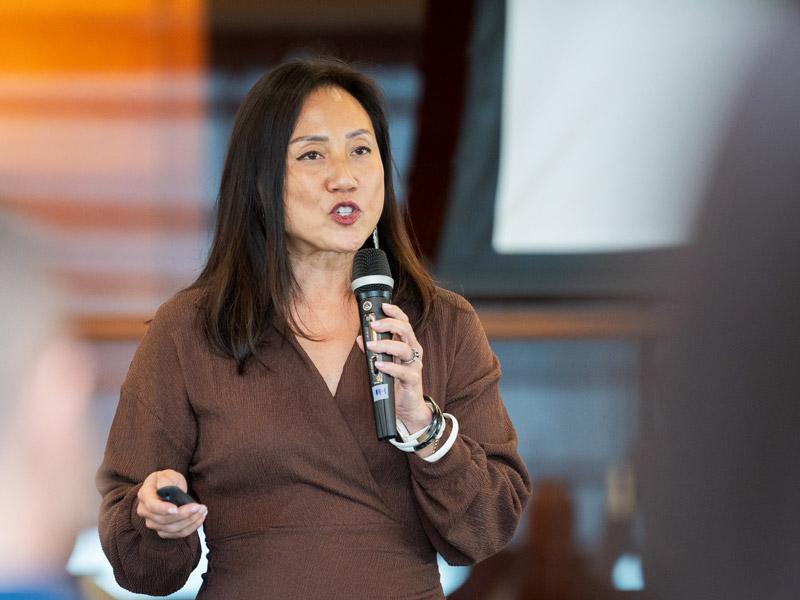
To make the most of AI, leaders need to take advantage of the tools that are available, said Sally Amoruso, chief partner officer at EAB. “It is too ubiquitous for us to ignore,” she said, speaking at a session, held in partnership with EAB, during the 2025 THE World Academic Summit. Amoruso shared insights about strategic AI adoption and key takeaways from EAB’s 2025 Presidential Experience Lab, co-hosted with OpenAI.
EAB offers technology solutions tailored for the higher education sector, covering areas such as marketing and enrolment, student engagement and data analytics. It works with more than 2,300 education providers across the world.
“What we have seen is that there are two large buckets where university leaders are embracing the power of AI,” Amoruso said. The first is for increasing competitiveness. “The long-term vision here is building AI-ready graduates, keeping in mind that the future of work is going to be infused with AI.”
Institutions are also implementing AI tools to achieve productivity gains. “Theoretically, we should be able to harness the power of AI and create cost savings, greater financial stability and financial resilience,” Amoruso said. “While that is the long-term vision, what we see more immediately is very specific individual or team-based productivity gains.” Currently, AI gains require investment in infrastructure and training, so “the costs are going to go up before they go down”, she said.
Amoruso spoke about other areas where AI has enabled innovation. In recruitment, for example, AI enables institutions to gather and synthesise data sets around prospective students and tailor recruitment processes. Personalising marketing and communications is an area where EAB supports universities.
The Universities of Surrey and Birmingham in the UK have developed AI tools to help with assessment and grading, with reports of a significant reduction in grading time, Amoruso said. “The students not only receive more immediate feedback, but they receive greater feedback because the AI is able to create a personalised and comprehensive assessment of every assignment,” she said.
Meanwhile, Khan Academy has launched a conversational AI tutor called Khanmigo. “They have programmed Khanmigo to be encouraging, patient and thoughtful,” Amoruso said. “Students can use Khanmigo to coach their writing, to serve as a debate partner, to assist with coding or, my favourite, to converse with historical figures.”
Louisiana State University in the US is preparing students for the future of the workplace by partnering with employers to teach students how to use AI in real-world scenarios. “What they have done is bring employers into the classroom and create project-based opportunities for students to apply AI to corporate problems,” Amoruso said. “My encouragement to campus leaders is to think about how we guide AI to be appropriate, considerate and thoughtful in the decision-making rubrics by which we train them.”
Find out more about EAB.
