‘If we make AI the enemy then surely it must become one’


Created in partnership with
Created in partnership with
You may also like
Chatbots sit on our students’ shoulders, gathering information meticulously, whispering advice in their ears – and yet, it often comes up short.
Still, GenAI’s hallucinations allow learners and educators to re-centre their thinking, recasting themselves as optimisers of fallible outputs. GenAI can also be used to challenge the untested assumptions of our own stances and approaches. Referencing my own attempts to come to grips with AI “plus/minus” for one class, I’ll show one way forward for instructors interested in short-course design using AI-assisted pedagogy.
GenAI can neither judge nor evaluate. Its algorithms simply isolate and aggregate character strings iteratively, based on prior patterns. It also lacks responsiveness to surrounding context. By contrast, teachers and learners debating value propositions via GenAI are best placed to arrive at discoveries in real time in an ongoing process of collective ethical contestation.
- Equip students to champion human creativity over machine outputs
- Why AI adoption in universities is really a question of trust
- ‘Students don’t have to prove authorship of every word, they show their supervision of AI tools’
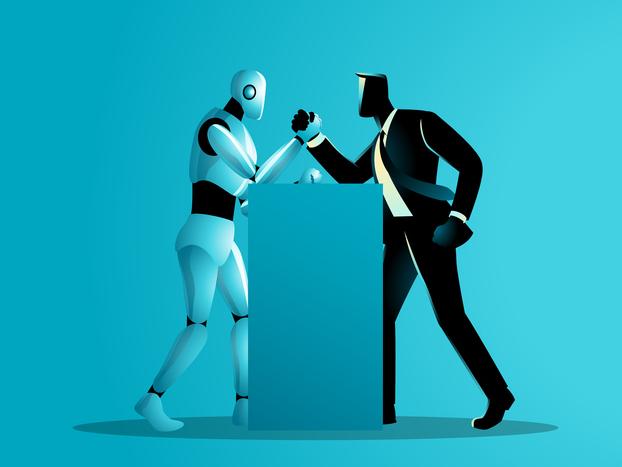
Up and down the line of humanities learning and teaching, our front-line professors and their students are meeting this crisis resolutely – all the while wondering if, by embracing AI methods and pedagogies, they are aiding and abetting the enemy.
In my teaching, I’m trying to convert the machine enemy to serve human purposes. In my humanities research methods class, I ask students to use GenAI tools to develop research proposals that make meaningful social impact, leveraging a broader variety of skills than my own disciplinary training in English literature can accommodate. It has been a stretch for them, and perhaps even more of a stretch for me. After all, I’m old enough to have brought a typewriter to college and to remember when mainframe computers took up the entire wing of a building.
Drafting research proposals collectively, our students directed their own learning process in teams, subject to guidance from GenAI whisperers – as my colleagues and I circulated, inquired and pestered. Our students incubated, developed and eventually delivered proposals that offered solutions to some of Hong Kong’s most pressing problems.
In a module of only 15 hours, there is little time for after-hours assessment. We asked four groups of 12 to 15 students to present deliverables before the end of each three-hour class session. The results, following rapid incubation, were tentative and messy but also cogent and inspiring.
Aligned with at least two UN Sustainable Development Goals, the initial group proposals included: mandatory health and wellness breaks during peak exam periods for primary school students; empathic rhetorical tactics and conflict avoidance during climate change discussions on X; supportive (non-shaming) access to sex education for secondary school students, provided by community specialists in non-clinical settings; and piloting AI-assisted chatbots to support students facing manageable anxiety and depression, in an effort to forestall crisis situations.
By removing hierarchy in the knowledge dissemination model, team-based inquiry collectivised effort and outcomes. Students assigned themselves specific roles – ethical designer, continuity reviewer, vlogger, storyboarder/artist, data compiler, techie, presenter – and worked together towards a common purpose.
GenAI use was key to this “right on time” pedagogy. For our students in arts and humanities, honing their communication skills in English and Chinese sets them up well for future interactions in learning contexts beyond the humanities and boosts workplace competency after graduation.
My experience as instructor of this class also taught me that GenAI can help us expand our transdisciplinary thinking by affording us access to knowledge beyond our specialisation. Within all this, human mastery of any AI-assisted process remains mission-critical.
Documenting the effects of his nervous breakdown in 1935, American novelist F. Scott Fitzgerald wrote: “The test of a first-rate intelligence is the ability to hold two opposed ideas in the mind at the same time, and still retain the ability to function.” We cannot afford to cede our humanity solely to AI, in binary opposition.
If we make AI the enemy, then surely it must become one. Sustaining the tension between AI and humanity, the leveraging of opposites in pursuit of the common good, must prevail. Our students are up to the task if we show them how.
Stuart Christie is a professor at Hong Kong Baptist University.
If you would like advice and insight from academics and university staff delivered direct to your inbox each week, sign up for the Campus newsletter.
