
Preparing for the Duolingo English Test: interactive reading questions explained
Learn how interactive reading questions work on the Duolingo English Test. We explain all five question formats, plus timing, scoring and strategy tips

Duolingo
Share
The Duolingo English Test provides higher education applicants with a flexible, fast and accessible pathway to prove their English language proficiency. Designed to evaluate practical academic communication, the exam integrates a variety of tasks that assess real-world reading, writing, listening and speaking skills.
An important part of the Duolingo English Test is the interactive reading section. Built around a single reading passage, the section presents candidates with six connected questions that assess text comprehension, cohesion and context recognition in a dynamic environment.
What is interactive reading?
Interactive reading is a multi-step reading task built around a single piece of text. Unlike standalone reading questions, this section requires test takers to work through six sequential questions based on the same passage.
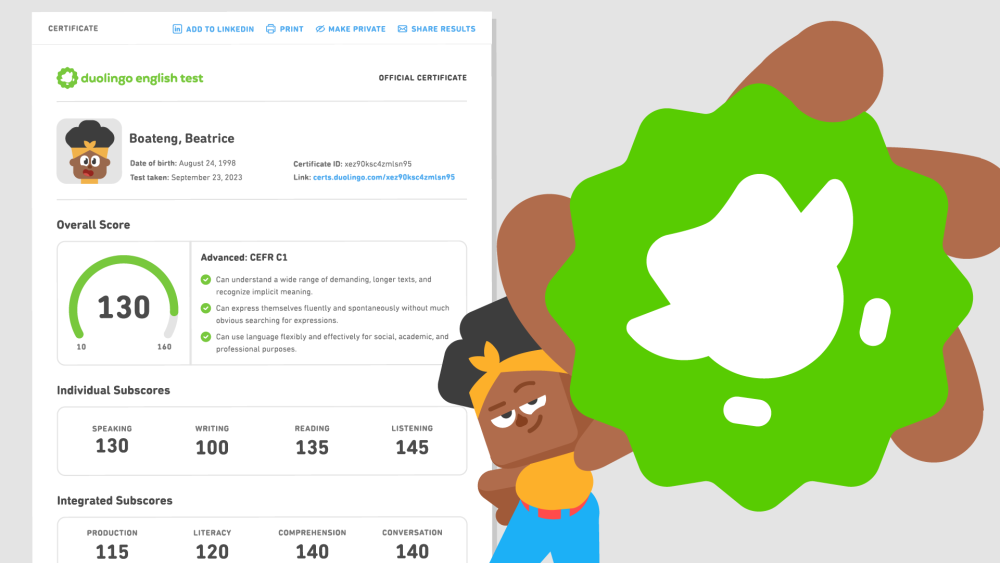
Performance on the interactive reading section contributes to three key test subscores:
- Reading: evaluates your ability to understand written English.
- Literacy: assesses your capacity to read and write effectively.
- Comprehension: Measures your ability to understand written and spoken language.
Timing and structure
During the interactive reading task, you will be allocated seven or eight minutes to complete all six questions about the given passage. The total time is shared across the entire question set rather than allocated to individual questions. This flexible structure allows you to manage your pacing dynamically, spending more time on complex text analysis and moving faster through initial sentence completion.
Question formats explained
Each interactive reading set features six questions drawn from five distinct question formats. Understanding each format is essential to maximising your score.
Complete the sentences
How it works: you will be presented with a passage featuring several blank spaces. For each blank, select the correct word from a drop-down list.
Strategy tips:
- Look at the full sentence: avoid evaluating blank spaces in isolation. Read the surrounding sentence in its entirety to capture grammatical cues and broader contextual meaning before choosing a word.
- Any order works: You are free to complete the blanks in whichever order you prefer. Fill in obvious missing words first to build clarity across the passage.
- Review at the end: You cannot proceed to the next question until every blank is filled. If time permits, re-read the completed passage to ensure the overall narrative flows logically.
Complete the passage
How it works: this task extends the text you saw earlier in the test by presenting a second paragraph or section. However, an entire sentence is missing between these two sections. Select the best sentence from a list of options to fill the gap.
Strategy tips:
- Use the hover preview feature: the test allows you to hover your cursor over each option to preview how the sentence looks between paragraphs. Take advantage of this feature to gauge whether your choice looks right.
- Focus on the before and after: examine the sentence immediately before and after the gap. Look for transition words, pronoun references and logical progressions to identify the correct bridge.
Highlight the answer
How it works: you’ll be presented with a question, and your job is to find the answer in the passage and highlight it by clicking and dragging your cursor over the relevant text. Once you highlight something, it will appear in a box below so you can review it before moving on. To change your selection, just click and drag again.
Strategy tips:
- Aim for precision: only highlight the precise phrase or sentence that directly answers the question. Avoid selecting entire paragraphs if a more specific section of the text answers the question. Equally, don’t select a single word if a more thorough answer is required.
- Review the selection box: once you’ve chosen an answer, the box around it will turn blue. Read it again to double-check your selection. If you need to revise your choice, click and drag over the text again.
Identify the idea
How it works: you are asked to select a statement from a list that best represents the central idea of the passage. Upon making a selection, the surrounding box turns blue.
Strategy tips:
- Read all the options: do not stop at the first answer that seems plausible. Some of the options may feel partially correct. They might mention something from the passage or sound relevant, but only one of the possible statements truly captures the passage’s main idea.
- Focus on scope: eliminate choices that are too narrow (focusing on a single detail) or too broad (extending beyond the focus of the passage).
Title the passage
How it works: choose the most suitable title for the passage from a list of options. As with the other interactive reading questions, your response will turn blue to confirm your choice.
Strategy tips:
- Consider the whole passage: a strong title encapsulates the focus of the passage from start to finish, not just one detail or paragraph. If an option only fits part of what you read, it's probably not the right answer.
How is interactive reading scored?
Understanding how each interactive reading question is scored will help you recognise what examiners are looking for and guide you in your answers:
- Correct or incorrect:
- ‘Complete the sentences’, ‘complete the passage’, ‘identify the idea’, and ‘title the passage’ questions are scored strictly on a correct or incorrect basis.
- Partial credit:
In contrast to the other questions on the test, ‘highlight the answer’ uses a variable scoring scale based on precision. Your score depends on how closely your highlighted selection aligns with the target answer.
Because partial credit is awarded, it is always in your best interest to highlight a response, even if you are uncertain. However, focusing on precise boundary selection ensures you’ll receive the highest score.
Approach each question with confidence
Taking an exam, regardless of content or format, can be daunting – particularly if a place at your chosen higher education institution depends on it. That’s why anyone taking the Duolingo English Test must be as prepared as possible. For a visual walkthrough of the interactive reading task, watch this guide from the official Duolingo English Test team.
FAQs
What is interactive reading on the Duolingo English Test?
Interactive reading is a multi-question task built around a single academic passage. Candidates complete six questions based on the text, contributing directly to their reading, literacy and comprehension subscores.
How long do I get for interactive reading?
You receive a total of seven or eight minutes per passage. This time limit is shared across all six questions, so pace yourself as you work through the passage.
What are the five question formats?
The five formats included in interactive reading are:
Complete the sentences
- Complete the passage
- Highlight the answer (appears twice)
- Identify the idea
Title the passage
How is interactive reading scored?
Most questions are scored as correct or incorrect. However, the ‘highlight the answer’ task offers partial credit depending on how accurately your highlighted selection matches the correct response.
Do I have to fill in every blank in the ‘complete the sentences’ question?
Yes. The test interface will not let you move on to the next question until you’ve chosen a word to fill every blank in the task.
What is the best approach for the ‘complete the passage’ question?
Hover over each option to preview how the text appears inside the passage. Pay close attention to the sentences immediately before and after the gap to guide you in selecting the right transition sentence.
How can I practice interactive reading?
You can practice interactive reading on the Duolingo English Test practice page. Practice questions can be completed individually or as part of a full-length practice exam. For detailed timing, scoring rules and exam preparation resources, download the official Duolingo English Test guide.
