
So proud of our growing INFANT

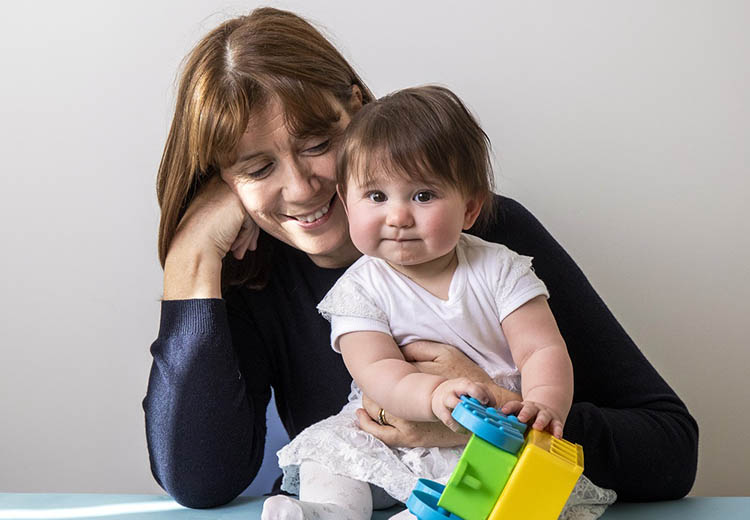
Professor Geraldine Boylan explains how the inspiring team at the Irish Centre for Maternal and Child Health Research is continuing to make a name internationally for its groundbreaking research focused on pregnancy, birth and early childhood.
As Ireland’s only dedicated research centre spanning maternal and child health, INFANT is a hub that houses a passionate and enthusiastic team of close to a hundred staff, students, clinicians and academics and led by one of its two co-founders and now sole director, Professor Geraldine Boylan.
Although INFANT is only eight years old, it is already firmly placed on the global map as a world leader in its field, as a result of breakthroughs in neonatal seizure and brain injury detection, remote monitoring of pregnancies, touchscreen technology to track the growth and development of children, maternal and infant nutrition and childhood allergy.
For example, the ANSeR (Algorithm for Neonatal Seizure Recognition) study, headed up by Geraldine, created an AI-powered decision support system that can detect seizures in new-born babies, alerting the healthcare team that the baby may need help. This enables the team to treat seizures promptly and improve the long-term outcomes for children who have had a difficult start in life.
The centre has licensed the algorithm to a Japanese company who have added the software into their monitoring machines, and the UCC technology is already in use in neonatal units in hospitals in Japan.
Another breakthrough called Babyscreen - this time led by a team of paediatricians and psychologists including Professor Deirdre Murray - has developed a gaming and touchscreen technology that can be easily used by young infants and children to help assess their cognitive development has been brought into clinic for validation with an industry partner and gaming company Hello Games. The promise of this approach means many more children who may have had some complications in early life can have their cognitive development assessed earlier and more easily, allowing more effective interventions.
INFANT also leads several research programmes in nutrition and pregnancy which focus on using technology to innovate in healthcare. The COVID-19 crisis has helped accelerate the adoption of some of these approaches in the clinic. An example of this is the Leanbh project which uses remote blood pressure monitoring of pregnant women in their home or community combined with a novel data analytics platform. Clinicians using this platform can identify pregnant women that may need to visit hospital earlier as well as those that are at low risk, reducing unnecessary travel or hospital visits.
Worldwide, about 130 million babies are born every year but even in 2021, over 2 million of those babies can die or be seriously ill at or soon after birth. The global and personal impact of this is enormous and is the reason why research into pregnancy, birth and the neonatal period is so vital for society. In countries like Ireland and the UK, even with very well-developed health systems, around 10% of all newborn babies end up in a neonatal unit — some with minor problems and others very sick. Geraldine points out that most parents are blissfully unaware of the type of complications some new-borns can experience – until their child is born with a problem.
“It’s so traumatic for a parent when a baby is born prematurely or unwell – and they walk into this unit where their tiny baby is surrounded by tubes, monitors and alarms. It is scary and it can be overwhelming, but they are in an environment where they will get the best possible care for their baby,” she says.
The professor can’t speak highly enough either of the amazing nursing and medical staff that work in the maternity and neonatal units at Cork University Maternity Hospital (CUMH) and in units all over Ireland: “I see on a daily basis how hard these people work. They work day and night delivering babies and caring for women and sick infants, while often juggling their own families and childcare and at the same time working extra shifts when needed at the drop of a hat.”
It is well recognised that hospitals that have a research centre such as INFANT, which is integrated into a clinical care setting, have better outcomes for patients and higher overall standards of care, she points out.
INFANT is also Ireland’s leading partner in conect4children, a pan-European research network which is carrying out clinical trials to develop better treatments for children.
“Our aim is to ensure that Irish children participate in the best trials available across Europe. About 60% of current drugs used for children were developed for adults only. We often use a smaller dose of the drug for children – but children are not small adults; their physiology and how they handle drugs is very different to adults. The gold standard for safe drug use is to test using randomised controlled trials which need to be done for children also,” explains Geraldine.
As well as the development of drugs and devices specifically for children, INFANT is involved in research in a wide range of areas from eczema and allergies to stillbirth and pregnancy loss, and optimal nutrition for premature babies.
The Centre was initially founded in 2013 with Science Foundation Ireland (SFI) funding, but 8 years on INFANT is self-funded from a wide variety of sources including national and international competitively won research awards, industry and philanthropy. INFANT is now standing on its own two feet, so to speak: “It’s a new phase for us, a very exciting phase. We were very grateful to get SFI funding to set the Centre up, and over the last 8 years we have built up an amazing, diverse, and talented team of people here.
The Centre has also expanded internationally over this time and now collaborates with over 50 academic and clinical partners worldwide and has almost 40 industry partners in sectors such as digital health, medtech, pharma and nutrition.
“International collaboration has always been key to what we do here and despite COVID and BREXIT we continue to build new collaborations across UK, Europe and further afield such as Tanzania, North America and Australasia.”
Just as INFANT is growing up, so too are the newborn babies who were the focus of much of the early research. The centre expanded to the third floor – a brand-new extension at CUH, which opened three years ago and was funded through the university and philanthropy.
It now has its own state-of-the art development assessment unit, ensuring that all babies are followed up, into and throughout the childhood years.
“We are really delighted with this assessment unit. We regularly have international visitors here at INFANT and they cannot believe the purpose-built set-up we have here for doing assessments. My challenge as Director is to sustain this unit and the team, to ensure we can follow up every child who participates in research into their teenage years,” says Geraldine.
The idea, she explains, is to see how complications some children experienced as newborns or in the womb affects them as they grow, and to ensure better outcomes through assessment and early intervention. It is very hard to get funding for this kind of research – but Geraldine says she is never going to stop trying.
One research team, for example, is investigating the right balance of nutrition for growing preterm babies. INFANT is also heading a team that is developing a new drug for children at risk of peanut allergy.
Another project is focused on identifying babies who will develop severe eczema, while the neonatal brain team have identified biomarkers in the blood for severe brain injury in babies.
INFANT researchers are also trying to understand the underlying causes of pregnancy loss and stillbirth and are looking at mothers’ experiences of maternal morbidity, to bring these issues to the forefront and begin conversations between patients, healthcare providers and the community.
A panel of families that have had infants in the neonatal unit at CUMH, or those who have experienced complications of pregnancy, is being set up to provide input into the design and development of parent information leaflets and future research projects at INFANT.
Geraldine expresses deep gratitude to the staff in the maternity hospital and the paediatric unit, who manage to find the time during their incredibly busy workdays to support and facilitate INFANT research.
“You need the right team of people with the right skill mix, and we have been very lucky in INFANT with our amazing team of people here, which is our major strength. It’s very rare to get a centre with all this different expertise together in one place,” she says. The ever-growing talented multidisciplinary team includes clinical researchers, scientists, engineers, computer scientists, physicists and nurses, and her own enthusiasm and passion is infectious, no doubt.
“We have a talented and enthusiastic pool of PhD students and post docs – the next generation who, I hope, will continue on the work we started and build on it. We have so much more to do, so many areas we have not even scratched the surface of yet, in terms of the research we need to do.”
To find out more about research impact and innovation at University College Cork visit: https://www.ucc.ie/en/research/