
People power can help fuel climate change reversal

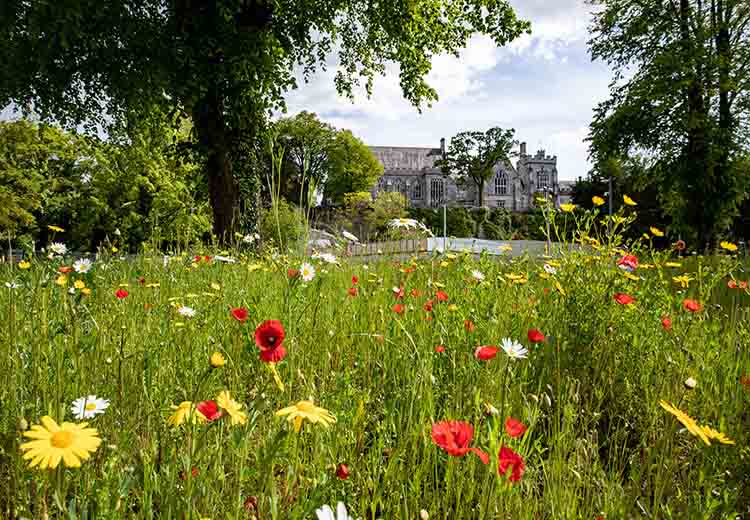
University College Cork (UCC) is ranked 8 in the world for impact as measured by the Times Higher Education World University Impact Rankings 2021. UCC was the first university in the world to receive the Green Flag (2010) and has led the way on sustainability development in Ireland. Three of UCC’s climate change experts - Dr Paul Bolger, Professor Brian Ó Gallachóir and Professor Áine Ryall - explain how we can all help make Ireland carbon neutral by 2050.
In October 2018, we were warned that we had just 12 years to avoid reaching dangerous levels of climate change; that we needed to keep global warming to a maximum of 1.5˚C.
Just a half degree more, and the risk of droughts, floods, extreme heat and poverty for hundreds of millions of people would significantly increase. This stark message came from the world’s leading climate scientists and featured in the UN’s Intergovernmental Panel on Climate Change (IPCC).
At an EU level, the 2030 targets have been set, which include cutting greenhouse gas emissions by at least 40% – relative to 1990 levels – and an ambition to become carbon neutral by 2050. In Ireland, the government supports this EU ambition and so is currently assessing how to make Ireland carbon neutral, by 2050.
But as the clock ticks, what planet-saving steps can we put in place? “There is no silver bullet. Climate change is what is called a ‘wicked problem’ – it doesn’t have any one solution,” says Dr Paul Bolger, manager of UCC’s Environmental Research Institute (ERI), which has over 100 projects focused on this issue.
“Climate change is a problem that goes to the very root of how we live on this planet. It involves how we heat our homes, where we live, how we get to work, how we get to where we want to play, what we eat, and what and how we purchase,” he explains.
However, there are four key areas that can be addressed: “There’s an energy issue – a technology issue – and that’s the piece that is usually talked about. What is the technology that is going to fix this? Is it wind or solar or tidal power? But that’s only one piece of the jigsaw,” he says.
“Just as important are the policies that government has. If you don’t have the right policy structures in place, it’s very difficult for a lot of these technologies to get any traction in the market.
“The third area is economics – who is going to pay for all of this? And the fourth area concerns the people – engaging with communities and the public on the need to change our ways, both as individuals and as a society.”
Paul stresses that in order to tackle climate change, teamwork across these four areas is necessary: “Within the ERI, within the university, we are trying to use a different way of approaching these problems – by taking the perspectives of lots of different disciplinary researchers and integrating them together to get better outcomes.
“Within the ERI for instance, we’ve got 20 different schools involved, which include everything from biology to chemistry to engineering to social sciences, to business and law, and the humanities, and public health and medicine.”
Energy accounts for most of Ireland’s greenhouse gas emissions and one expert in this area is Brian Ó Gallachóir, Professor of Energy Engineering at UCC’s School of Engineering. He is also Director of MaREI, the Science Foundation Ireland Centre for Energy, Climate and Marine. More than 220 researchers are involved in MaREI, in 13 third-level and research institutes, working with more than 80 industry partners and hosted by the Environmental Research Institute.
Brian’s simple breakdown of statistics shows us where we are now and highlights where we need to get to: “Currently, 88% of our energy comes from fossil fuels and just 12% of our energy comes from renewable energy – nationally. So, we have a long journey to transition to a net zero emissions country by 2050.”
His work involves taking a broad view of the entire energy system, in order to identify where we can make planet-saving changes.
“This energy system includes the power plants, which are generating electricity and causing emissions, but it also includes the cars and trucks we are driving, and our heating systems in our homes and in our factories,” he explains.
Brian says Ireland generates about 40% of its electricity from wind energy; electricity represents just a fifth of our energy use.
“While we’re getting 40% of our electricity from wind energy, that means we are only getting about 8% of our overall energy from wind energy,” he adds.
Therefore, we need to do a lot of work on changing our energy sources for heat and transport, which together make up 80% of our energy use.
“While we have been doing well on changing the supply of electricity, we haven’t done much in terms of heat and transport and that is why at the moment about 50% of our energy use is coming from oil,” he points out.
However, the challenge when it comes to addressing climate change goes way beyond determining which fuels and technologies we use – it’s how we imagine and build our future.
“We’re working with a number of citizens and community-based organisations on an engaged research project, the Dingle Peninsula 2030 project. We are undertaking transdisciplinary research to co-produce with the community a rural energy transition to a low carbon future. It’s very fulfilling to both support and witness the diffusion of sustainability.”
And how we do we ensure then, that action is actually taken? That’s where the law steps in – and another of our experts, Professor Áine Ryall, a qualified barrister who lectures in, and researches, environmental, climate, and European Union law at UCC’s Centre for Law and the Environment.
“It is important to keep in mind that there are legal mechanisms that individuals and non-governmental organisations (NGOs) can use to hold governments to account when there is a failure to meet climate obligations.”
Áine says that climate litigation is becoming far more common, and she cites a recent case taken in the Irish courts: “We have an important Supreme Court decision from July 2020, where an NGO, Friends of the Irish Environment, brought the government to court in an attempt to force more effective and more urgent climate action. This court action was successful.”
“The Supreme Court determined that the National Mitigation Plan was unlawful because it failed to meet the requirements of Ireland’s 2015 climate legislation. Following the Supreme Court ruling, the government is required to specify, in clear terms, the measures it proposes to take to enable Ireland to meet its climate obligations.”
“The case, known as Climate Case Ireland, also succeeded in raising the profile of constitutional rights and human rights in the specific context of climate change and environmental protection,” she says. “This is really only the beginning of the rights-based litigation we are likely to see more of in the future.”
One example of potential future litigation is regarding our air quality: “The are standards set down in law governing air quality, and if it’s possible to prove through monitoring data that those air quality standards have been breached, then it’s possible to ask a court to make an order forcing action to ensure better air quality – and there has been very successful litigation in London and into other European capitals in that regard,” explains Áine.
“Nobody wants to bring legal action, it is very much seen as ‘a last resort’, but if it’s the case that health is being impacted negatively – including children’s health, then it is understandable that people will turn to the courts in an attempt to force action to improve air quality. Governments and public authorities take notice when people win court cases,” she adds.
It is encouraging that we have such expertise at University College Cork leading the way in addressing the problem of climate change, but it’s also clear from them that we all need to get on board; to work together to make Ireland carbon neutral by 2050 and play our part in saving the planet.
To find out more about research impact and innovation at University College Cork visit: https://www.ucc.ie/en/research/