
Aligning mathematics and human creativity
By combining mathematics, computer science, AI and musical structure, researchers have uncovered unique patterns in musical rhythm that resemble those found in nature

Sponsored by Sorbonne University Abu Dhabi

Sponsored by
Sponsored by
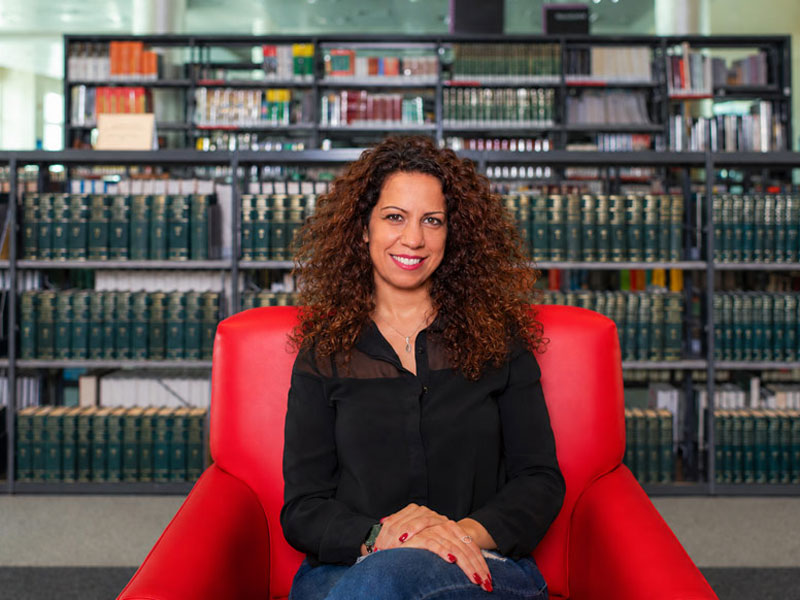
The conventions of mathematics can make it appear at odds with human creativity. Research on mathematical frameworks, counting rhythms and musicology by Lama Tarsissi, associate professor at Sorbonne University Abu Dhabi in the United Arab Emirates, questions this dichotomy.
“This project began as a collaboration between me, a computer scientist and a musicologist,” explains Tarsissi. “Our goal was to discuss and determine how many distinct rhythmic possibilities exist that can be counted systematically. To model this, we simplified musical rhythm into three core symbols: one for the onset or beginning of a sound, one for extending it and one for silence.”
By representing musical structure using an alphabet of three symbols, Tarsissi and her collaborators bridged musical notation with formal language theory. The researchers made a surprising discovery when calculating how many valid musical sequences could be constructed using this three-letter system: the valid combinations followed the Fibonacci sequence.
Reflected throughout nature and architecture, the Fibonacci sequence is a series of numbers where each number is the sum of the two preceding it. “Finding out that musical rhythm directly aligns with this unique sequence was a remarkable result,” says Tarsissi. “It demonstrated that scaling rhythms allows us to classify musical structures systematically within a clear theoretical framework.”
Using combinatorics – a branch of mathematics that studies the counting, arranging and combining of elements within finite or discrete sets – on words provided a useful mathematical framework for studying musical rhythms. Formal language theory studies how sequences, patterns, alphabets and letters can be linked to form structured strings, mirroring the mechanics of music. “Combinatorics on words gives us the formal tools to analyse musical syntax and structural sequences through a rigorous algebraic lens,” says Tarsissi.
In addition to discovering new insights around musicology, the research connects mathematics with other academic disciplines, such as computer science and linguistics. True to the crossdisciplinary nature of the project, a computer scientist was brought in to test Tarsissi’s mathematical models, executing experiments to validate the formal computational models.
“While our paper concerns purely theoretical mathematics, the final section outlines several concrete directions for practical application in areas such as music composition, digital music tools and AI,” Tarsissi says. “For instance, training AI models on music requires effective tokenisation. Representing music through word-based formal language theory offers an alternative framework for music analysis and generative machine learning tasks, such as token design for generative models.” Tarsissi and her team are now extending their research framework from to include melody, with an aim to develop further AI applications based on their preliminary findings.
The work also poses broader questions about the relationship between mathematical patterns and human creativity. “Mathematics and human creativity complement one another; neither can replace the other,” Tarsissi explains. “As a mathematician, if you give me an alphabet of three letters, I can generate every mathematically possible permutation and sequence. However, mathematics alone cannot tell you if a sequence is artistically meaningful, emotionally expressive or culturally resonant. Theory gives us the complete set of structural rules, but human creativity provides meaning and aesthetic judgment.”