
Smart wireless networks for more efficient irrigation in rural areas

Sponsored by

Sponsored by
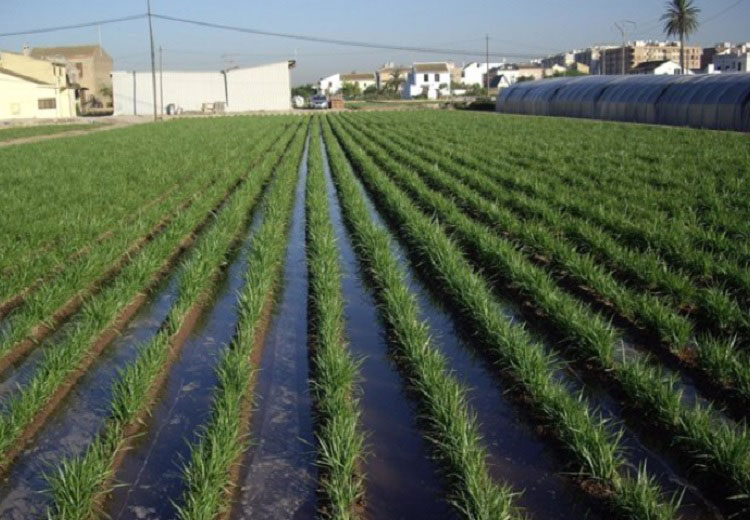
Precision farming is a term that defines the management of agricultural production based on observation, data collection and subsequent action to improve crop efficiency, whether agronomic, environmental, or economic. This agriculture involves the integration of advanced technologies to monitor crops and optimise resource use to achieve, among other objectives, more efficient irrigation and, ultimately, good crop yields.
Among the technology required for precision agriculture, Internet of Things (IoT) systems have great potential. However, in some areas, such as rural areas, their implementation is more complicated due, among other factors, to the impact of vegetation. In particular, soil monitoring applications can suffer from interference caused by foliage density or plant height and/or width.
To address this, a team from the Universitat Politècnica de València (UPV) proposes a new strategy for distributing soil monitoring networks, which allows irrigation to be scheduled as efficiently as possible, also in these areas. Their work proposes a monitoring system that includes the architecture, the design of the nodes and an algorithm to determine irrigation needs based on FAO recommendations and sensed data.
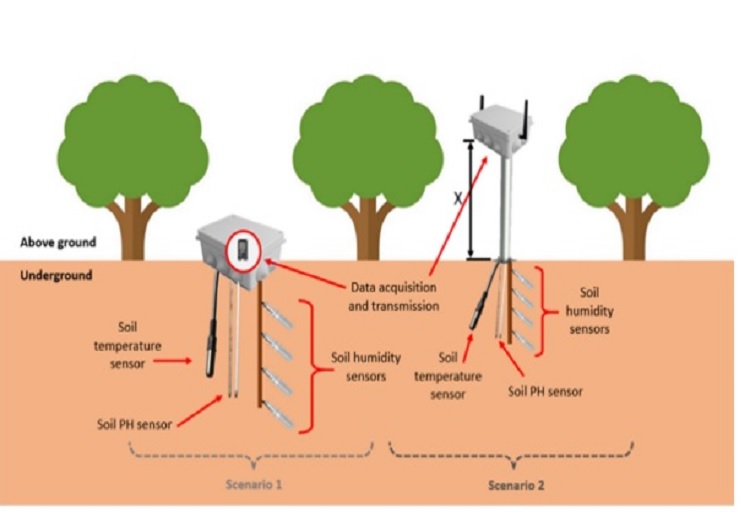
To get there, they evaluated different deployment configurations of wireless sensor networks (WSNs), identifying the effects of the rural environment on the signal and the fundamental requirements for the design of such networks. They analysed the performance of these networks with different types of vegetation (orange orchards, scrubland, and grassland) and with different Wi-Fi node locations (on the ground, near the ground and above the ground).
"By working, we saw that vegetation creates high variability in areas with high foliage density; sensors installed on the ground had more coverage problems, even with vegetation where most of the foliage is at a higher altitude. Deployments close to the ground are the best in the case of orange trees," explains Jaime Lloret, a researcher at the Department of Communications and director of the IGIC Research Institute of the UPV.
However, the deployment strategies on and near the ground in the orange groves showed high variability in signal quality, even without any obstacles between the transmitter and receiver.
"However, aspects of the rural environment and deployment that affect the signal, such as node height, crop type, foliage density or irrigation method, must be taken into account when designing an efficient WSN deployment," concludes Jaime Lloret.
Reference
García, L.; Parra, L.; Jimenez, J.M.; Parra, M.; Lloret, J.; Mauri, P.V.; Lorenz, P. Deployment Strategies of Soil Monitoring WSN for Precision Agriculture Irrigation Scheduling in Rural Areas. Sensors 2021, 21, 1693. https://doi.org/10.3390/s21051693