
SHOULD WE SAY GOODBYE TO PLASTIC CONTAINERS FOR FOOD PRESERVATION?

Sponsored by
Sponsored by
The food packaging sector is one of the largest consumers of non-degradable plastics; their use ensures proper food preservation, extends shelf life, and reduces losses along the food chain. However, they also cause a significant environmental pollution problem.
To address this challenge, in addition to encouraging responsible consumption and recycling, one solution is to replace conventional plastic packaging with biodegradable materials, which can be composted together with food waste. Moreover, incorporating active compounds into the packaging can give it additional preserving properties, such as a high antioxidant and antimicrobial capacity. And this is precisely what helps packaged food to be better preserved and to have a longer shelf life... reducing the environmental impact of traditional packaging.
Within this field, a team from the Institute of Food Engineering for Development of the UPV, led by Dr Amparo Chiralt, studies how different compounds of natural origin, with proven antioxidant and antimicrobial activity, can be incorporated into biodegradable polymeric matrices with hydrophilic (such as starch) and hydrophobic (such as biodegradable polyesters) nature to obtain active materials for packaging. To ensure the preservative function of the material, these compounds must be released into the food in a controlled way, acting against potentially present micro-organisms or interfering with oxidative processes.
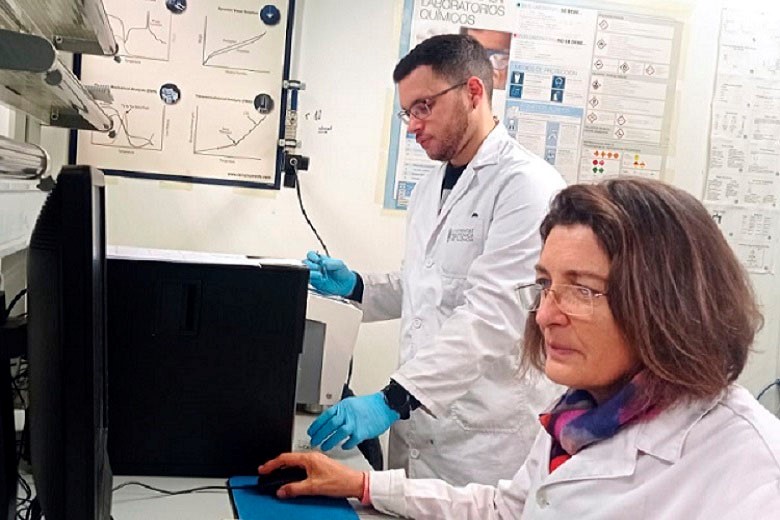
Amparo Chiralt and Pedro A.V. Freitas in the laboratories of the Institute of Food Engineering for Development
The UPV research group uses phenolic acids in many plants with antimicrobial, antioxidant and other health-promoting activities to design active biodegradable materials for food packaging. Their studies have found that the type of polymer (hydrophilic or hydrophobic) significantly affects the release and effectiveness of active compounds in contact with aqueous foods, which are the most sensitive to microbial spoilage. They have also found that biodegradable polyesters, with low water affinity, do not effectively release the active compounds; hydrophilic polymers release the active compounds effectively when hydrated with food contact, but with hydration, they lose the appropriate barrier capacity and mechanical resistance.
Obtaining biodegradable multilayer films with an active layer for food contact is a solution to enhance sustainable and ecological food packaging, combining hydrophilic and hydrophobic biopolymers. Different works of the group show the effectiveness of laminating biodegradable films with complementary properties, with phenolic acids or plant extracts rich in these compounds, with high antioxidant and antimicrobial capacity.
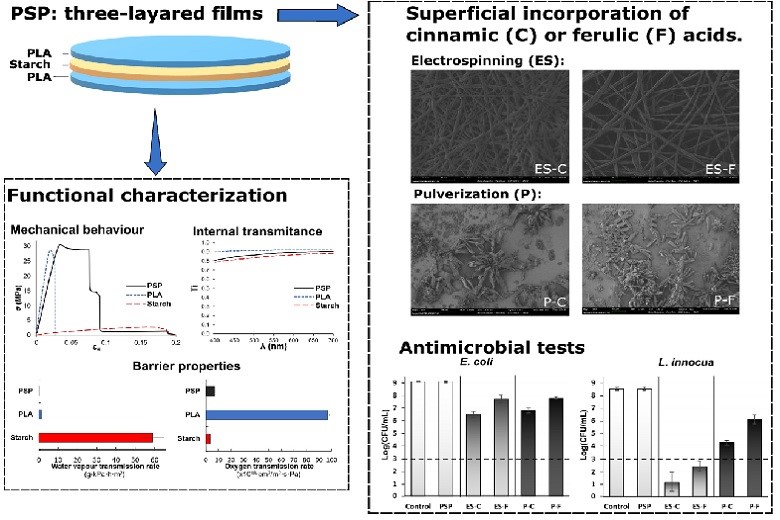
Influence of incorporation method of active compound on antibacterial action of biodegradable laminates
Among other results, the materials developed by the UPV laboratories have made it possible to extend the shelf life of pork meat packaged in these laminates with a high level of conservation of quality parameters and microbiological safety. They have also developed single-dose bags with active extracts obtained from rice straw for packaging unsaturated oils, such as sunflower oil, which protect them from oxidative processes.
These results demonstrate that biodegradable polymers have a high potential for sustainable and environmentally friendly solutions for food packaging. They also use agri-food waste as a source of active compounds or reinforcing materials (celluloses) to improve their functionality and competitiveness in the market.
However, a major remaining challenge is to increase their production, reduce their cost, and adapt their properties to the requirements of food packaging, which are very different for different types of food, depending on their composition and sensitivity to spoilage.
Further reading:
1) Ordoñez, R., Atarés, L., & Chiralt, A. (2022). Antibacterial properties of cinnamic and ferulic acids incorporated into starch and PLA monolayer and multilayer films. Food Control, 136, 108878.
URL: https://www.sciencedirect.com/science/article/pii/S0956713522000718
2) Ordoñez, R., Atarés, L., & Chiralt, A. (2022). Properties of PLA films with cinnamic acid: Effect of the processing method. Food and Bioproducts Processing, 133, 25-33.
URL: https://www.sciencedirect.com/science/article/pii/S0960308522000104
3) Hernández-García, E., Vargas, M., & Chiralt, A. (2022). Starch-polyester bilayer films with phenolic acids for pork meat preservation. Food Chemistry, 385, 132650
URL: https://www.sciencedirect.com/science/article/pii/S0308814622006124
4) Freitas, P. A., González-Martínez, C., & Chiralt, A. (2023). Using rice straw fractions to develop reinforced, active PLA-starch bilayers for meat preservation. Food Chemistry, 405, 134990.
URL: https://www.sciencedirect.com/science/article/pii/S0308814622029521
5) Freitas, P. A., González-Martínez, C., & Chiralt, A. (2023). Antioxidant starch composite films containing rice straw extract and cellulose fibres. Food Chemistry, 400, 134073.
URL: https://www.sciencedirect.com/science/article/pii/S0308814622020350