
Nazarbayev University’s global vision for higher education
As global education evolves, Nazarbayev University leads with a commitment to internationalisation and meaningful, cross-border academic cooperation
Nazarbayev University

Sponsored by
Sponsored by
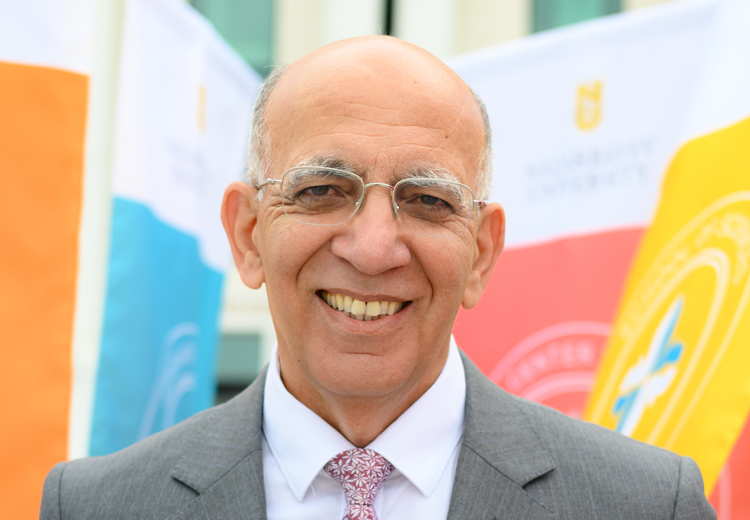
THE spoke with Waqar Ahmad, president of Nazarbayev University, about the university’s focus on internationalisation, the changing landscape of academic partnerships and his institution’s approach to knowledge exchange.
What defines a genuine, equal academic partnership in today’s global higher education landscape?
Historically, some of the oldest seats of knowledge creation were in the broader Asian region, including the Middle East and Central Asia. The House of Wisdom (8th to 12th century), under the Abbasid dynasty, was the greatest seat of learning of its time, and far more than its disparaging depiction as a mere factory for translating ancient Greek philosophy, science and medicine.
Names such as Al-Khwarizmi (8th to 9th century), Al-Farabi (10th century), Al-Biruni (10th to 11th century), Avicenna (10th to 11th century), Omar Khayyam (11th to 12th century, and much more than a poet), among others, have had had a seminal and lasting impact on the development of disciplines ranging from philosophy to linguistics, music theory, medicine, astronomy, mathematics, chemistry and beyond. Many are commemorated by having asteroids and lunar craters named after them. Statues of others adorn cities in Europe, Asia and elsewhere, and some have given names to everyday terms we use today (algorithm from Al-Khwarizmi; canon from Avicenna).
However, in recent history, higher education institutions in the West have led research and teaching. Recognising their privileged position, they have often formed relationships with institutions in the developing world that are hierarchical and extractive, that serve Western partners at the expense of those in the developing world, and that do little to build capacity in the partner institutions. While there are exceptions (such as Saudi Arabia and the UAE in the last two decades), on the whole, institutions in the developing world have lacked the resources, leadership, institutional autonomy and academic freedom to become internationally competitive. This is why Nazarbayev University (NU) is special. NU was established to be a world-class, research-intensive university with a strong focus on addressing national and regional challenges.
Western institutions sometimes shun approaches for equal partnerships because of their perception of the quality of partners based on rankings. While I was at another institution, we were visited by a European institution to discuss a potential partnership, only for the institution to write to us stating that its executive board had rejected the proposal due to our then non-participation in the Times Higher Education rankings and position in the QS World University Rankings that was lower than their ranking. Today, the institution I led is ranked in the top 200 in Times Higher Education’s rankings, 200 places above the arrogant European institution.
Other Western universities engage in partnerships that are extractive, with little interest in building local capacity. Countries in the Middle East have witnessed Western universities closing campuses when their expectations, to a significant extent financial, were not met. I am happy to admit that there are exceptions to this generalisation; I have had the privilege of working with some of these institutions.

Why are regions like Central Asia, and institutions like NU, increasingly attractive for global partnerships?
Western institutions have various motivations for forming partnerships, often driven by self-interest, extracting large fees for supporting institutional development, creating conduits for student recruitment through articulation agreements, and as tools for exerting soft power. Recent decades have seen the establishment of foreign campuses, with varying degrees of success. Some countries (such as the UAE and Qatar) have attempted to create higher education hubs, again with varying degrees of success. Successful hubs normally provide a supportive ecosystem, enabling the best graduates to find suitable employment or to engage in entrepreneurial activity. In some cases, they may cover set-up and running costs, enforce only a light-touch accreditation regime, provide tax-free status and make it easy to repatriate profits from educational activity.
Reflecting the recent hostile environments for international students, the US and UK have seen a sharp decline in international student numbers. Consequently, in the UK, approximately 75 per cent of universities are facing significant financial hardships. As for the US, there are reports of well-established faculty taking roles in Canada and elsewhere. The anti-immigrant rhetoric from both President Donald Trump and Prime Minister Keir Starmer will only exacerbate the hardship being experienced by these institutions. This, among other drivers, is resulting in discussions on the creation of new higher education hubs in India, the Middle East and other destinations. Additionally, some universities that traditionally attracted international students to their main campuses are now establishing campuses in countries from which many of their students originated. While some of these are dedicated campuses, others are partnerships with local institutions. Some of the ventures appear to be hasty reactions to the financial predicaments in which institutions find themselves and may lead to regrets later.
In Central Asia, Kazakhstan deserves credit for investing in school and university education, including having the foresight to invest in and provide legal protection and institutional autonomy to NU. The country is now attracting universities from different countries and different market points (from widening participation to highly selective institutions). If these are to be lasting partnerships, they need to shun traditional extractive models, something Kazakhstan’s Minister of Science and Higher Education, the driving force behind this development, is well aware of. Partnerships where a local institution is involved have to be equal. There has to be a commitment to local capacity building. The highest standards have to be maintained; often there is a perception that branch campuses do not maintain the same standards as the parent campus. There has to be a commitment to research and knowledge exchange and appropriate investment in infrastructure to ensure this. Relationships need to be built with local businesses, the public sector and industry, so that graduates acquire appropriate skills for employability and research addresses questions that matter regionally. And at least part of the surpluses generated have to be reinvested in the country to build institutions.
NU invests much in strengthening local higher education capacity, developing leadership talent through our programmes in higher education leadership, delivering executive education through our well-established Deans’ School, sharing curricula with local universities, providing funds for joint research and opening up our research laboratories to researchers from other universities. We have also invested in the development of local faculty – accounting for a mere one in 10 at our inception, one-third of our faculty are now of Kazakh origin and our target is to reach four in 10 by 2030. We look forward to working with new entrants to Kazakhstan’s higher education ecosystem.
What role can regional alliances, such as the Asian Universities Alliance, play in reshaping the global partnership dynamic?
While the West has dominated higher education for several centuries, that hegemony is now under threat. For example, Tsinghua University, Peking University and the National University of Singapore are now in the top 20 institutions in the Times Higher Education World University Rankings, while the University of Tokyo, Nanyang Technological University, the University of Hong Kong, Fudan University, the Chinese University of Hong Kong and Zhejiang University are in the 26 to 50 range. A further eight Asian institutions are ranked 51-100. Alongside NU, several of these institutions are part of the Asian Universities Alliance (AUA) of research-intensive universities.
My 14-year-old university now sits on a firm research platform from which to take off. We are focusing on research questions that matter for the country and the region. We are building critical mass in research, teaching and knowledge exchange in carefully selected focus areas. Our research contribution is increasingly of international standing. In 2025, for example, over 70 per cent of our publications are in the top quartile and around 40 per cent in the top decile in Scopus-indexed journals.
NU’s experience of partnerships with AUA institutions constitutes partnerships of equals, with AUA members possessing a genuine desire to build mutual capacity, open opportunities for student and faculty collaboration and, in some cases, provide funding for collaborative research. We are strengthening our links with several AUA partners. For example, we will be launching a dual degree in business entrepreneurship with an AUA partner. We are discussing the expansion of joint research, collaborative teaching, and faculty and student exchange with other AUA partners. Strengthening such alliances will build excellence in teaching, student experience, research and knowledge exchange in the region, something that has rarely happened in the extractive models of partnerships. Given the investment in higher education in China, the Middle East, India, East Asia, Kazakhstan and elsewhere, one would expect this trend to accelerate in the years to come.
Given this, Western institutions face a challenge. If they maintain the hierarchical and exploitative model of partnership, they will lose partners, especially now that, due to financial challenges, they will not be negotiating from a position of power. If they move to models that are mutually rewarding, then they will make less profit but will benefit from longer-lasting and mutually beneficial partnerships. They will also benefit from partnerships with the new powerhouses in teaching, research and knowledge exchange, an increasing number of which will enter the world elite in the short-term future.
NU is rethinking its own partnership model. In our early years, we benefited from a number of handholding partnerships with some of the world’s elite universities. As a 14-year-old institution, we are now approaching partnerships differently. Two-thirds of our research outputs are co-authored with international collaborators. We have a number of partnerships to promote faculty and student mobility and, as noted, particularly strong relations with AUA institutions. Currently, we are developing joint and dual undergraduate and postgraduate degrees with leading institutions (with AUA partners and others). These degrees are jointly conceived and use the resources of both institutions, with students spending an equal amount of time at NU and the partner institution. They will likely have a single fee. We are also exploring joint research funds between NU and AUA (and other) partner institutions. In making partnership choices, we will hold on to our principle of equality, where both partners benefit from the relationship.