
Collaborating to accelerate sustainability in Asia

Sponsored by
Sponsored by
The United Nations’ Sustainable Development Goals offer a research focus for many universities. National Cheng Kung University brought a research group together to discuss how progress on the goals could be accelerated in Asia
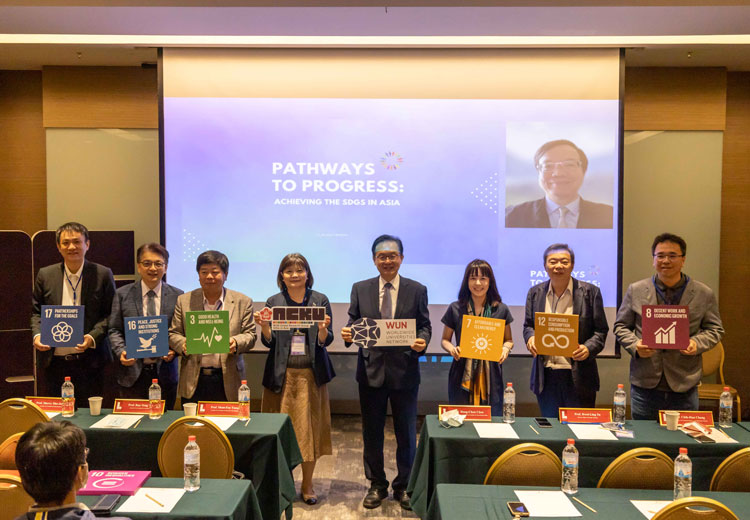
In November, international academics came together at National Cheng Kung University (NCKU) in Tainan, Taiwan to attend a symposium titled Pathways to Progress: Achieving the SDGs in Asia. Presently ranked first in Taiwan and 24th in the world for social impact in the THE Impact Rankings, NCKU hopes to create the solutions for today’s global problems and to cultivate the leaders to solve tomorrow’s.
The SDG conference focused on how researchers can work towards the United Nations’ Sustainable Development Goals. NCKU’s WUN Global Research Group, founded in 2021, has provided funding for 15 related projects this year, and the one-day conference was an opportunity to showcase this work.
“The ultimate goal of this programme is to realise the benefits and positive impact of the SDGs, as well as to fulfil the university’s social responsibility,” said NCKU vice-president Hong-Chen Chen, who said the symposium would provide valuable opportunities to exchange ideas and share experiences. Tsair-Fuh Lin, who is chair of the WUN Global Research Group, explained that this year’s research projects would focus on areas including water quality and treatment, sustainable construction, energy storage control systems, public health and climate change education, falling under five of the UN’s 17 goals.
The 15 projects backed by the WUN Global Research Group this year connected 31 institutes and 71 researchers across five continents. One of the themes under the spotlight was how Taiwan can improve disaster self-reliance as the effects of climate change intensify. Yung-Nane Yang, a professor at NCKU, recommended that self-reliance initiatives be taught to children in school so that the younger generation has a sense of disaster preparedness. Encouraging the public to participate in disaster prevention, he explained, would make responses to future natural crises more sustainable.
Other research presentations included academics sharing research on climate change migration, behavioural addictions, physical literacy, sustainable aquaculture and how to promote reusable containers in the fast-food industry. In her presentation, Josephine Esaete from Makerere University in Uganda explained how academics from her institution worked alongside researchers from NCKU and Universitas Airlangga in Indonesia to understand how climate change education needs to be gender inclusive, as there are very few women leaders at the grassroots level in sustainability projects.
Apramita Devi, a postdoctoral researcher at the University of California, Davis has been working with Lin from NCKU and Helen Chappell from the University of Leeds to create “smart crops” of millets that can contribute towards a diet that’s rich in micronutrients, are drought-resistant, gluten-free and more climate resilient.
This year’s conference built on the success of NCKU’s 2022 conference, which invited scholars from partner universities to discuss the practicalities of international research collaboration, practical sustainability solutions for communities and the social responsibility of universities. Lin explained the key steps the research group would be taking to achieve progress towards the SDGs, including establishing global partnerships within academia, government and industry and collecting relevant information in a shared SDG database hub.
The next steps include seeking internationally recognised research funding, strengthening links with member universities and giving researchers a platform where they can publish research results and increase their visibility and impact. He said the symposium showed the “feasibility of cross-country and cross-disciplinary teamwork”.
Find out more about the WUN Research Global Group – SDGs in Asia.