
Wastewater Purification: Novel Heterojunction Photocatalyst for Tetracycline Degradation
The graphitic carbon nitride-based catalyst works via a step-scheme mechanism, achieving complete tetracycline elimination.

Sponsored by

Sponsored by
Tetracycline, a widely popular antimicrobial agent, is also an environmental hazard. Recently, researchers from Kyungpook National University have come up with a novel method to remove this compound from wastewater via photodegradation. Specifically, they have fabricated a novel 2D/2D nitrogen-rich graphitic carbon nitride-based heterojunction photocatalyst with step-scheme mechanism for this purpose. The catalyst is expected to find a variety of other applications in a sustainable world.
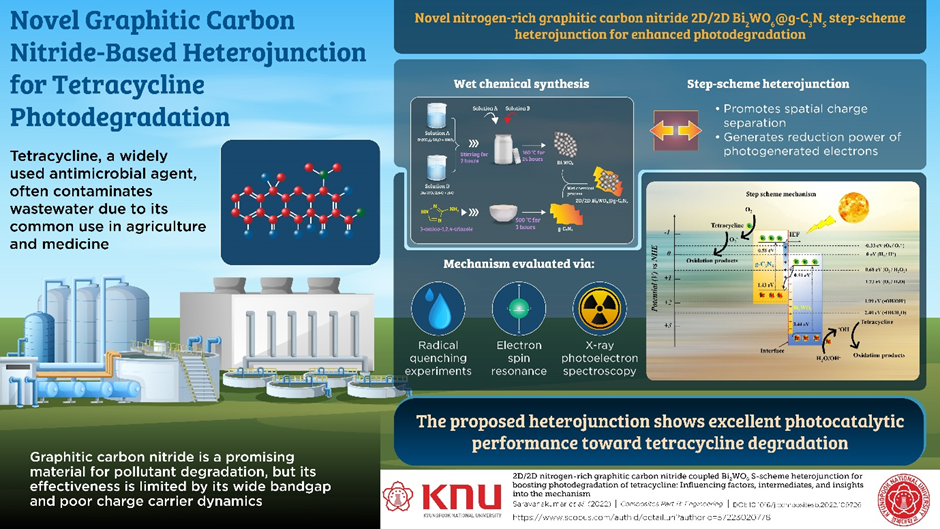
Image title: Graphitic carbon nitride based step-scheme photocatalyst for tetracycline removal
Image caption: The proposed heterojunction exhibits step-scheme mechanism, making it promising for tetracycline photodegradation in wastewater.
Image credit: The authors
License type: Original Content
Usage restrictions: Cannot be reused without permission
The present century has witnessed the rapid growth of industries and factories on an unprecedented scale. Amidst this boom, the pharmaceutical industry has expanded many-fold, leading to easier, cheaper, and abundant availability of medication to masses. However, this has also led to excessive use of pharmaceuticals in medical and healthcare products, causing significant unanticipated and adverse impacts on public health as well as the environment. Nevertheless, the global consumption of antibiotics continues to rise, and this excess has caused an inevitable rise in toxic contamination in our aquatic ecosystems, worsening global water scarcity.
Tetracycline, the second-largest manufactured antimicrobial agent, is typically utilized in aquaculture and animal husbandry, and thus frequently finds its way to and contaminates water sources. Photocatalytic oxidation has been proposed by scientists as a sustainable strategy for its environmental remediation, as this is a feasible and eco-friendly method for removing emerging contaminants from water. Moreover, photocatalytic degradation has two main merits: it can mineralize a wide range of pollutants into simple inorganic and organic molecules, and it does not lead to secondary pollution.
In this regard, an international team of researchers, led by Dr. Chang Min Park, Associate Professor at the Department of Environmental Engineering at Kyungpook National University, has come up with an innovative 2D/2D type catalyst that can effectively remove antibiotic contamination. Their findings were made available online on 10 February 2022 and published in Volume 234 of the journal Composites Part B: Engineering on 1 April 2022.
In this study, the researchers synthesized 2D/2D Bi2WO6@g-C3N5 (nitrogen-rich graphitic carbon nitride) heterojunction catalyst through a simple wet-chemical method. They analyzed its crystal structure, composition, and optical properties through various techniques such as radical quenching, electron spin resonance, and X-ray photoelectron spectroscopy analysis. Consequently, the team found that heterojunction exhibits a step-scheme (S-scheme) mechanism, whose formation significantly improves the photogenerated charge carrier transfer and retains large redox potential.
As a result, in comparison to unitary Bi2WO6 and g-C3N5, the Bi2WO6@g-C3N5 S-scheme catalyst exhibited stronger visible light absorption and photocatalytic efficiency. The high yield of reactive oxidative species produced by the proposed photocatalyst effectively degraded tetracycline into mineralized products under visible light irradiation. Notably, the optimized Bi2WO6@g-C3N5 catalyst effectively removed 99.8% of tetracycline. Therefore, the Bi2WO6@g-C3N5 catalytic system demonstrates good universality in eliminating tetracycline across various environmental conditions.
According to Dr. Park, “From lab scale to pilot-scale plants treating real wastewater, water interferences, particularly natural organic matter or inorganic ions, can be tested and eliminated using the prepared 2D/2D heterojunction photocatalyst. Our research findings afford an eco-friendly approach to combat antibiotic pollution in industrial wastewater, emphasizing photocatalysis as a viable alternative to the existing methods.”
Overall, with its precisely engineered 2D/2D heterojunction photocatalyst, improved electron mobility, ability to generate reactive species, and effectiveness in removing persistent contaminants, the novel graphitic heterojunction stands out as a promising option for a broad spectrum of environmental applications.
Reference
Title of original paper: 2D/2D nitrogen-rich graphitic carbon nitride coupled Bi2WO6 S-scheme heterojunction for boosting photodegradation of tetracycline : Influencing factors, intermediates, and insights into the mechanism
Journal : Composites Part B: Engineering
DOI : 10.1016/j.compositesb.2022.109726
*Corresponding author’s email: cmpark@knu.ac.kr
About the institute
Kyungpook National University (KNU) is a national university located in Daegu, South Korea. Founded in 1946, it is committed to becoming a leading global university based on its proud and lasting tradition of truth, pride, and service. As a comprehensive national university representing the regions of Daegu and Gyeongbuk Province, KNU has been striving to lead Korea’s national and international development by fostering talented graduates who can serve as global community leaders.
Website: https://en.knu.ac.kr/main/main.htm
About the author
Dr. Chang Min Park is Associate Professor in the Department of Environmental Engineering at Kyungpook National University (Korea, Republic of). He received his Ph.D. in the Department of Civil, Architectural and Environmental Engineering at The University of Texas at Austin (USA) in 2011. He was an NRC Research Associate in National Risk Management Research Laboratory at the U.S. Environmental Protection Agency in USA (2017). His research interests include drinking water, industrial water, and wastewater treatment with a focus on emerging contaminant treatment in membrane, adsorption, and sono-photocatalytic treatment utilizing engineered nanohybrids.
Website: https://sites.google.com/view/encl