
High-Speed Magnesium Alloy Innovation Promises Lighter, Stronger Future Materials
Scientists investigate the potential of BA53 alloy for boosting productivity and performance in automotive, aerospace, and high-tech applications.

Sponsored by

Sponsored by
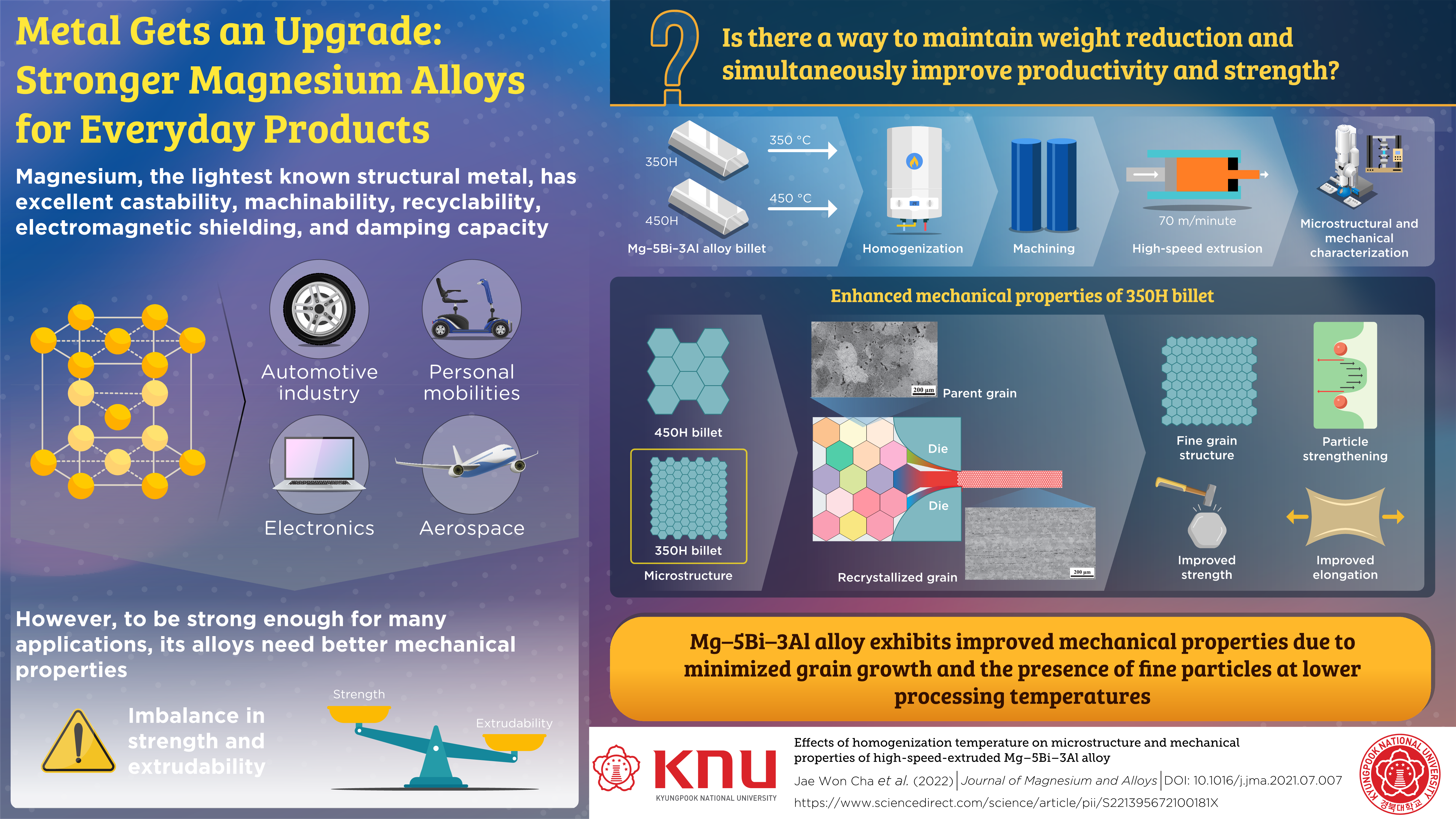
High-performance magnesium alloys are critical for many applications due to their lightweight and high-strength properties. In a new study, scientists from Korea have made a significant advancement in magnesium alloy development by introducing a new Mg–5Bi–3Al (or BA53) alloy. This alloy promises to make manufacturing more efficient and cost-effective, thus addressing long-standing problems with conventional magnesium alloys, such as slow production and high costs.
Image title: A Faster Route to Stronger Magnesium for Everyday Products
Image caption: The new BA53 magnesium alloy promises enhanced strength and productivity for diverse industrial applications.
Image credit: Sung Hyuk Park from Kyungpook National University
License type: Original Content
Usage restrictions: Cannot be reused without permission
Amidst the climate change crisis and rising global warming, governments globally are tightening automobile emission regulations to achieve a reduction in carbon emissions. As a result, the automobile industry has turned its focus to making lightweight vehicles, including lighter cars, railways, airplanes, drones, urban air mobility, and bicycles. Magnesium, being the lightest known structural metal, is promising in this regard, and its alloys have attracted significant attention for developing lighter automobile components. Furthermore, magnesium has excellent castability, machinability, recyclability, electromagnetic shielding, and damping capacity.
Extrusion is a crucial metal-shaping process used to form magnesium products such as rods, tubes, and beams, enhancing their strength and making them lighter. Before extrusion, the metal undergoes a process called homogenization, where it is heated evenly to mix its components and remove any uneven parts that form during cooling. This prepares the metal for shaping, ensuring it is easier to work with and improves its overall quality. However, the slow production speeds and high costs associated with traditional magnesium alloys have been significant challenges in their widespread use. Notably, commercial magnesium has Mg17Al12 and Mg2Zn phases, whose melting during high-temperature, high-speed extrusion leads to the formation of hot cracks.
In this regard, a group of researchers from the Republic of Korea, led by Professor Sung Hyuk Park from the Department of Materials Science and Metallurgical Engineering at Kyungpook National University, recently addressed these challenges by creating a new high-speed-extruded magnesium alloy called Mg–5Bi–3Al or BA53. Their study was made available online on 13 August 2021 and published in Volume 10, Issue 10 of the Journal of Magnesium and Alloys in October 2022.
The present study revealed that setting the homogenization temperature to 350 °C made it much easier to shape the BA53 alloy. This created a higher concentration of fine particles within the grains, preventing them from growing too large during the process. Consequently, the alloy showed excellent mechanical properties, such as greater tensile strength and flexibility, which are essential for durability and performance in various applications. The researchers attributed these properties to stronger grain-boundary hardening, particle hardening, and strain hardening effects. However, when the temperature was set to 450 °C, the alloy developed a rougher microstructure with larger grain sizes. Although the alloy still retained good mechanical properties, its tensile strength and flexibility were not as impressive as those seen at 350 °C. This contrast underscores the crucial role of choosing the right homogenization temperature to maximize the BA53 alloy's performance.
Prof. Park explains, "Our study shows that the choice of homogenization temperature can greatly impact the microstructure and mechanical properties of the BA53 alloy during high-speed extrusion. This finding opens up new possibilities for using magnesium alloys in applications where strength and productivity are key."
Moreover, the improved extrudability and mechanical properties of the BA53 alloy at lower homogenization temperatures (350 °C) can contribute to sustainability efforts in manufacturing. By reducing the energy required for processing and minimizing material waste, this advancement aligns with the industry's goals for sustainable practices. Prof. Park concludes, "Being able to extrude BA53 at speeds as high as 69 m/min without compromising its mechanical properties is a game-changer for industries needing lightweight, high-strength materials. This study provides a sustainable way to improve the performance of magnesium alloys in structural applications."
Reference
Title of original paper: Effects of homogenization temperature on microstructure and mechanical properties of high-speed-extruded Mg–5Bi–3Al alloy
Journal : Journal of Magnesium and Alloys
DOI : https://doi.org/10.1016/j.jma.2021.07.007
About the Institute
Kyungpook National University (KNU) is a national university located in Daegu, South Korea.
Founded in 1946, it is committed to becoming a leading global university based on its proud and lasting tradition of truth, pride, and service. As a comprehensive national university representing the regions of Daegu and Gyeongbuk Province, KNU has been striving to lead Korea’s national and international development by fostering talented graduates who can serve as global community leaders.
Website: https://en.knu.ac.kr/main/main.htm
About the author
Sung Hyuk Park is a Professor in the Department of Materials Science and Metallurgical Engineering at Kyungpook National University, a position he has held since 2016. He earned his Ph.D. under the supervision of Professor Chong-Soo Lee at POSTECH. Prior to joining Kyungpook National University, Prof. Park served as a Senior Researcher at the Korea Institute of Materials Science from 2011 to 2016. His research interests encompass various areas including lightweight magnesium alloys, metal-metal hybrid materials, plastic deformation, twinning behavior, and fatigue properties of metallic materials such as magnesium, aluminum, titanium, nickel alloys, and steels. Prof. Park is actively involved in editorial boards, serving on journals like the Journal of Magnesium and Alloys, Korean Journal of Metals and Materials, Metals, and Materials International.
Website: https://www.shparklab.com/professor