
Biopolymer-Metal Organic Framework Aerogel to Remove Nonsteroidal Anti-Inflammatory Drugs
The novel adsorbent effectively removes ibuprofen and naproxen from wastewater, achieving their environmental remediation.

Sponsored by

Sponsored by
Popular pharmaceuticals such as ibuprofen and naproxen easily find their way into water bodies, causing environmental pollution. They can be effectively removed via adsorption. In this regard, researchers from Kyungpook National University have fabricated a novel biopolymer-metal organic framework aerogel adsorbent, which exhibits excellent removal efficiencies for both drugs. Furthermore, the proposed aerogel is environmentally friendly and sustainable, making it lucrative for various applications related to organic contaminant removal from aqueous solutions.
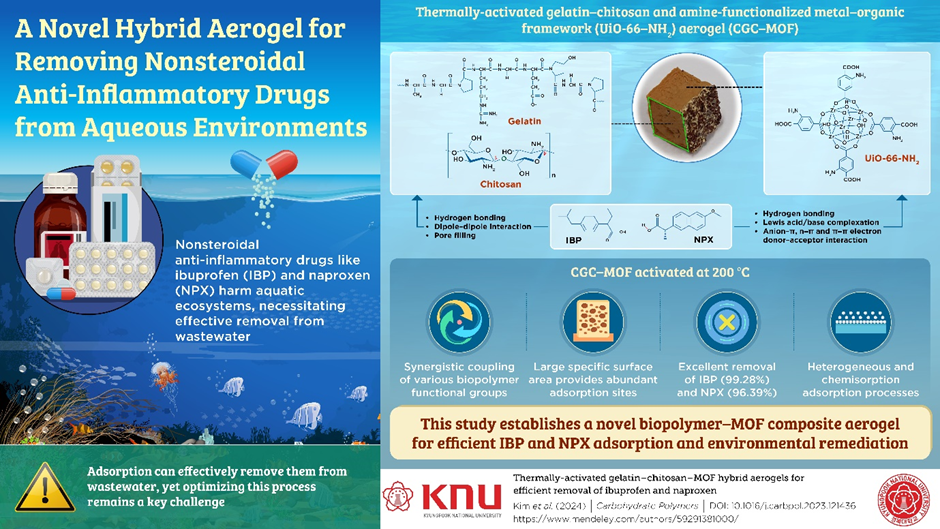
Image title: Novel biopolymer-MOF aerogel for remediation of ibuprofen (IBP) and naproxen (NPX)
Image caption: The gelatin and chitosan-based adsorbent achieves excellent removal efficiencies of 99.28% and 96.39% for IBP and NPX, respectively.
Image credit: The authors
License type: Original Content
Usage restrictions: Cannot be reused without permission
Nonsteroidal anti-inflammatory drugs (NSAIDs) are a widely popular kind of medicine with various applications in the form of analgesics, antipyretics, and anti-inflammatory drugs. They are primarily used to relieve the symptoms of rheumatoid arthritis, including stiff joints and pain, and help combat gout, fever, and headache. Ibuprofen (IBP) and naproxen (NPX) are two of the most abundantly available NSAIDs. While they help treat various diseases, these drugs have their own share of problems. Long-term exposure to IBP and NPX not only has side effects on reproductive function but also contributes to environmental pollution and depletion of aquatic life due to their wide availability and careless disposal.
These drugs pose direct and indirect threats to public health, biodiversity, aquatic, and terrestrial ecosystems. Therefore, it is crucial to remove pharmaceutical drugs that have already found their way into sewage treatment plants, wastewater, surface water, rivers, groundwater, hospitals, and pharmaceutical effluents. The potential to remove these contaminants from water would improve human health, protect the various ecosystems, and thus preserve biodiversity.
With this goal in mind, a team of researchers from Republic of Korea and USA, led by Dr. Chang Min Park, Associate Professor in the Department of Environmental Engineering at Kyungpook National University, has demonstrated the use of biopolymer-based aerogels for the adsorption and environmental remediation of NSAIDs IBP and NPX. Their work was made available online on 28 September 2023 and published in Volume 324 of the journal Carbohydrate Polymers on 15 January 2024.
According to Dr. Park, “Advanced oxidation processes, biological degradation, ion exchange, adsorption, and membrane filtration have been employed to remove contaminants from water. Among these methods, adsorption has numerous advantages, such as technological simplicity, ease of operation, excellent removal efficiency, cost-effectiveness, good selectivity, reusability, and harmful by-product mitigation.”
In this study, the researchers fabricated a novel biopolymer-based adsorbent: thermally-activated gelatin–chitosan and amine-functionalized metal–organic framework (UiO-66–NH2) aerogel (CGC–MOF). Biopolymers, naturally occurring polymers synthesized by living organisms like plants, animals, fungi, bacteria, and algae, are biodegradable, non-toxic, potentially low-cost, derived from renewable sources, and abundantly available, which makes them sustainable and environmentally friendly. Integrating MOFs into a support biopolymer matrix to form an aerogel is an effective way to develop excellent adsorbents through a synergistic combination of the excellent biopolymer properties and unique MOF physicochemical properties, thus boosting the adsorption performance.
The team optimized the aerogel by thermally activating it at 200°C (CGC–MOF200), which enhanced its textural properties. Notably, the high specific surface area and the hierarchically porous nature of the CGC–MOF200 aerogel provided abundant adsorption active sites, which facilitated the efficient adsorption of IBP and NPX, with excellent removal efficiencies of 99.28% and 96.39%, respectively. Furthermore, the synthesized aerogel demonstrated good stability and reusability, making it attractive for various real-life applications.
“Effective removal of pharmaceutical drugs from water would improve the quality of water. This could make the treated water suitable for reuse and water management sustainable, contributing to the United Nations Sustainable Development Goal 6 of clean water and sanitation for all,” concludes Dr. Park on a promising note.
Reference
Title of original paper: Thermally-activated gelatin–chitosan–MOF hybrid aerogels for efficient removal of ibuprofen and naproxen
Journal : Carbohydrate Polymers
DOI : 10.1016/j.carbpol.2023.121436
*Corresponding author’s email: cmpark@knu.ac.kr
About the institute
Kyungpook National University (KNU) is a national university located in Daegu, South Korea. Founded in 1946, it is committed to becoming a leading global university based on its proud and lasting tradition of truth, pride, and service. As a comprehensive national university representing the regions of Daegu and Gyeongbuk Province, KNU has been striving to lead Korea’s national and international development by fostering talented graduates who can serve as global community leaders.
Website: https://en.knu.ac.kr/main/main.htm
About the author
Dr. Chang Min Park is an Associate Professor in the Department of Environmental Engineering at Kyungpook National University (Republic of Korea). He received his Ph.D. in the Department of Civil, Architectural and Environmental Engineering at The University of Texas at Austin (USA) in 2011. He was an NRC Research Associate in National Risk Management Research Laboratory at the U.S. Environmental Protection Agency in USA (2017). His research interests include drinking water, industrial water, and wastewater treatment with a focus on emerging contaminant treatment in membrane, adsorption, and sono-photocatalytic treatment utilizing engineered nanohybrids.
Website: https://sites.google.com/view/encl