
Improving urban climate resilience with predictive analytics
As predictive analytics improve, communication methods need to be honed to protect people from climate challenges

Sponsored by

Sponsored by
The planet is witnessing global effects of climate change such as frequent heatwaves, heavy rain, flooding, storm surges and wildfires. While there are ongoing efforts to mitigate climate change, it is equally important to protect those at risk from its impact. A panel discussion held during the 2025 THE Global Sustainable Development Congress explored the pivotal role that universities play in enhancing urban climate resilience.
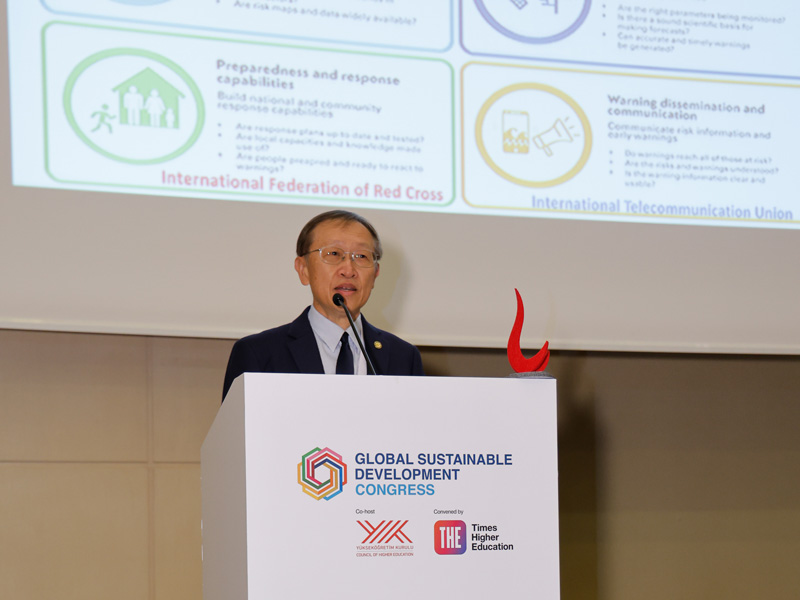
2024 was officially recognised by the World Meteorological Organisation as the hottest year on record, said Fei Chen, associate head of the Division of Environment and Sustainability at The Hong Kong University of Science and Technology (HKUST). Climate scientists’ central role is to inform society about the weather and climate hazards, he said. However, scientists cannot stop there and need to work with society to help people understand the economic, infrastructure and health impacts of climate-related challenges.
Early warning systems save lives and are cost-effective, Chen said. But only half the world’s population is currently protected by these. Collaboration with local and international organisations such as the United Nations can improve this.
Predictive analytics is key. Many systems already exist, so it is important to build on successful examples and scale them up, Chen said. Private sector groups, such as insurance firms, can also be brought into the fold due to their need for reliable data to assess urban risks, he added.
In a world characterised by increasing urbanisation, climate change is intensifying vulnerabilities, driving segregation and evidencing inequalities, said Soledad Garcia Ferrari, personal chair of global urbanism and resilience at the University of Edinburgh. It poses major challenges for urban resilience and addressing them requires approaches that look beyond the physical footprint of weather hazards, emphasising factors such as governance, relationships and communication.
Effective communication can be achieved through an integrated strategy that combines high-resolution weather modelling and prediction capabilities with transdisciplinary research focusing on urban areas. Garcia Ferrari noted that dialogue is key. Understanding a population’s perspective and experiences takes time but expands knowledge beyond the academic and into the community’s approach to the risks and hazards they face to co-create suitable solutions.
Garcia Ferrari shared an example of her work in Latin American cities that are vulnerable to climate hazards. “Technical knowledge alone is not sufficient. We need effective solutions that understand, accept and legitimise local knowledge,” she said. The goal is to increase knowledge and capacity, with the co-creation of tools to enhance risk communication, mitigation and adaptation to climate change.
Alexis Lau, head of the Division of Environment and Sustainability at HKUST, spoke about the power of co-creation using an example of an AI-based air pollution tracking system in Hong Kong that shared local air quality risk data.
The Hong Kong Asthma Society saw the opportunity to integrate tailored features into the app for their members and proposed that the app track specific data most relevant to them. The app was adjusted and improved the safety and quality of life of its users, earning a global public service award. “This was a very good lesson,” Lau said. “Even if we have the best science for prediction, to make it useful for the stakeholders, we need to work with them to co-create.”
The panel:
- Fei Chen, associate head, Division of Environment and Sustainability, The Hong Kong University of Science and Technology
- Soledad Garcia Ferrari, personal chair of global urbanism and resilience, University of Edinburgh
- Alexis Lau, head, Division of Environment and Sustainability, The Hong Kong University of Science and Technology
- Alison Lloyd, associate provost of institutional data and research, The Hong Kong University of Science and Technology (chair)
Find out more about The Hong Kong University of Science and Technology.