
Fostering global and regional partnerships through higher education
Cross-border partnerships within higher education elevate student experience, research and regional development

Sponsored by The Education University of Hong Kong

Sponsored by

Sponsored by
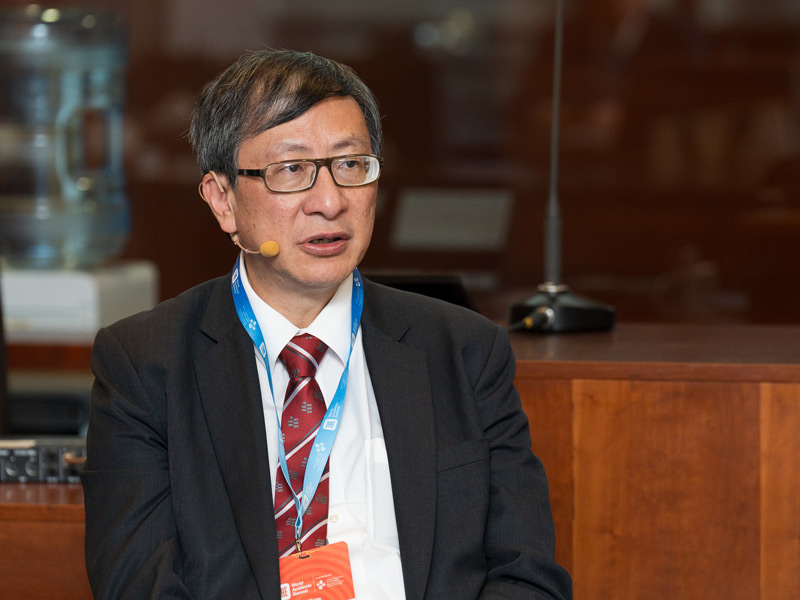
The Education University of Hong Kong (EdUHK) is building global and regional networks that sustain knowledge creation and transfer. According to EdUHK’s president John Chi-Kin Lee, partnerships should not be one-off events. “It is a sustained, ever-growing relationship,” said Lee, addressing a session, hosted in partnership with EdUHK, during the 2025 THE World Academic Summit.
The discussion brought together experts to explore the role of universities as regional connectors that advance integration and opportunity across the Greater Bay Area and countries within China’s Belt and Road Initiative.
“Regional integration under the Belt and Road Initiative doesn’t start with infrastructure,” said Meruyert Seidumanova, professor of practice at Almaty Management University in Kazakhstan. “It starts with people just like me – graduates with ideas that we are building together.”
The educational opportunities offered through the initiative connect people from different countries, fostering research opportunities and knowledge exchange, Seidumanova said. For example, she had three supervisors for her PhD research at EdUHK – from Australia, mainland China and Hong Kong. “It taught me to look at education through different cultural and theoretical lenses, which I still apply to my research,” she said.
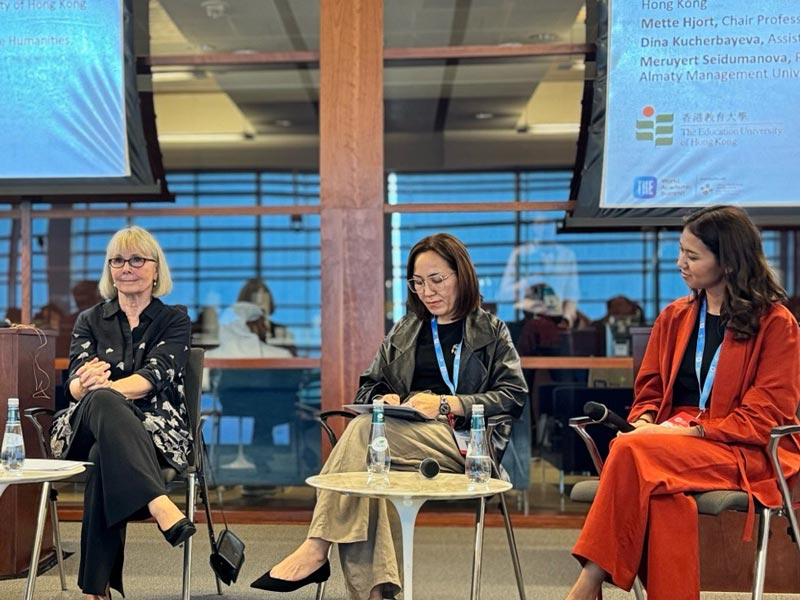
“Belt-and-road thinking is embedded in our institutional DNA,” said Mette Hjort, chair professor of film and media at EdUHK. She pointed to a new initiative connecting EdUHK students with communities and educators in Zanzibar. “We partnered with five local trainers and with a range of local cultural organisations,” she said. The students produced a “substantial creative project, which was performed and shared with the Zanzibar community”.
Lee noted that the university plans to further develop its partnerships in the Global South, particularly in women’s studies. “We are planning to establish more scholarships and research projects that can facilitate education development in the Global South,” he said.
Dina Kucherbayeva, assistant professor at KIMEP University in Kazakhstan and a former student at EdUHK, said that she maintains strong links with her alma mater. She visits the university regularly to continue to engage with other academics. Kucherbayeva’s research focuses on the implementation of language policies in Kazakhstan. “The long-term relationships and partnerships help us to sustain the ideas of the Belt and Road Initiative,” she said.
“I wanted to be part of a sustained regional engagement, and EdUHK provided me with great partnerships around Central Asia and Southeast Asia,” said Seidumanova. “There is also an emphasis on cross-border research at EdUHK, and I wanted to be part of the ecosystem that EdUHK has already built.”
Hong Kong serves as a hub for cross-cultural research and education, the panellists agreed. For example, EdUHK’s academic programmes are taught in English, which allows students to present their ideas internationally, said Hjort. “For students from Belt-and-Road countries seeking to come to Hong Kong, they will find that there is considerable support for them.”
The panel:
- Mette Hjort, chair professor of film and media, The Education University of Hong Kong
- Dina Kucherbayeva, assistant professor, KIMEP University
- John Chi-Kin Lee, president, The Education University of Hong Kong
- Meruyert Seidumanova, professor of practice, Almaty Management University
Find out more about The Education University of Hong Kong.