
Enhancing excellence through lifelong learning
To keep pace with a rapidly evolving skills landscape, universities must rethink pedagogical approaches to embrace lifelong learning

Sponsored by The Education University of Hong Kong

Sponsored by

Sponsored by
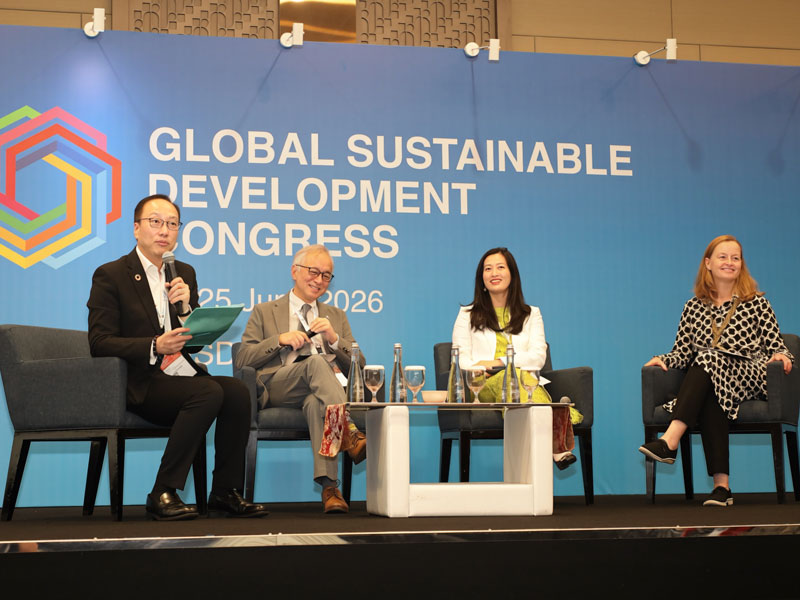
The traditional higher education model focused on teaching learners to acquire knowledge does not fully meet the skills demands of the modern era. A panel discussion – held in partnership with The Education University of Hong Kong (EdUHK) – at the 2026 THE Global Sustainable Development Congress explored the role of lifelong learning in driving institutional excellence and impact.
“We see lifelong learning as a mindset,” said Wing Kai Stephen Chiu, associate dean of international engagement and chair professor of sociology at EdUHK. “It’s about widening access and creating opportunities for people in different stages of life.”
In line with this vision, EdUHK has opened up lectures and learning resources to the public. The university has also developed a diversified learning ecosystem that supports learners from different backgrounds and career trajectories. It has created the Elder Academy, which offers a learning pathway for retirees. The university has also introduced senior entry programmes for mature learners and offers vocational programmes for working adults. “We are the only institution in Hong Kong that offers in-service training for teachers, supported by government funding,” Chiu said. “For us, learning does not stop at graduation.”
Ninh Nguyen, vice-president of global outreach at Phenikaa University in Vietnam, said that the country is looking to overhaul its teacher training system to cater to learners from different backgrounds. “Our teacher training institutions only provide education to pre-service teachers. The government would like to change that, so that they can provide professional and continuous development for teachers across the system.” Phenikaa University also provides learning opportunities for working adults who didn’t have a chance to attend university, she said.
Establishing a culture of lifelong learning can be challenging, said Katrin Kohl, Unesco co-chair in reorienting education towards sustainability at York University in Canada. With barriers such as care responsibilities and financial constraints, making lifelong learning part of jobs would help people access new resources and advance their careers. As lifelong learning becomes increasingly essential for individuals, a deeper discussion is needed at the policy level to explore how it can be facilitated, Kohl said.
Vietnam’s Ministry of Education has set lifelong learning as a priority and is creating pathways between university and vocational training, said Nguyen. Integrating real-world, practical skills learning can make traditional courses more relevant. Similarly, inviting experts and practitioners into the campus as guest lecturers enables students to gain industry exposure while studying.
Societal preferences for traditional higher education might prevent students from pursuing vocational training, as university degrees are widely perceived as the more desirable pathway, said Chetwyn Chan, vice-president for research and development at EdUHK.
However, policies and mindsets are changing, said Chiu. “It’s up to the universities to make their degrees relevant,” he added. “At EdUHK, almost all of our undergraduate degrees have a mandatory internship programme so that students can get to know the world of work.”
The panel:
- Chetwyn Chan, vice president for research and development, The Education University of Hong Kong (moderator)
- Wing Kai Stephen Chiu, associate dean of international engagement and chair professor of sociology, The Education University of Hong Kong
- Katrin Kohl, Unesco co-chair in reorienting education towards sustainability, York University
- Ninh Nguyen, vice-president of global outreach, Phenikaa University