
Tong Zhou Team's Research Selected for Physical Review Letters' Collection of the Year 2025
Researchers proposed the DREAM framework for electric altermagnets, enabling electric-field control of spin polarization. The work was selected for the 2025 PRL annual collection.

Sponsored by

Sponsored by
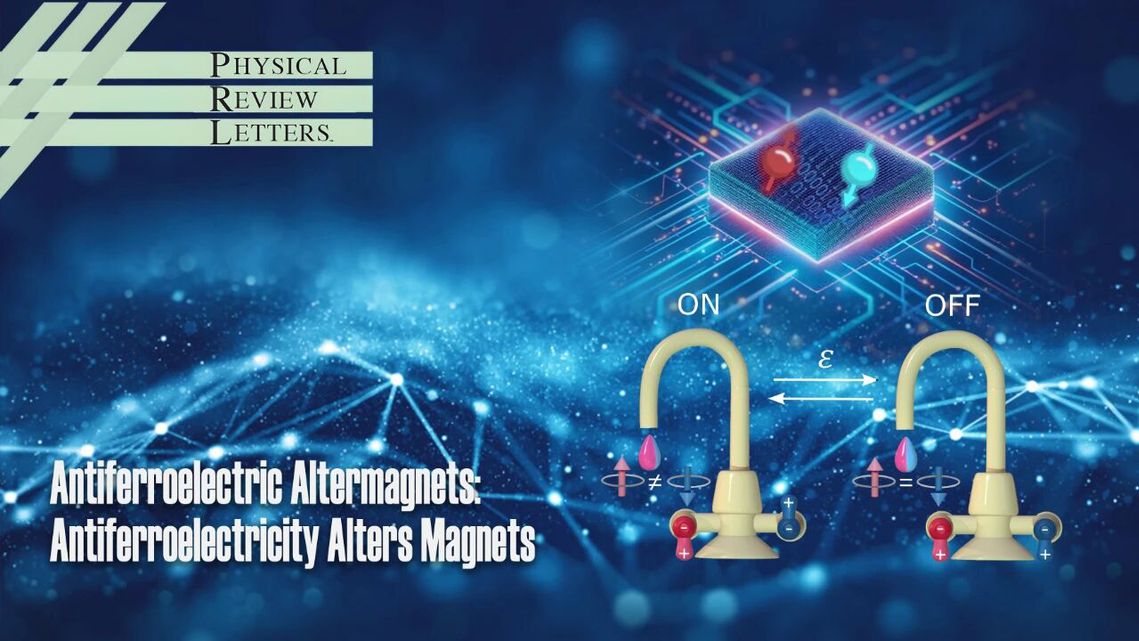
Recently, Physical Review Letters (PRL), one of the world's premier physics journals, officially announced its collection of the year 2025. The original research achievement on antiferroelectric altermagnets by the team of Associate Professor Tong Zhou from the Eastern Institute of Technology, Ningbo (EIT), has been selected.
Physical Review Letters is among the most influential physics journals globally,featuring roughly 2,500 papers each year. Only about 60 of these are chosen for this annual collection, a curated selection that showcases the most groundbreaking and impactful scientific advances across disciplines such as quantum information, particle physics, cosmology, nuclear physics, and condensed matter physics.
This achievement selected for the PRL collection of the year 2025 is the first representative work of the "DREAM" trilogy proposed by Tong Zhou's team—Design and Realize Electric AlterMagnets.
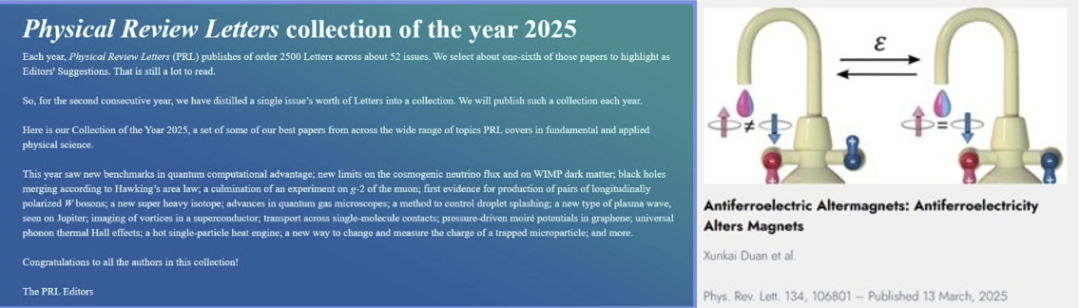
Research achievement by Tong Zhou's team selected for the Physical Review Letters collection of the year 2025. Image provided by the research group
The magnetoelectric coupling effect stands as a key frontier in condensed matter physics and materials science, essential for high-density information storage and low-power spintronic devices. However, the magnetoelectric coupling strength in traditional multiferroic materials is relatively limited, falling short of the requirements for efficient electric‑field control of magnetism and spin. Altermagnets, with their unique symmetry characteristics and spin polarization, offer new opportunities for achieving strong magnetoelectric coupling and electric-field control of spin. Yet, a systematic theoretical framework and achievable material systems were lacking.
Addressing this key chanllenge, Tong Zhou's team originally proposed and systematically developed the research direction of Magneto-Electric Altermagnets (DREAM). They established a new class of multiferroic altermagnet systems centered around Antiferroelectric Altermagnets (AFEAM), Ferroelectric Altermagnets (FEAM), and Molecular Ferroelectric Altermagnets (MFEAM).
Since the English acronyms of these new material types all end with "EAM", the team named this series of works DREAM (Design and Realize Electric AlterMagnets).Guided by clear design principles and theoretical models, the DREAM framework integrates material realization with characterization and detection pathways. It enables efficient electric‑field control of both magnetism and spin polarization, thereby establishing a new paradigm for the electrical manipulation of magnetism.
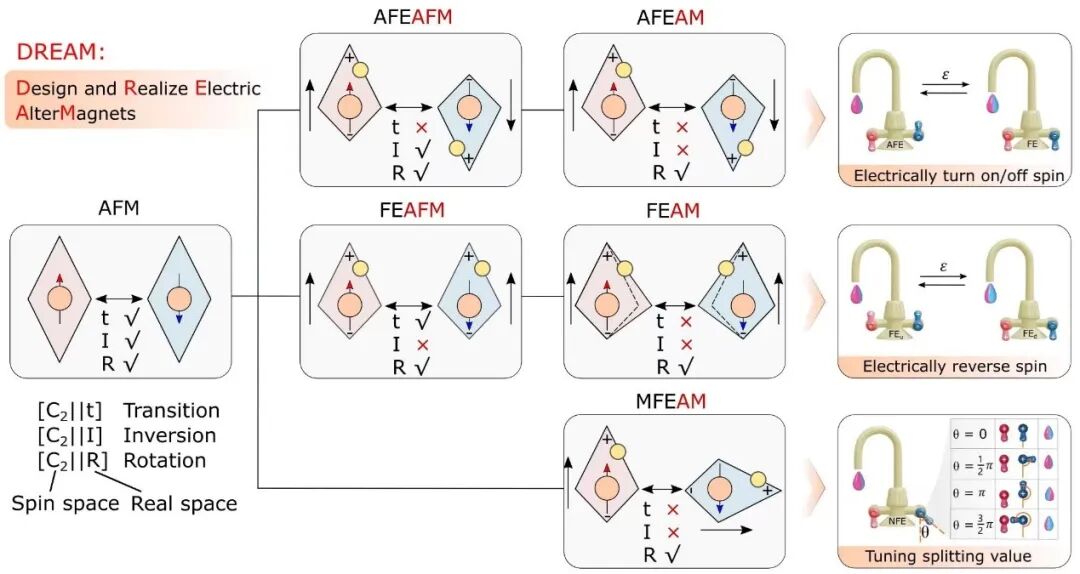
Schematic of the DREAM design principle and applications. Image provided by the research group
1. Antiferroelectric Altermagnets (AFEAM): Electrical Control of Spin‑Polarization On/Off
The team proposed the AFEAM concept and its material realization scheme, utilizing an electric field to switch between antiferroelectric and ferroelectric states, thereby achieving electrical control over the presence or absence of spin polarization. This result was published in Physical Review Letters, selected as an Editors' Suggestion and now for this annual collection. Since its publication in March 2025, the paper has received over 160 citations and has been designated an ESI Highly Cited Paper (top 1%) and Hot Paper (top 0.1%).
2. Ferroelectric Altermagnets (FEAM):Electrical Control of Spin‑Polarization Direction
The team introduced the concept of two-dimensional FEAM concept and its material realization scheme. By switching the ferroelectric polarization direction with an electric field, they achieved electrical control over the direction of spin polarization. This result was published in Nano Letters and has received over 50 citations since its publication in May 2025.
3. Molecular Ferroelectric Altermagnets (MFEAM):Electrical Control of Spin‑Polarization Magnitude and Direction
The team proposed the MFEAM concept and their material implementations. By manipulating the orientation of organic molecules, they achieved controllable regulation of both the direction and magnitude of spin polarization. This result was published in Science China: Physics, Mechanics & Astronomy and was selected as a Journal Cover Article, Editor's Suggestion, and Research Highlight.
Upon release, the DREAM series of works rapidly sparked an international research interest and attracted widespread attention. They were featured in reports by media outlets including the American Physical Society's Physics, Phys.org, the AAAS EurekAlert!, and Scientific American. Several academicians (both domestic and international) and pioneering scholars in the field of altermagnetism have highly praised the work, noting that it "opens a new paradigm for multiferroic material design". This selection for the PRL collection of the year 2025 further underscores the originality and academic impact of the DREAM achievements.
The representative papers of the DREAM trilogy all list the Eastern Institute of Technology, Ningbo as the primary affiliation. Ph.D. student Xunkai Duan, postdoctoral researchers Ziye Zhu and Jiayong Zhang are the first authors of the respective papers, with Associate Professor Tong Zhou serving as the sole corresponding author. Collaborators include Chair Professor Suhuai Wei from the Eastern Institute of Technology, Ningbo, Professor Zhenyu Zhang from the University of Science and Technology of China, Professor Igor Žutić and postdoctoral researcher Yuntian Liu from the University at Buffalo, State University of New York, among others.
Link:
https://doi.org/10.1103/PhysRevLett.134.106801;