
Suhuai Wei's Team Secures Spot in "Top 10 Semiconductor Research Advances" for the Second Straight Year
Teaser: Researchers improved deep-UV LEDs by introducing nitrogen-vacancy defects to slow electrons and balance carrier injection. This boosted efficiency and was named a 2025 Top Semiconductor Advance.

Sponsored by

Sponsored by
On February 13, the Journal of Semiconductors officially announced the "2025 Top 10 Semiconductor Research Advances". The study "Overcoming asymmetric carrier injection in III-nitride light-emitting diodes through defect engineering", conducted by Professor Suhuai Wei, Chair Professor and Dean of the School of Physics at the Eastern Institute of Technology, Ningbo (EIT), and his collaborators, was successfully selected. This marks the second consecutive year that Professor Suhuai Wei's team has received this prestigious honor.
GaN-based deep-ultraviolet light-emitting diodes (DUV LEDs) hold great promise for applications in sterilization, medical treatment, and quantum communications. However, the quantum efficiency is still lower than 10%, severely limiting their development.
This efficiency bottleneck arises because LED operation requires synchronized injection of both electrons and holes—the two types of carriers. Electrons, however, drift much further than holes, resulting in imbalance in the active region. Conventionally, the electron blocking layer (EBL) has been widely applied to decelerate electrons, but this inadvertently restricts hole transport, creating an intrinsic trade-off.
Professor Suhuai Wei's team has pioneered an alternative strategy: strategically introducing nitrogen vacancies defects at material interfaces to create deceleration steps for electrons, enabling them to release excess energy and slow their dynamics.The results demonstrate that the electron relaxation time, initially as long as 8.61 ps, was reduced to 0.15 ps, effectively synchronizing electron and hole transport and substantially enhancing radiative recombination efficiency.
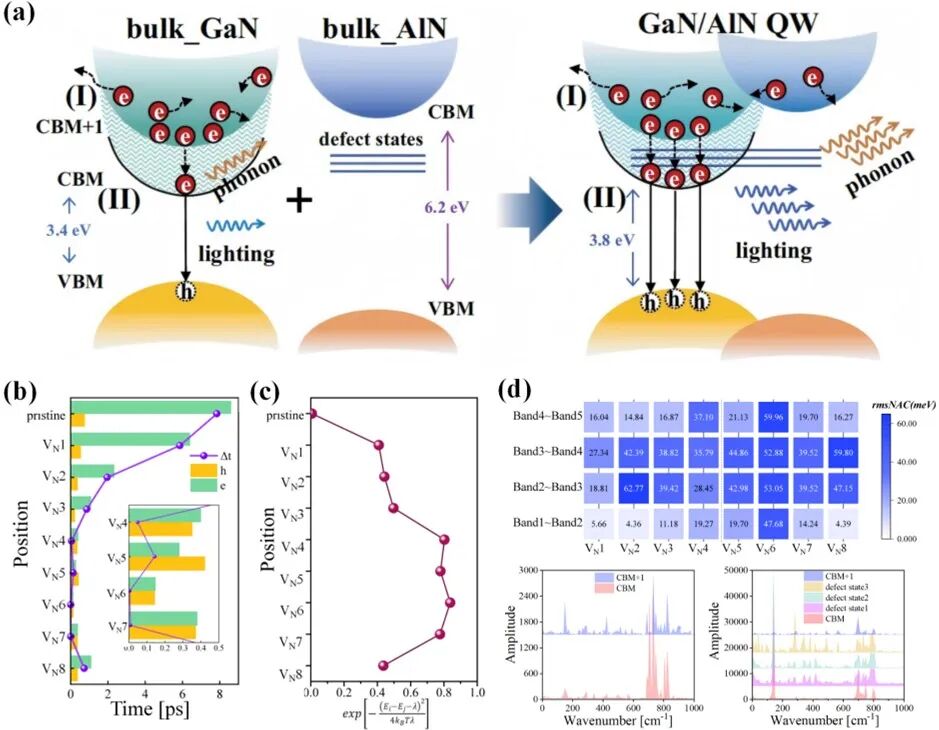
First-Principles Calculations reveal the physical mechanism of defect-accelerated electron cooling. Image provided by the research group
The ingenuity of this work lies in transforming a traditionally detrimental defect into a beneficial tool for carrier modulation—turning a liability into an asset. This approach provides a new paradigm for designing high-efficiency DUV LEDs. The findings were published in the leading physics journal Physical Review Letters.
The first author of the paper is Dr. Yuxin Yang, formerly a doctoral student at the Changchun Institute of Optics, Fine Mechanics and Physics (CIOMP), Chinese Academy of Sciences, and currently a postdoctoral fellow at the School of Physics of the Eastern Institute of Technology, Ningbo. Professor Suhuai Wei from the Eastern Institute of Technology, Ningbo, together with Researchers Zhiming Shi, Xiaojuan Sun, and Dabing Li from CIOMP, serve as co-corresponding authors.This marks the second consecutive year that Professor Suhuai Wei's research has been recognized among the Top 10 Semiconductor Research Advances. In January 2025, his collaborative work proposing a novel theory of "Softening of the optical phonon by reduced interatomic bonding strength without depolarization" was selected for the 2024 Top 10 Semiconductor Research Advances. That study was published in Nature in October 2024.
Link: