
Risks to "Forever Chemicals" from Marine Fish
A global study led by Chunmiao Zheng finds PFAS accumulating in 212 marine fish species, posing hidden health risks through seafood consumption.

Sponsored by

Sponsored by
Commonly consumed fish such as salmon and tuna may be silently contributing to a "hidden health risk," according to a recent study.
A collaborative research led by Professor Chunmiao Zheng, Chair Professor in the School of the Environment and Sustainable Engineering, College of Engineering, Eastern Institute of Technology, Ningbo, and Associate Professor Wenhui Qiu of Southern University of Science and Technology (SUSTech), has revealed that per- and polyfluoroalkyl substances (PFAS) are progressively accumulating in marine food webs and entering the human body through seafood consumption.
The study provides the first systematic assessment of exposure risks associated with PFAS in 212 species of edible marine fish worldwide, offering critical scientific support for safeguarding dietary safety. The findings were published in Science on December 19 (Beijing time).
The Pervasive yet Hidden Hazards of "Forever Chemicals"
PFAS are a class of synthetic chemicals widely used in industrial production and consumer goods, earning them the moniker "forever chemicals" due to their environmental persistence. They are commonly found in everyday items such as cosmetics, non-stick cookware coatings, household cleaners, adhesive notes, carpets, dental floss, ski boards, outdoor sportswear, and athletic shoes.
Due to their resistance to degradation in the environment, PFAS can bioaccumulate through food chains and persist in the human body, posing potential threats to health. Previous studies have linked PFAS exposure to adverse effects on fertility, liver toxicity, renal impairment, neurotoxicity, and carcinogenicity.
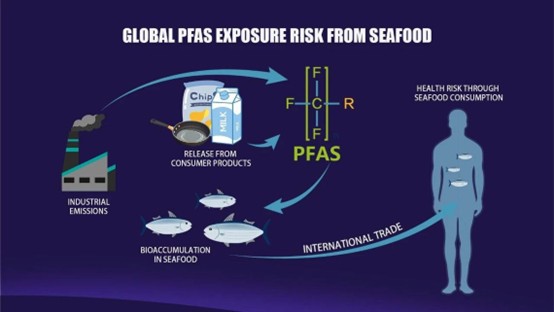
Professor Chunmiao Zheng emphasized that this study "Risks of Per- and Polyfluoroalkyl Substance Exposure Through Marine Fish Consumption" systematically evaluates PFAS concentrations in 212 species of edible marine fish and the associated dietary exposure risks for human populations. It delineates the complete journey of PFAS—from industrial emissions to marine fish, and subsequently to human bodies via global trade networks—revealing how environmental health risks are invisibly transmitted and redistributed in the modern globalized chain. This work holds significant scientific and practical relevance.
Unveiling the "Invisible Journey" of Pollution through a Global Risk Map
To elucidate the relationship between PFAS concentrations in marine fish and their oceanic origins, the research team conducted a "global census" of PFAS levels in edible marine fish.
By integrating two decades of seawater PFAS monitoring data from 3,126 locations worldwide and employing a marine food web model, the team predicted PFAS concentrations in 212 edible marine fish species, accounting for 99% of the global catch. PFAS concentrations in fish were found to correlate with regional emission histories and oceanic dilution capacities, with significantly higher levels observed in higher-trophic-level species.
To validate the model predictions for the period 2010–2021, the team analyzed actual fish samples—spanning 33 families, 87 species, and 150 specimens collected globally—using high-performance liquid chromatography-tandem mass spectrometry (HPLC-MS). Validation results showed that 33% of the data points fell within a two-fold error range, while 94% were within a ten-fold error range. Trophic-level validation also largely aligned within a ten-fold error margin, with any outliers falling within the range of measured data variability.
By incorporating global catch, trade, and demographic data, the study estimated the daily intake of C8-PFAS through marine fish consumption across different populations. The findings indicate that PFAS are being transferred via global fish trade from regions with higher contamination levels to those with lower levels. This highlights and quantifies the global health risks posed by PFAS through marine fish consumption, particularly for countries and regions reliant on imported seafood. It also underscores the potential of global food trade to reshape PFAS exposure patterns (see figures below).
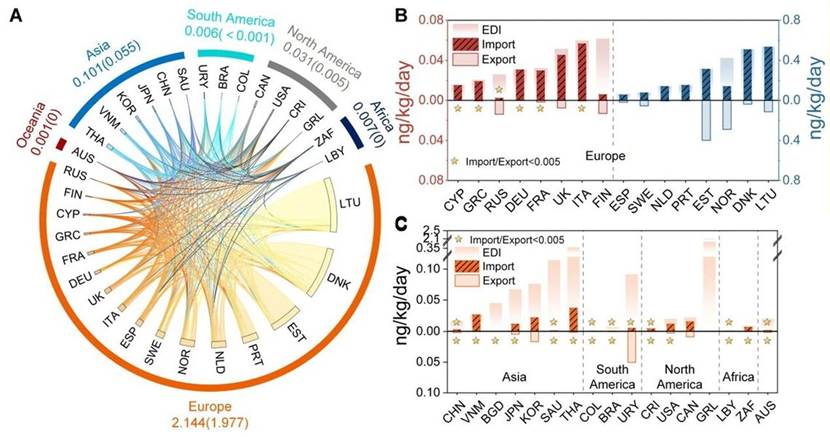 Specific pathways through which international trade alters national C8-PFAS exposure (A) and estimated daily intake of C8-PFAS from marine fish consumption under the influence of international trade (B and C). | Image provided by the research team.
In essence, PFAS can "hitch a ride" on international trade vessels, transferring from heavily polluted waters to the dining tables of countries with cleaner coastal waters. This implies that even residents of nations with pristine coastlines may face additional risks from imported seafood.
Longer-Chain PFAS: "A Subject of Greater Concern"
Every bite of marine fish may carry the "pollution memory" of a distant oceanic region—a memory now silently linking human health to remote marine environments through global trade networks.
Associate Professor Wenhui Qiu pointed out that longer-chain PFAS, such as perfluorodecanoic acid (PFDA, C10), perfluorononanoic acid (PFNA, C9), and perfluoroundecanoic acid (PFUnDA, C11), exhibit stronger bioaccumulation potential. This elevates PFAS concentrations in fish and subsequently increases human dietary exposure.
Moreover, the bioaccumulative properties of these longer-chain compounds influence toxicologically derived reference doses, leading to stricter intake standards. Together, these factors contribute to potential health threats that are not yet fully understood, warranting further attention to the risks posed by longer-chain PFAS.
This study establishes an innovative research framework that systematically elucidates the bioaccumulation dynamics of PFAS in marine food webs and the resulting human exposure risks. The framework integrates environmental concentration data, marine food web modeling, bioconcentration factors, global catch statistics, trade networks, and health risk assessment, clearly tracing the complete pathway of PFAS from aquatic environments to fish and subsequently to humans via dietary exposure.
The research discovers that PFAS exhibit significant biomagnification effects in marine food webs, forming the chemical basis for accumulation in fish and subsequent human dietary exposure.
"Notably, due to their greater persistence and bioaccumulation potential, longer-chain PFAS pose more pronounced ecological and health risks on a global scale," stated Professor Chunmiao Zheng. This study clarifies the differential bioaccumulation behaviors of various PFAS homologs and their divergent risk profiles, providing key scientific evidence for formulating fisheries management and PFAS regulatory policies.
Associate Professor Wenhui Qiu and doctoral candidate Ge Yang of SUSTech's School of Environmental Science and Engineering are co-first authors. Professor Chunmiao Zheng of the Eastern Institute of Technology, Ningbo is the principal investigator and co-corresponding author.
Other co-corresponding authors include Associate Professor Wenhui Qiu of SUSTech, Professor Zhaomin Dong of Southeast University, and Professor Minghong Wu of Fuzhou University. Southern University of Science and Technology is the first affiliation of this publication.
The study received support from the National Natural Science Foundation of China, as well as research grants from Guangdong Province, Shenzhen City, Zhejiang Province, Ningbo City, and other provincial and municipal agencies.