
Research Progress | Breaking Ionic Conductivity Records: Academician Xueliang Sun's Team Featured in Science
Researchers developed a new oxyhalide superionic conductor enabling all-solid-state batteries with record conductivity and stable operation even at -50°C, advancing extreme-environment energy storage.

Sponsored by

Sponsored by
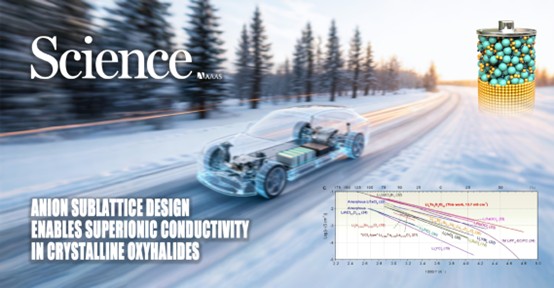
What if electric vehicles and low-altitude aircraft could operate stably in extreme cold as low as -50°C, completely eliminating battery anxiety? This vision may soon become reality.
A team led by Academician Xueliang, Chair Professor of Eastern Institute of Technology, Ningbo (EIT), Foreign Member of the Chinese Academy of Engineering, with collaborators, has developed a new superionic conductor that offers a novel technological pathway toward high-performance all-solid-state batteries—particularly those exhibiting exceptional cycling stability and rate capability under extreme conditions. The related research was published in Science on October 10.
In a study titled "Anion sublattice design enables superionic conductivity in crystalline oxyhalides," Academician Xueliang Sun's team at EIT, together with Professor Yifei Mo's group at the University of Maryland, reported the development of a new superionic conductor, Li₃Ta₃O₄Cl₁₀, which achieves a record room-temperature ionic conductivity of 13.7 mS/cm among halide-based solid electrolytes, and enables highly stable all-solid-state battery operation even at -50°C.
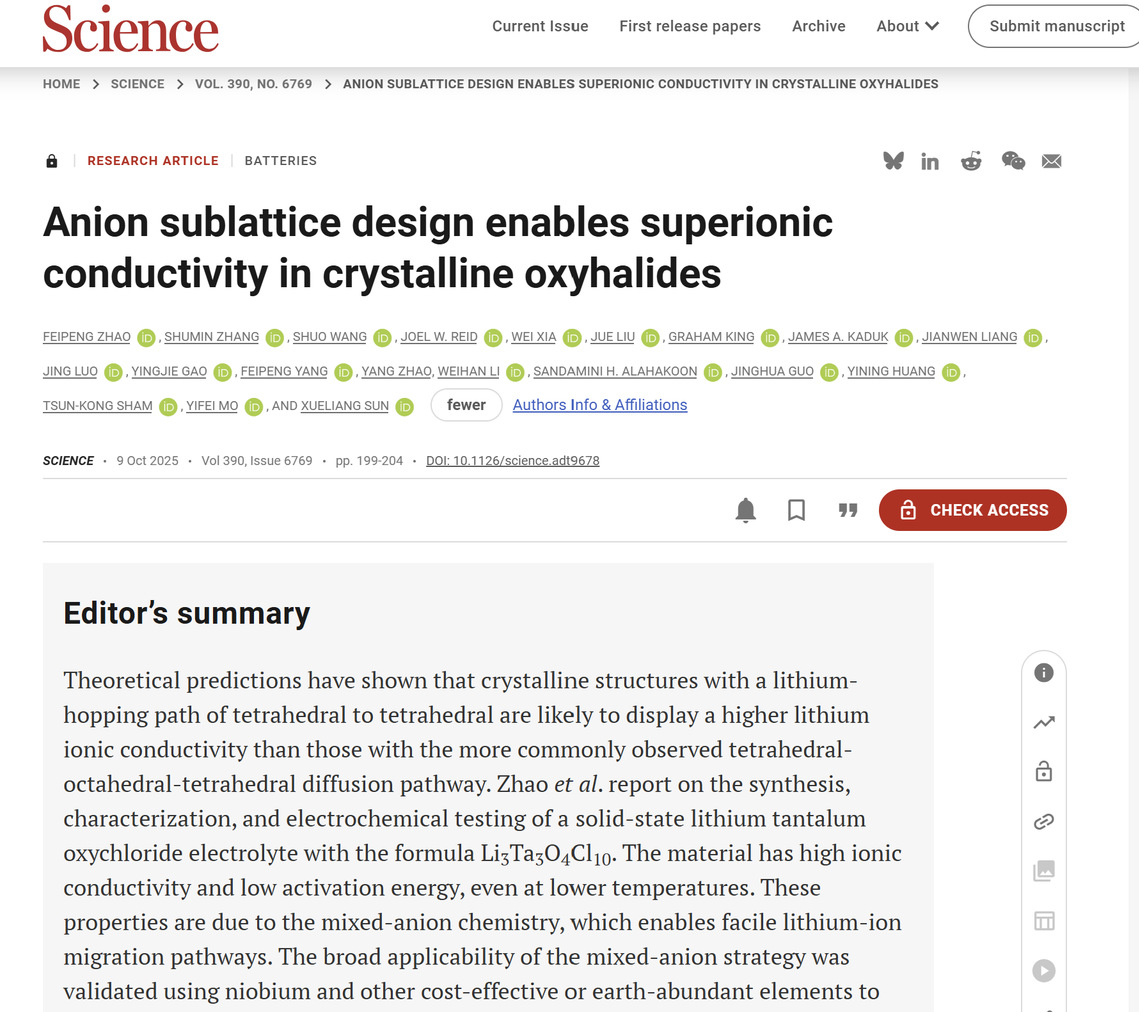
This work demonstrates that anionic framework engineering gives oxyhalides a unique crystal structure and ultrahigh ionic conductivity, offering new insights for understanding and applying mixed-anion solid electrolytes. According to Academician Xueliang Sun's team, the emergence of this novel oxyhalide electrolyte breaks the theoretical barrier that only sulfides enable continuous low-coordination conduction. This not only contributes to the development of fast ion conductors but also opens new directions for exploring crystalline mixed-anion electrolytes. It provides a new technical route for realizing high-performance all-solid-state batteries—especially those with excellent cycling stability and rate performance in extreme environments—and is expected to accelerate the transition of all-solid-state batteries from the laboratory to practical applications.
The co-first authors are Dr. Feipeng Zhao, formerly a postdoctoral fellow at Western University and now a Specially-Appointed Professor and Doctoral Supervisor at the Institute of Functional Nano & Soft Materials (FUNSOM) at Soochow University; Dr. Shumin Zhang, formerly a postdoctoral fellow at Western University and now a Professor at the School of Physical Science and Technology at Soochow University; Assistant Professor Shuo Wang from the Eastern Institute of Technology, Ningbo; and Dr. Joel W. Reid from the Canadian Light Source Inc. The corresponding authors are Chair Professor Xueliang Sun from the Eastern Institute of Technology, Ningbo, and Professor Yifei Mo from the University of Maryland. Co-authors include Assistant Professor Weihan Li and Assistant Professor Wei Xia, both from the Eastern Institute of Technology, Ningbo. This work received support from Dr. Jue Liu at the Neutron Diffraction Center of Oak Ridge National Laboratory in the United States.