
Life in Silicon-Based Solid-State Batteries
All-solid-state batteries promise 1,000 km EV range, but silicon anodes react with sulfide electrolytes, causing lithium loss and rapid capacity fade.

Sponsored by

Sponsored by
Imagine smartphones that require charging only once a week, or electric vehicles capable of exceeding 1,000 km on a single charge. All-solid-state batteries (ASSBs), regarded as the next-generation power source, could turn this vision into reality.
However, a critical challenge hinders their development: when high-capacity silicon is used as the anode, it exhibits severe interfacial incompatibility with sulfide-based solid electrolytes (e.g., Li₆PS₅Cl, LPSC). Continuous side reactions at the interface lead to significant lithium consumption, resulting in rapid capacity fading, poor Coulombic efficiency, and sluggish kinetics.
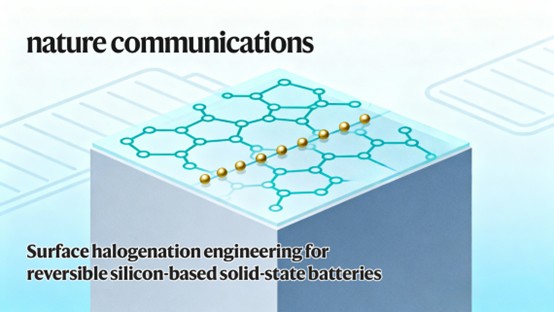
To address this, a research team led by Assistant Professor Wei Xia from the Eastern Institute of Technology, Ningbo, in collaboration with Researcher Ning Lin from Yongjiang Laboratory, proposed a surface halogenation engineering strategy — essentially coating silicon particles with a halide jacket. This approach successfully mitigates interfacial degradation between silicon negative electrodes and solid electrolytes, markedly improving reversibility and cycling stability, thereby providing key technical support for the practical application of high-energy-density solid-state batteries.
Recently, the findings were published in Nature Communications.
One core bottleneck in silicon-based ASSBs lies in the poor (electro)chemical compatibility between silicon negative electrodes and sulfide solid electrolytes, which also leads to sluggish interfacial charge transfer kinetics. Together, these issues cause severe irreversible lithium loss, limiting initial Coulombic efficiency and long-term cyclability.
How can a simple and controllable surface modification strategy be designed to reconstruct the silicon surface, simultaneously address poor interfacial compatibility and slow charge transport, and effectively suppress lithium loss caused by unstable solid electrolyte interphase growth and kinetically trapped lithium? Ultimately, the core objective was to achieve enhanced reversibility, cycling stability, and high-load performance in silicon-based solid-state batteries under room-temperature conditions.
The team developed an innovative surface halogenation strategy that substantially enhances the electrochemical performance of silicon negative electrodes in ASSBs. The key lies in utilizing the spontaneous reaction between halides such as AlCl₃ and the native amorphous oxide layer on silicon surfaces. Under mild conditions, this forms a multifunctional composite interphase — Al(Si)OCl — that stabilizes the interface and facilitates charge transport.
This strategy addresses the dual bottlenecks of interfacial compatibility and charge-transfer kinetics between the silicon negative electrons and the sulfide solid electrolyte. Through neutron depth profiling coupled with gas chromatography, the researchers achieved precise quantification and distinction between lithium consumption and kinetically trapped lithium. Results showed that surface halogenation reduced lithium consumption from 9.9% to 7.5% and dramatically lowered kinetically trapped lithium from 1.5% to 0.1%, thereby raising the initial Coulombic efficiency in half-cells from 88.4% to 94.3%.
Electrochemical impedance spectroscopy and distribution of relaxation times analysis confirmed a significant reduction in interfacial charge-transfer resistance and an increase in electronic conductivity by over 40-fold, with interfacial impedance remaining stable during cycling. The modified Si@AlCl₃ negative electrodes exhibited remarkable cycling stability: in half-cells, capacity retention after 200 cycles at 3C increased from 14% (pure Si) to 86%, with an average Coulombic efficiency of 99.998%. Under high-load conditions, the Si@AlCl₃ electrode maintained 72% capacity retention after 500 cycles at 5.1 mA cm⁻². In full-cell configurations paired with a ternary cathode, the battery retained 80% capacity after 200 cycles at 1C, with an average Coulombic efficiency exceeding 99.95%.This study not only provides a simple, controllable, and scalable interfacial reconstruction method but also elucidates — through multi-scale characterization — the dual mechanism by which the halogenated interphase suppresses irreversible lithium loss. The work offers important theoretical and technical foundations for the design and industrialization of highly reversible silicon-based solid-state batteries.
The first author is Haosheng Li, a visiting scholar at the Eastern Institute of Technology, Ningbo, and a postdoctoral researcher at Yongjiang Laboratory. Corresponding authors are Assistant Professor Wei Xia of the Eastern Institute of Technology, Ningbo and Researcher Ning Lin of Yongjiang Laboratory. Collaborators also include Researcher Caijin Xiao from the China Institute of Atomic Energy.
This work was supported by the National Natural Science Foundation of China, the Key R&D Program of Zhejiang, the Zhejiang Provincial Natural Science Foundation of China, and Zhejiang Provincial Postdoctoral Science Foundation.