
Abu Dhabi University students develop solar-powered system to generate water from air
An innovative student-led project uses solar energy and advanced materials to generate clean water from air, targeting remote, desert and infrastructure-limited regions

Sponsored by Abu Dhabi University

Sponsored by

Sponsored by
As water scarcity remains a critical global challenge, a team of students from Abu Dhabi University (ADU) is developing an innovative solar-powered system capable of generating clean drinking water from air, offering a promising solution tailored to arid environments.
Aligned with the UAE’s sustainability initiatives, the project demonstrates how student-led innovation can contribute to advancing national priorities while addressing global environmental challenges. Led by master’s student Mubarak Ahmad Al Hamadi, alongside Anas Omar Mustafa and undergraduate students Malak Hasan Alabdul Razzak, Reel Mohamed Ahmed, Sabeeha Zainab Hasham and Marjan Mohammad Aref Shadmani Fard, under the supervision of principal investigator to the research Sharul Sham bin Dol, the project has progressed beyond ideation and testing and is now entering optimization phase.
The team is currently enhancing system performance through an AI-enabled digital-twin design to increase water production while reducing overall energy consumption. A field-tested prototype has already been deployed, demonstrating its potential as a practical solution for water-scarce environments in the UAE and beyond.
The project is being funded by the Dubai Research, Development and Innovation Grant Initiative as part of the Dubai Future Foundation, underscoring its significance as a high-impact sustainability-focused research effort. It also builds on earlier work under the Mubadala-Abu Dhabi University Collaborative Project Award in 2024.
An innovative solution to a growing global challenge
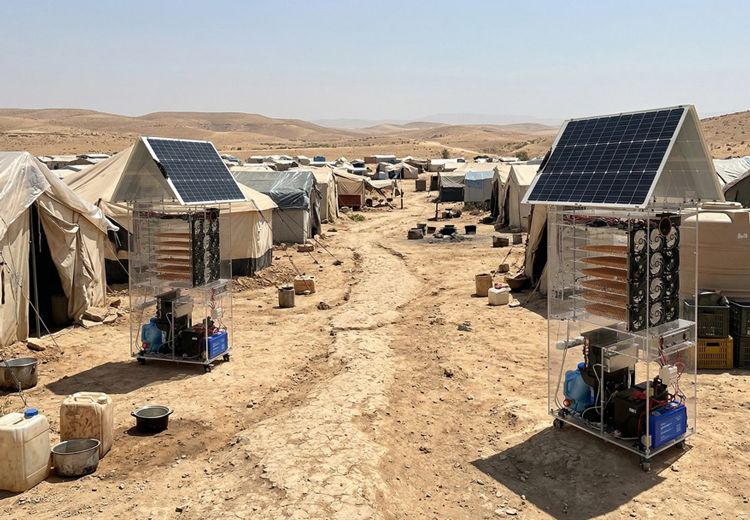
The project seeks to develop an integrated system capable of extracting potable water from atmospheric humidity using solar energy. This creative approach positions the technology as a promising, scalable and sustainable solution for regions facing limited water resources and infrastructure constraints, such as desert environments, remote communities, refugee camps, temporary settlements and locations that are difficult to access through conventional transportation and supply networks.
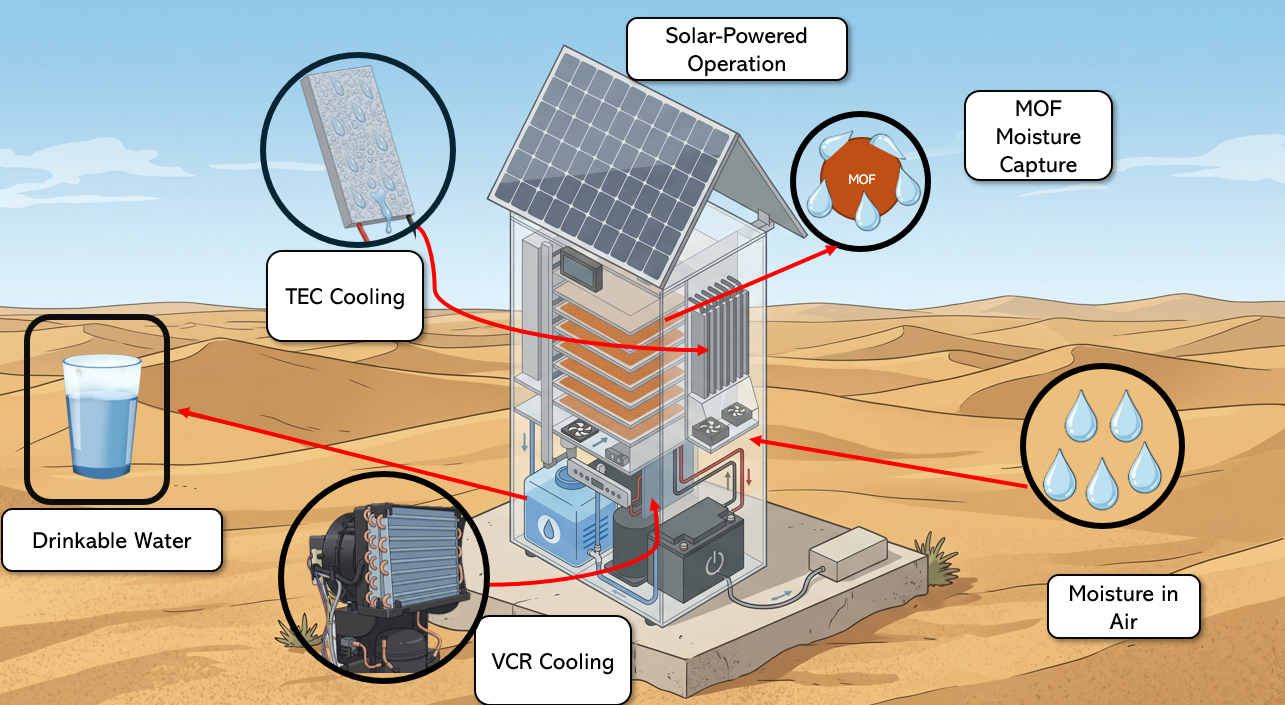
The system integrates several advanced technologies, including metal-organic frameworks (MOFs), vapor compression refrigeration and thermoelectric cooling. Together, these technologies enhance the efficiency of capturing moisture from the air, condensing water vapor and converting it into usable drinking water. By reducing dependency on energy-intensive desalination and groundwater pumping, the solution minimises associated greenhouse gas emissions.
The system extracts moisture from air through a combination of advanced water adsorption-desorption technologies and smart cooling technologies. MOFs enable operation in humidity levels as low as 10 per cent, making the system ideal for arid regions where access to reliable water sources can be limited. Powered by solar energy, the solution utilizes the UAE’s abundant solar resource to provide a more sustainable and energy independent water source.
“Water scarcity, particularly in arid regions, was the key motivation behind this project,” says Hamadi. “We wanted to explore how renewable energy could be used to generate clean drinking water from a readily available resource – the air around us. Working as a multidisciplinary team allowed us to combine different perspectives and technical skills, while the support and guidance we received at Abu Dhabi University enabled us to transform our idea into a practical, research-driven solution. This experience has strengthened our ambition to develop technologies that contribute to sustainable development and address real-world challenges.”
Long-term impact
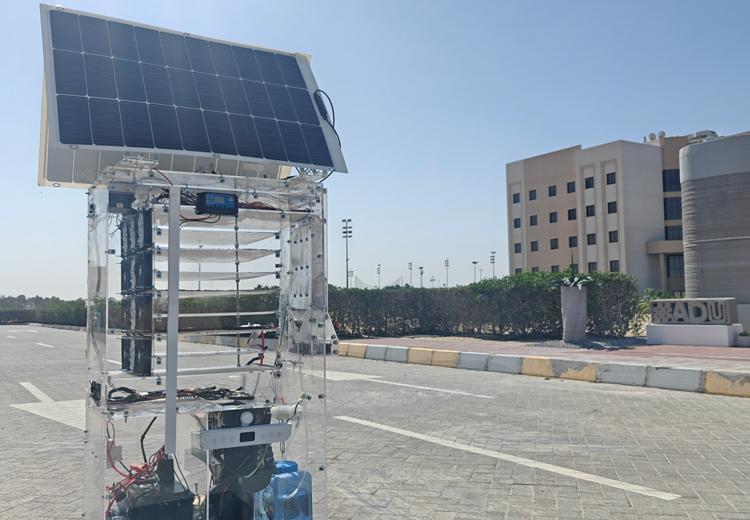
A functional prototype has already been designed, fabricated and tested, demonstrating progress beyond the conceptual stage. Preliminary results show water production of up to 13 litres per day, with testing conducted across the UAE, reinforcing its adaptability in varying environments.
At its current scale, the system can generate nearly 5,000 litres annually. At a larger scale, a 100 square-meter deployment footprint could accommodate around 350 units, producing up to 4,500 litres per day, enough to support the daily needs of more than 2,200 people. Beyond water generation, the system could reduce dependence on transported bottled water, reducing logistical needs and plastic waste.
“This project reflects the innovative mindset we strive to cultivate at Abu Dhabi University,” says Dol. “By integrating advanced technologies with renewable energy, our students are developing a solution that addresses global water scarcity while supporting the UAE’s sustainability and water security priorities under the UAE Water Security Strategy 2036.”
The team hopes this innovation will contribute to scalable solutions for water-scarce regions. Future development will focus on improving system efficiency, strengthening smart integration and adapting the technology for deployment in remote areas and temporary settlements, ultimately supporting sustainable water solutions across the UAE and other water-scarce regions.