ADVERTISEMENT
China’s jobs crunch is eroding the value of UK master’s degrees
One-year degrees may be cost-effective, but pre-existing doubts about their quality are now becoming a barrier to employment, says Grace Chau
Source: Getty Images
Some Chinese students and families have become increasingly sceptical about the value of a UK master’s degree. Compared with programmes in the US, Australia and Canada, UK master’s courses are typically completed in just one year, leading some to question whether there is sufficient time for teaching, research and the development of deeper subject knowledge. In addition, relatively accessible entry requirements for some programmes have raised concerns among Chinese families and employers about the quality and prestige of certain UK master’s degrees.
UK universities’ reliance on income from international students is well known – and around one-fifth of the total revenue from that source is accounted for by students from China. Unsurprisingly, then, their steep decline is causing a lot of concern – particularly given increasing visa rejection rates from other major source countries.
In a 2025 survey by the British Universities International Liaison Association, 80 per cent of institutions reported a decline in postgraduate applications from China, with an average drop of about 17 per cent.
But why is this happening? And is the trend likely to endure?
For many years, UK master’s degrees, in particular, held strong appeal for Chinese students and families. Their one-year duration was seen as efficient and cost-effective compared with longer programmes elsewhere, particularly in the US, while still carrying strong international prestige. Degrees from Russell Group and other high-ranked universities, in particular, were widely viewed as a route to career advancement and a means of reinforcing middle-class status.
ADVERTISEMENT
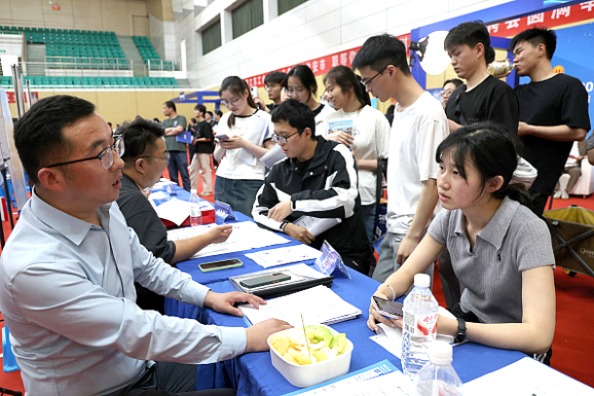
There has always been an accompanying worry about the relative academic quality of the one-year master’s, but, before the pandemic, that did not prevent Chinese returnees from the UK from finding jobs amid strong economic growth. In the post-pandemic period, there was a further significant spike in Chinese students pursuing a UK master’s, but economic slowdown and increased competition in the China labour market have made finding employment more challenging for everyone – including overseas returnees.
In this environment, employers have become more selective, and graduates report that recruiters are increasingly sceptical about one-year British master’s degrees, which are sometimes referred to pejoratively as “水硕” – literally “water master’s”.
In addition, relatively accessible entry requirements for some programmes have raised concerns among Chinese families and employers about the quality and prestige of certain UK master’s degrees. British bachelor’s and PhD degrees are still viewed more positively, but far fewer Chinese students pursue these degrees.
Policy shifts have also altered the institutional value of overseas degrees. In the early 2000s, Chinese policy actively encouraged international education mobility and facilitated the “cashing in” of overseas credentials. In the post-pandemic era, however, the emphasis has shifted towards educational self-reliance and domestic talent development. As a result, overseas degrees no longer confer advantage in either the public or private sectors, and returnees may even face subtle disadvantages in recruitment, particularly in government-linked and state-owned organisations.
China’s post-pandemic economic slowdown and structural adjustment have added further pressure. Falling property values, in particular, have hit the middle-class households that traditionally fund international study. With postgraduate tuition fees often approaching £30,000 a year and total annual costs – including living expenses and visa fees – frequently surpassing £50,000, affordability has become a decisive factor for many families, particularly given the declining career prospects a UK degree offers in China.
The constant uplift in international fees has contributed to a growing narrative among some Chinese students that they are treated as “cash cows” by a financially strained higher education system. Many also express frustration at the limited support they receive from UK universities, particularly in careers guidance and employment services. One Chinese undergraduate in the UK, who later moved to the US for a master’s degree, described her UK institution as “offering nothing” in comparison.
Policy uncertainty has further intensified these concerns. The UK’s immigration framework for international students has undergone repeated revisions in recent years, particularly regarding post-study work rights. Reintroduced in 2021, the Graduate Route was initially welcomed. However, proposed changes – including a reduction from 24 to 18 months for most graduates from January 2027 – have created further uncertainty. For some students, this signals a weakening commitment to international talent retention. As one master’s student noted, “it gives the impression that the UK does not welcome international students.”
ADVERTISEMENT
Many students also perceive narrowing credible pathways from study to long-term residence. The UK is often seen as offering temporary access to the labour market without a clear route to settlement. Even where post-study work visas are secured, transitions into longer-term routes such as the Skilled Worker visa remain difficult, with employers often reluctant to sponsor graduates on time-limited visas. The government’s intention to double the length of time required for indefinite leave to remain to 10 years will only add to Chinese students’ sense of not being wanted once they stop paying tuition fees.
A similar perception exists about other major anglophone host countries, too, but Chinese students are increasingly evaluating international education through criteria beyond institutional rankings, including employability, student support, affordability, post-study opportunities and perceptions of welcome. And in these areas, the UK faces growing competition from countries such as Germany, which are positioning themselves more explicitly as long-term destinations for international talent.
In short, the decline in Chinese enrolment is likely to endure, further straining a funding model heavily dependent on international tuition income, particularly among institutions already under pressure.
More broadly, it highlights the risks of over-reliance on a single overseas market. And it suggests that even as they become more vital than ever amid declining domestic incomes, UK universities’ established international recruitment models may no longer be fit for purpose.
Grace W. F. Chau is an educator, writer and independent researcher whose work focuses on Chinese migration and politics. She is an affiliate in the School of Social and Political Sciences at the University of Glasgow.
Read more about

Related articles


Featured jobs
ADVERTISEMENT